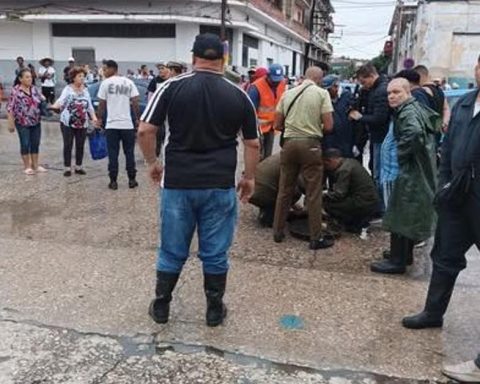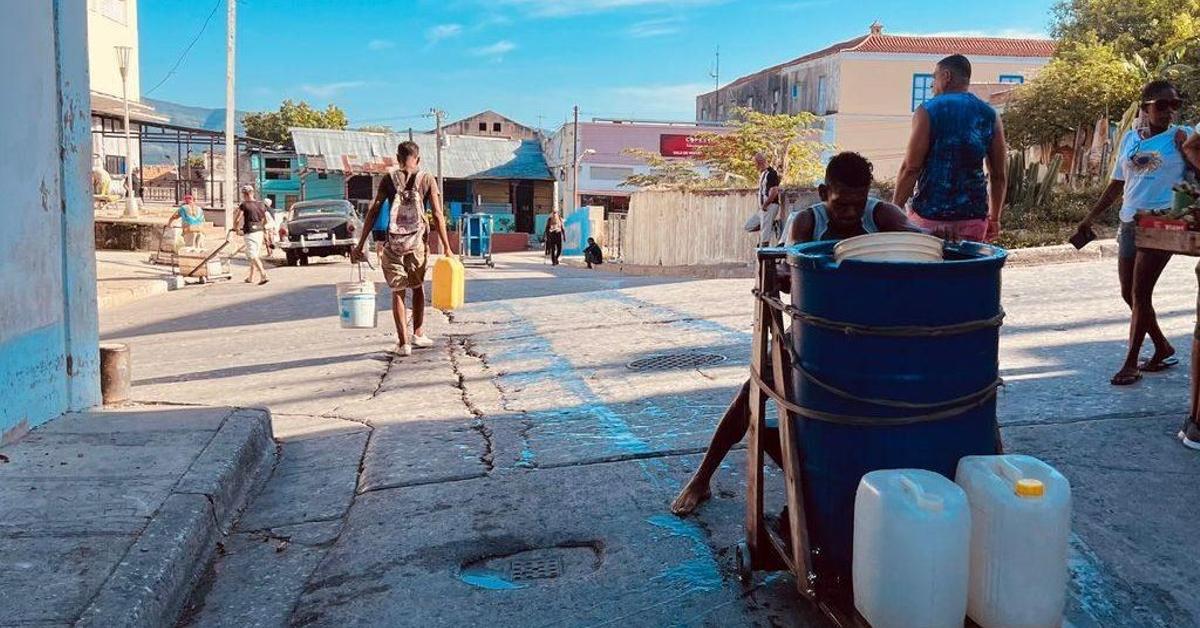
Santiago de Cuba/A mass of sweaty people move every afternoon in Santiago de Cuba. They push carts and load cubes, but do not proclaim or sell anything. They are looking for something more essential: water. In recent days, the supply in the city has minimized and the blackouts worsen the situation, which has left half a million residents, only in the provincial head, without service.
Despair is evident. People leave their houses with 20 -liter containers mounted on wheelbarrows, paint buckets with improvised handles, plastic blinks and even tanks. The mission is to load with water all the containers you can and where you can.
https://www.youtube.com/watch?v=wukhrknwqfe
/ 14ymedio
The most experienced know fixed points of the city in which they can supply themselves: pipes to which the water does reach, a battery in the Provincial Fisheries Directorate, the courtyard of a state company or a church willing to donate from their resources to those who touch their door looking for “cooking water” or “to give the children”.
However, sometimes these sources are dried and then the shortage materializes in a phrase, short but sharp, that hangs from the doors: “There is no water.” “That is a church, where water comes occasionally and people are going to load,” he explains to 14ymedio One of the residents pointing to the poster that hangs from the threshold. “I came to replenish myself, but I will have to look for another place,” he values with reluctance.
/ 14ymedio
Ensuring liquid is not exclusive work of adults either. Children, sometimes alone, barefoot already foot, or by bicycle, are around the Santiago streets with ancient carbonated soft drinks and plastic gallons that fill in the privileged points of the city. With less patience than adults, they wait on standing tails, with one hand on the waist and an obvious restlessness. On the contrary, the elderly avoid the sun and always seek to rest on some sidewalk.
“The thing is critical. People move from afar with their trucks loaded with containers of all kinds,” explains another hunter water. And he adds that, if the situation was bad before, the electric cuts and the national blackout have made the supply even less frequent.
“Water scarcity is something that we have assumed Santiagueros, it is part of day to day,” he confesses. “On the outskirts of the city the thing is worse.”
According to the official reports of this week, more than half a million Santiagueros, only in the Eastern capital, suffer the lack of water and the cycles of the service have extended – at least in the official version – up to 30 days. “The water supply in the municipality of Cabecera can well be defined in a single word: alarming,” the Radio Revolution station, which also described the drought that the province suffers as “the most severe of the last decade, said days ago.”

/ 14ymedio
In Havana, where a large part of the city is still in the dark, the lack of supply begins to worry the residents, especially in multifamily buildings, where the neighbors depend almost exclusively on whether water from the aqueduct arrives at community tanks.
“To Plaza de la Revolution they were going to try to pump the water this morning but just at that time there was no light. Result: I had to stop downloading the bathroom to save what I have left in my reservation,” acknowledges a resident of the municipality.
Cistern trucks do not reach to respond to the problem either. As confirmed by the authorities, only 80 pipes circulate a day, when more than double, about 170, to meet the demand.
/ 14ymedio
The focus of the official press, however, is in The Tunaswhere “irregularities [del abasto] In recent days they are also related to the long interruptions of the electrical service, for example with two large system disconnections in the country in a few hours, ”the authorities explained.
Of the three dams that supply the city, only one, the corner, has a generator set to continue pumping, but starting it consumes 80 liters of oil per hour, an amount that, they recognize, “it is very difficult to sustain at the moment.”
It is expected that in that city and in the rest of the island, as in Santiago, the pipes are dry and in the streets it is not seen “not a single water pipe.”
/ 14ymedio