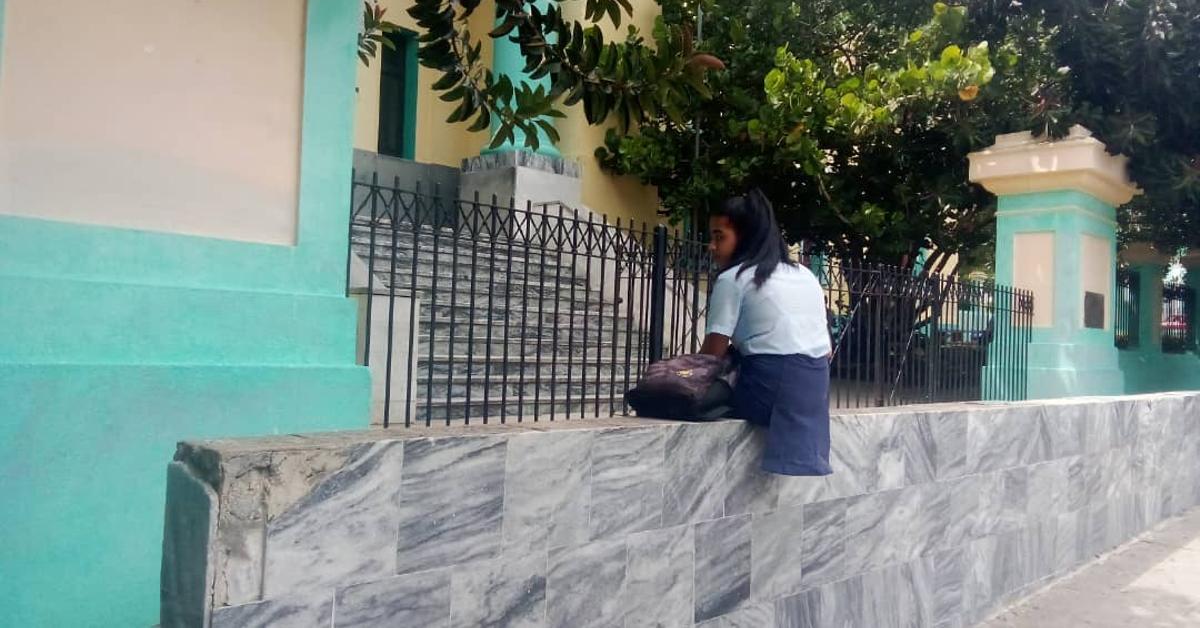
Matanzas/This Friday there were still quotas to enroll at the Federico Engels School of Languages, in the city of Matanzas. For the academic period 2025-2026, the first levels of English, Portuguese, German, Russian and French are planned. At the entrance, Wilber, 22, awaits impatient. “I plan to meet my parents in the United States, so I want to take at least one basic that allows me to have an elementary knowledge of the English language,” he explains to 14ymediowhile waiting for someone authorized to formalize their registration.
Although the school has its own name, it does not have a stable headquarters. After rotating for several facilities, José Luis Dubroq, former Second Teaching Institute, located on Dos de Mayo Street. “For me the schedule that the school has, from five to seven at night, it is a problem, but for learning I do what is necessary, as if I have to pay money apart to the teachers,” says the young man, convinced that reaching another country with a minimum of English is an advantage.
Most students are young who have already passed through high school and pre -university classrooms, where English is mandatory, but recognize that what has been learned was little. “I am sorry to say it, but I made six English semesters between high school and the pre -university but I can’t even have a basic conversation, I learned very little,” Wilber admits. He remembers the reasons: “Many classes were lost because they had no teachers and those that I had had a very low level or lasted little in front of the classroom. I remember a teacher who spoke very well English but only lasted a week because the visa came to emigrate and left.”
/ 14ymedio
A decade ago, with the thaw Between Washington and Havana, English was presented as national urgency. In 2015, the newspaper Granma He stressed that “as priorities in education, the teaching of the history of Cuba and the Maternal Language (Spanish), as well as the mastery of the English language.” The guideline contrasted with what was lived in the 70s, when the Russian language displaced English in the classroom. Even Raúl Castro, during a Celac summit, came to admit the need for “the next Cuban) must speak English. It is a necessity for our country, not only because of the vicinity of the northern neighbors; if it were for that, we would prefer to be mute.”
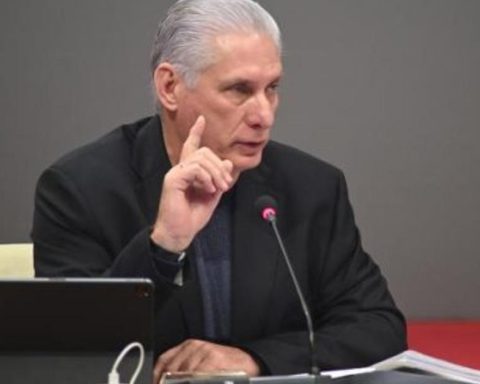
The official enthusiasm, however, went out and neither did the ruler Miguel Díaz-Canel dominate the English language. Many young people who want to learn the language today opt for private teachers, with much higher prices but with better results. The Federico Engels school demands the applicants identity card, a 12 -grade certificate and a letter from the work center or the Cuban Women Federation. The news was a jug of cold water for Wilber, who lives from the roughness he receives from his family. “This seemed very easy for me to be true. So they have the right to speak another language the people who work for the State,” he protests. Even so, she insists on convincing the teacher in charge of collecting the documents, determined not to give up her goal.
The official cost is just 20 pesos per month, well below what private teachers charge. But the benefit is diluted in the lack of quality. Ailed, a medical science student, explains it like this: “School can only enter people over 17 years old, but my parents with additional money got my sister to enter last year without having the minimum age required. They never have a fixed classroom or classroom, because they depend on the availability of the teaching center that provides her space, in this case, the pre -university.”
For many, interest in learning languages is linked to the desire to emigrate, not to obtain a certificate without validity outside the state sector
Organizational chaos adds to the lack of teachers and resources. Although the plan establishes classes from Monday to Friday, the schedule is almost never fulfilled. “To learn languages, it is essential to rely on audiovisuals, but in the School of Languages they are still in the old woman, with the chalk, the draft and the board as the only auxiliary means,” Ailed laments, which ended up hiring a private teacher. “In a quarter I have learned what my sister received in six months. In the end she had to do the same as me. Unfortunately, the cheap is expensive.”
Federico Engels does not offer intensive courses or advanced programs. For many, the interest in learning languages is linked to the desire to emigrate, not to obtain a certificate without validity outside the state sector. The low registration confirms it. “Many of the teachers who are in school also give their clients privately. Then they do it with all the professionalism that requires and earn their money below the curtain. That is also understandable,” Ailed admits.
In the classrooms of the Federico Engels, the desks are still waiting for students. What is not clear is yes, with those conditions, there will be whoever wants to occupy them.