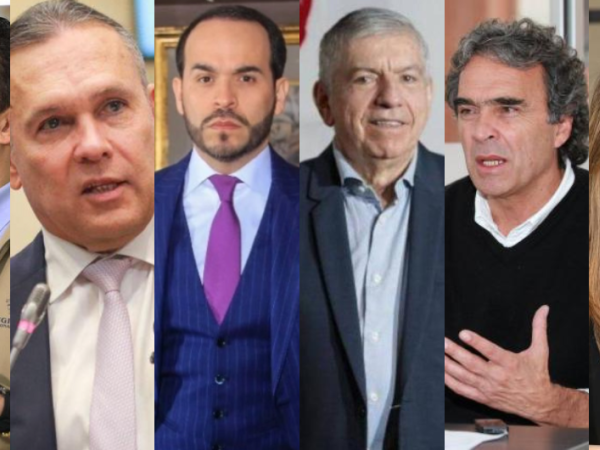
In private, several political leaders speak of a “bomb” that threatens the boldest opposition experiment: The great March consultation under the slogan democracy vs. autocracy.
(Read more: Minhacienda reports good behavior of Colombian bonds in Europe)
THE MECHANISM –who intended to gather already independent parties to choose a single competitive presidential candidate– He had been advancing with months of conversations, until internal accounts threaten to move the chairs.
Headed by Alexander Vega, the U would be delaying the agreement to open space to Mauricio Lizcano, despite the fact that the initial rule was clear: excluding those who were part of the current government or their campaign. The maneuver fell like a missile at the negotiating table.
The conservative party does not play in favor of consensus either. With the entrance of Efraín Cepeda as a candidate, now the community seeks that each party has its own candidate in the consultation. It’s not just about convictions: That formula would guarantee the conservative boss to mobilize his bench behind his name, even without still being in national surveys.
Meanwhile, the Democratic Center and Radical Change continue to review whether they enter and under what conditions. Although Uribismo has expressed disposition, the idea that the scheme of “Every party with candidate”, because its internal base is more cohesive and could be strengthened.
(Read more: the cuts to the 2026 budget that the Ministry of Finance would seek to condition)
Vote
Istock
This has been the process
It is worth remembering that, at the initial table, the possible members were the Liberal Party -where former president César Gaviria has been the main articulator-,, The Conservative Party, the New Liberalism, the U Party, Radical Change and the Democratic Center.
The original proposal was bold: allow a wide range of applicants, including independent and candidates for signatures, and that in January the five best positioned in the surveys to face in March in a single consultation were chosen.
In parallel, the independents make accounts. Sergio Fajardo and Vicky Dávila, pointers in the surveys without partisan guarantee, must evaluate whether to stay by signatures or join some form of consultation. For its part, Abelardo de la Espriella, who has been playing in political circles, but has not yet measured its real impact on national surveys, must also decide before December whether or not to enter the mechanism.
Beyond the internal bid, which is at stake overflows the political arena. Indefinition and electoral atomization are already beginning to have effects on the economy: entrepreneurs who postpone investment decisions, external investors who expect more clarity about the country’s management, and consumers who feel that political volatility translates into less confidence and more cautious.
For a productive sector that seeks regulatory certainty and stable rules, opposition fragmentation is not a simple partisan pulse: it is an additional risk factor in a country that already dealt with low growth and tax pressures.
The background question is whether traditional politics It will end up imposing its logic of quotas and maneuvers on an unprecedented democratic opening attempt. If the coalition fractures, the dream of a unique candidate could be shipwrecked before sailing, leaving the opposition divided just when I needed unity.
And, with this, prolonging the feeling that Colombia is sailing in the midst of a clear political storm, a scenario that no investor – national or foreign – celebrates.
(Read more: they open inquiry into minenergy for alleged irregularities in contract with Air-E)
Portfolio writing