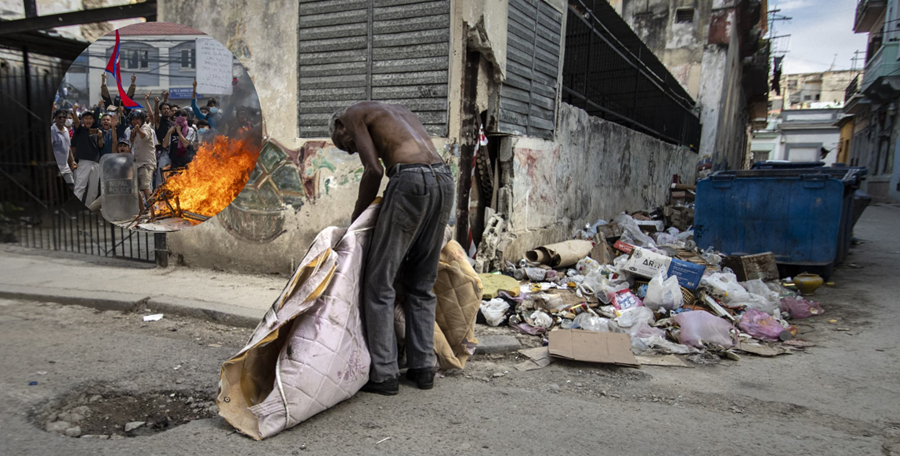
Nepal had been under a communist regime for 17 years, feded two days ago and today its history is another. Cuba has been losing her soul for more than six decades and still is afraid.
Havana, Cuba.- The bad idea of a regime and two days of protests have been enough for Nepali to End the fourth mandate of Prime Minister Khadga Prasad OLIwho made public its resignation and, with it, the collapse of an authoritarian and corrupt government. The fundamental cause of the outbreak was the blockade of 26 social media platforms, an official measure whose objective was to lower the intensity to the public debate on the situation of the country, which is among the poorest of Asia, where young people face high unemployment rates while the communist dome and their relatives live surrounded by luxuries.
Amid the rise of citizen discomfort, the power seemed appropriate to sting a nerve point that threatened his hegemony. When he wanted to back down, it was too late. Social networks are untouchable for new generations, they are a source of information and amusement, a way of contact with the world in real time and, mainly, a space where they exercise their right to freedom of expression. The government regulations was the drop that filled the glass and the force test ended with several official buildings – including Parliament – wrapped in flames, residences of leaders taken by the protesters and several politicians evacuated in a hurry.
Today Katmandú, its capital, monopolizes headlines, but since 2022 they have also been Sri Lanka, Bangladesh and Indonesia: whole peoples taking the streets, planting face to dynasties that administered the country as if it were their property, a kind of feudalism of the 21st century with perpetuated families in power, extreme poverty, inflation, corruption, clientelism and massive exodus. Any similarity with what happens in Cuba is not coincidence, but the reality implanted by a communist party that remains afloat thanks to the perseverance of the few partners who have left, and the understandable fear – but unacceptable at this point – of a population that continues to deposit their hopes in a dialogue that has been trampled again and again.
Seeing what happens in Nepal, the memory of many Cubans returns to the immediate days of the Etecsa tarifflast May, the unconforme and brave young people who demanded the revocation of the measure and ended up accepting an alleged negotiation in which something was barely modified for everything to remain the same. If those boys had joined only half of those affected by the tariff, perhaps today we would be observing the facts in Nepal with personal and national satisfaction. But it didn’t happen. Those who planted to denounce the unfair prices and arbitrariness of a deeply discriminatory decision were harassed, pressed, threatened. They left them alone and today Internet access is more limited to all Cubans; A limitation that adds to so many others, innumerable and prolonged for too long, but all that matters is to take advantage of the two or three hours of current for cooking and washing in record time, or sleeping for a while with air conditioning to recharge the neurons that we have left, or wait for the third consecutive day in the tail for the gas bullet.
The Etecsa tariff was not the drop that filled the glass, nor have the blackouts of between 15 and 16 hours average as an average, although they can be more. It has not been the shortage of drinking water that is symbolically relieved when the municipal government sends a single pipe to serve hundreds of neighbors who fall into blows for filling a cube and a cucumber. They have not been the eyes and airways irritated for having to cook with firewood or coal. They have not been feminicides, the Crime index shotmedical negligence that cause children’s deaths, nor labor accidents that could have been avoided if those who mislead this island would have made the corresponding investment at the right time.
The Cuban glass, there is no doubt, is deeper than the Nepali. It is of an unexplored depth, the Mariana fossa of a perennial debacle. Nepal had been under a communist regime for 17 years, feded two days ago and today its history is another, pointing to new challenges. Cuba has been losing the soul for more than six decades, sacrificing to the children under a communist dictatorship, and still is afraid. Nepal, despite their twenty dead, hundreds of injured and an uncertain political future, reminded those of those kinds of reminder that there is no regime capable of resisting a town in the streets, which those above have more fear than those below, and that, if there is no country for young people, then for whom.