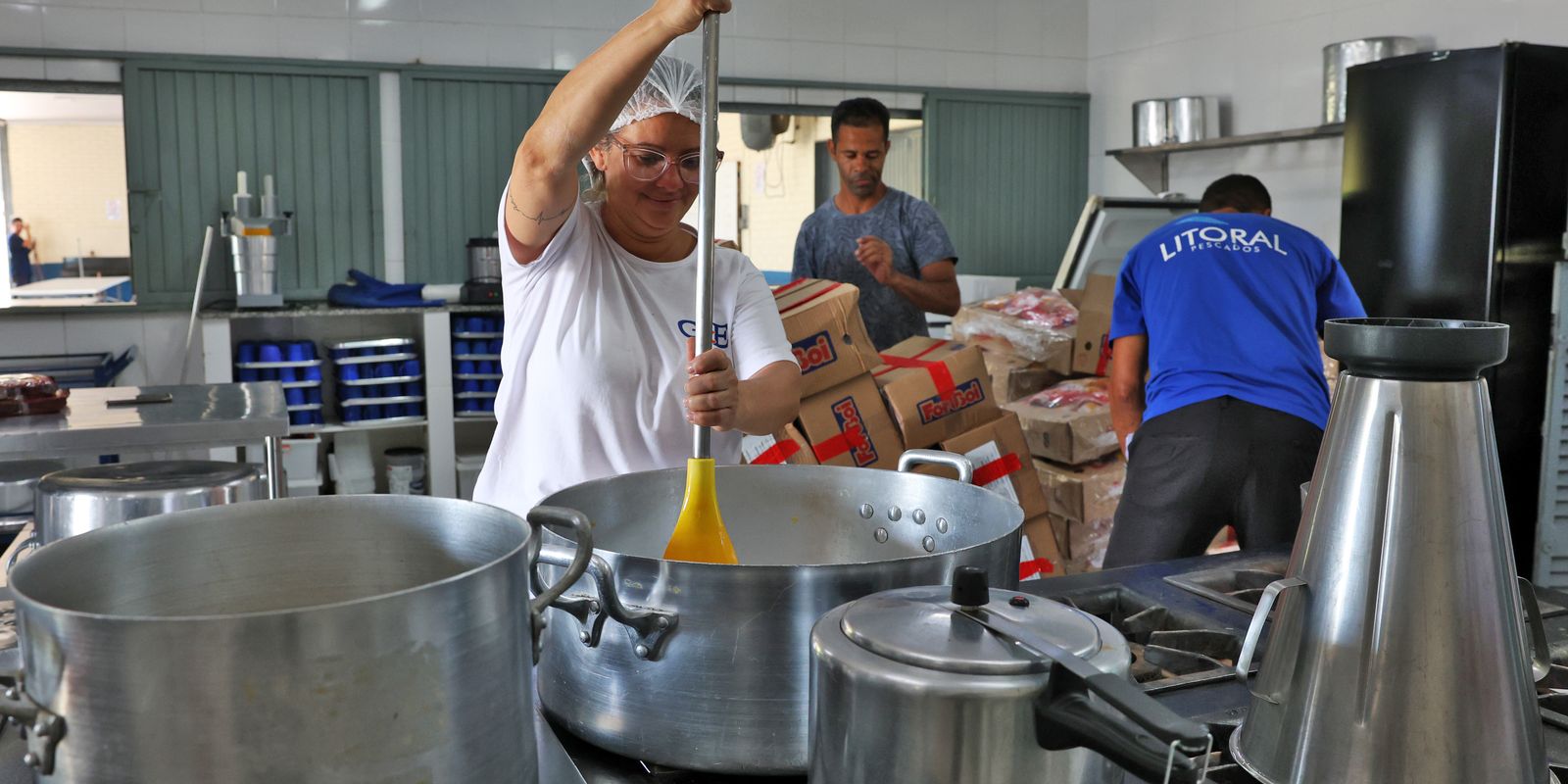
Worldwide, countries are investing more in school lunch. The report The state of school feeding in the worldreleased on Wednesday (10), shows that Global school feeding funding more than doubled between 2020 and 2024. With this, during this period, 80 million children, who did not have access to food at school, began to have the school lunch.
The report is released every two years by the United Nations World Food Program (WFP). Data show that global investment went from $ 43 billion by 2020 to $ 84 billion in 2024. These values are equivalent to about R $ 232 billion and R $ 454 billion, respectively, in the current price.
According to the report, since 2020, there was a 20% increase in the number of children attended with school feeding worldwide, reaching 466 million students in 2024. The number of countries with national school feeding policies almost doubled in the same period from 56 to 107.
According to the study, the increase in care is taking place “where it is most necessary: low -income countries have increased by 60% the number of children served in the last two years,” a press release. Africa leads this advance, with 20 million more children being fed by national programs, especially Kenya, Madagascar, Ethiopia and Rwanda.
According to the director and representative of the United Nations World Food Program in Brazil, Daniel Balaban, countries are increasingly understanding the importance of this investment.
“The most important thing is that 99% of these values are from the budgets of the countries themselves. It is not loan, it is the countries themselves by putting their own budgets. And increasingly we are seeing poor countries, small, especially Africa, understanding the importance of investment in school feeding, because it is an investment in children, is an investment in education, is an investment in health. So you have a return.”
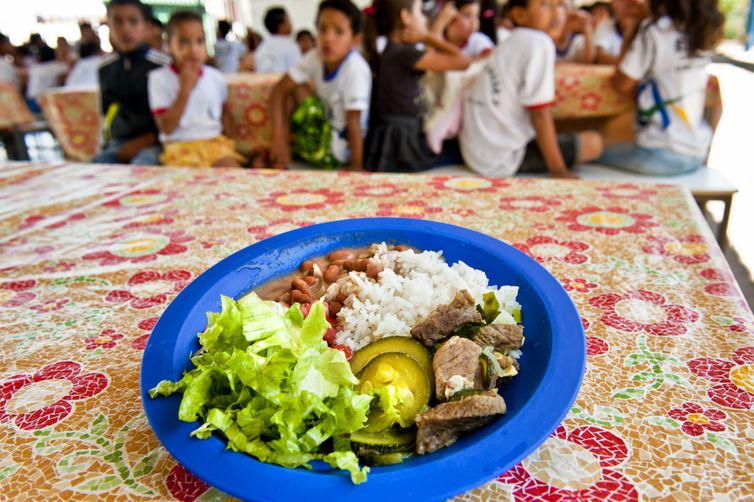
School lunch improves learning, generates income and jobs for the community – Sergio Amaral/Ministry of Development and Social Assistance, Family and Hunger Fighting/Disclosure
Impact on Learning
The report shows that School meals contribute to improving cognitive performance, math skills and literacy.
“We did research showing that exactly those children who receive proper diet can have better grades, perform better at school,” says Balaban.
“The more children get food in schools, but they have the nutrients needed so they can understand and understand what the teacher is teaching in the classroom. Often, the child is so weak that they fall, and people think, ‘Oh, lazily sleep at night.” But it’s hungry. We have to understand it.
The lunch also bring, according to the report, financial and social returns. Each $ 1 invested in a lunch generates between $ 7 and $ 35 for economic benefits. In addition, the study estimates that it feed 466 million children generates about 7.4 million jobs in school kitchens, as well as indirect jobs in logistics, agriculture and supply chains.
The study also points out that sustainable models, such as school feeding programs with local purchases, promote healthy diets and dietary systems rooted in local and national economies.
Brazilian protagonism
The report points to Brazil as one of the references, with the National School Feeding Program (PNAE), coordinated by the National Fund for the Development of Education (FNDE), which is one of the largest in the world. Currently, the program provides daily meals to nearly 40 million students in 150,000 schools, totaling 50 million meals per day and an annual investment of $ 5.5 billion.
“Brazil is one of the pioneers in the world. In 2009, it was able to pass a school feeding law that puts that at least 30% of the resources that go to food have to be bought directly from family farmers. This was something revolutionary, because the local family farmer could sell part of his production to school feeding. Before that, foods were purchased from trades, large networks, and money was not even in the community.”
The growth of programs is, according to research, faster in member countries of the school feeding coalition, which is a global network led by more than 100 governments and six regional bodies, with WFP -based secretariat and support from over 140 partners. Two out of three new beneficiaries are in coalition countries. Currently, Brazil is one of the coalition presidents, along with Finland and France.
In addition, Brazil created in 2011 the Center for Excellence Against Hunger, in collaboration with WFP, which today supports over 80 countries worldwide in the development of sustainable solutions to combat hunger and improve nutrition through school feeding and other social protection strategies.
The report is launched the week before the 2nd World SCHOOL FOOD COLLABLE, which will be held in Brazil, on September 18 and 19worldwide event on the subject, which brings together leaders from around the world to evaluate advances and mobilize new actions.
*Collaborated Lana Cristina, from TV Brasil.