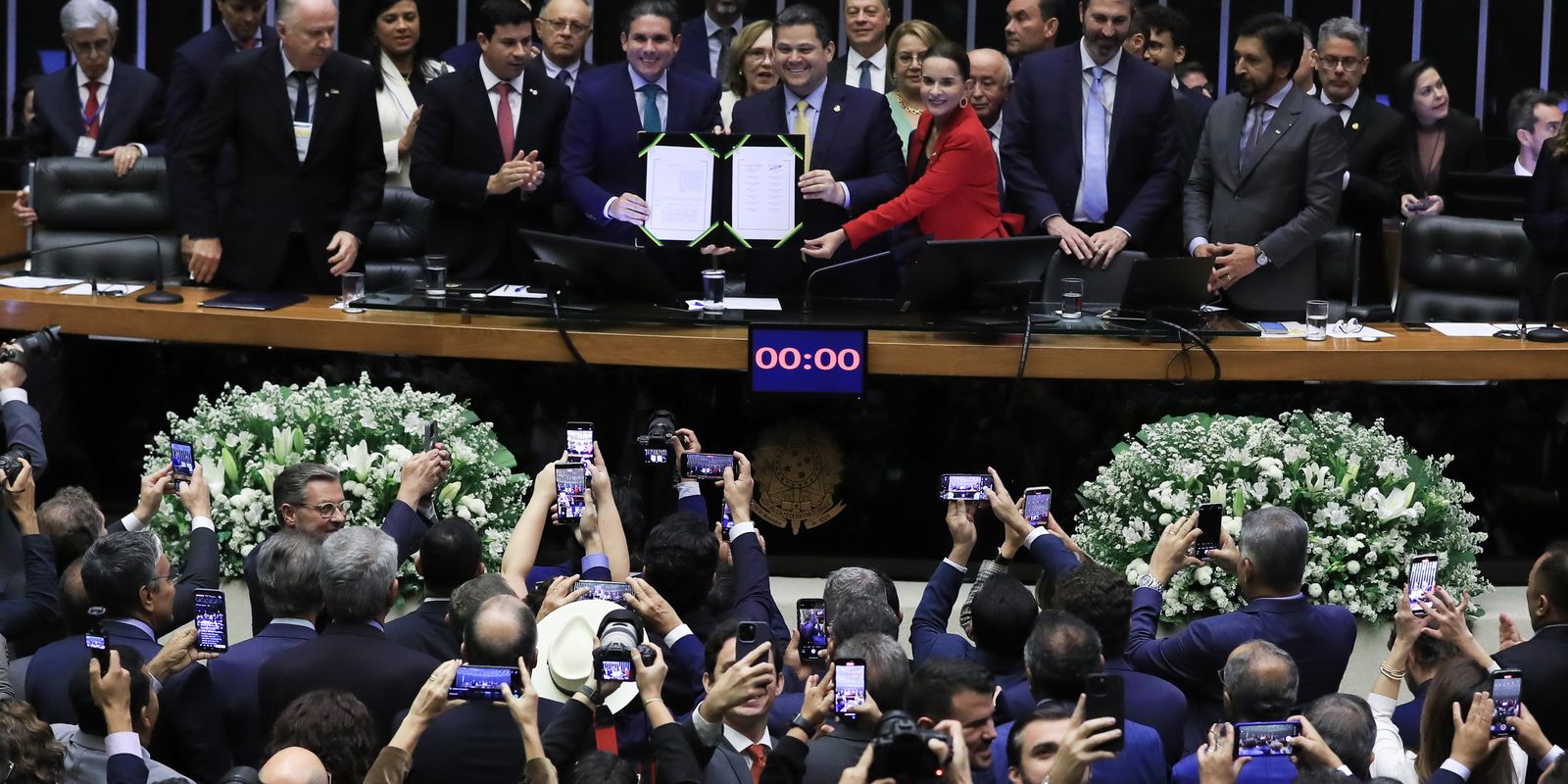
The National Congress promulgated on Tuesday (9) to Proposed Amendment to the Constitution (PEC) 66/2023which removes federal precatory from the Executive’s primary expenses limit from 2026. The text also limits the payment of these debts by states and municipalities and refinance of social security debts of these entities with the Union.
In practice, the measure relieves the situation of states and municipalities, by allowing them to pay court debts in smaller and longer -term portions. PEC also helps the federal government meet the fiscal target by removing part of these expenses from the expenses.
Precations are orders issued by the judiciary so that public entities – Union, states, municipalities and municipalities – pay recognized debts in judicial proceedings in which no further appeals.
The president of the National Congress, David Alcolumbre (Union-AP), said that the measure is a solution for the payment of precatory, classified by him as “one of the most complex and old problems of the Republic.”
“The problem, for all entities, is the lack of budget reserves for the payment of these expenses, which are usually unpredictable. Because of this, payments are postponed, which increases the size of this type of debt due to high interest rates,” he said.
Although it removes the precatory from primary expenses by 2026, the text adds each year from 2027, 10% of the stock of precatory within the tax targets provided for by the Budgetary Guidelines Law (LDO).
>> Follow the channel of Brazil agency on WhatsApp

President of the Senate, David Alcolumbre, at the Congress session to promulgate the Constitutional Amendment (PC 136/2025) Lula Marques/Agência Brasil
Limitation
For precatory due by states, Federal District and Municipalities, the approved text limits the payment according to the stock of late precatory.
Thus, on January 1st of each year, if total delayed values are up to 15% of the net current revenue (RCL) of the previous year, the municipality or state may pay securities whose sum is equivalent to 1% of that revenue. These rates will even apply to federative entities that do not have inventory.
The percentages grow gradually until they reach the payment equivalent to 5% of the RCL if the stock is greater than 85% of revenue.
In all situations, the calculation to find the value of the precatory stock will be with monetary restatement and default interest. The correction will take place by the lower value index between the Selic rate, currently at 15%, and the broad consumer price index (IPCA) plus 2%, calculated simply.
“The promulgation of this amendment is a true achievement for Brazilian municipalism,” said Alcolumbre. “We are clear that these new constitutional provisions will not solve, as in a magic pass, the serious and recurring financial problems of the municipalities. But they represent a gateway, a salvation for those who know how to reorganize financially and take this opportunity to address their accounts,” he said.
Refinancing
By the text, states, Federal District and municipalities may regularize social security debts with their own social security regimes (RPPS) and the General Social Security Regime (RGPS). PEC also opens the opportunity to regularize the debts of intercity public consortia with RGPS.
The installment with RGPS will be made in 300 monthly installments, extendable for another 60, upon limitation of the installment to 1% of net current revenue (RCL), and correction and interest given by IPCA + 0% to 4%.
In the assessment of the President of the Chamber of Deputies, Hugo Motta (Republicans-PB), the change in the Constitution will give a greater guarantee of the tax health of subnational entities.
“By establishing limits for the payment of precatory by the municipalities, the new constitutional amendment gives greater predictability to local administrations and ensures that the obligations determined by the court do not result in the financial collapse for these federated entities,” said Motta. “At the same time, it opens a special deadline for the payment of debts as much as their own regimes, as with the general social security regime, giving the municipalities breath and allowing them to rearrange their accounts with a view to actuarial balance and the sustainability of the system,” he added.
Supplementary credits
PEC also authorizes supplementary and special credits open by 2025 to compose the expense limit from 2026. In the government’s evaluation, the measure gives tax space so that the federal executive can accommodate pre-budget precatory from 2026 and pay $ 12 billion of maternity leave, arising from a Federal Supreme Court (STF) decision.
In 2024, the Supreme Court declared unconstitutional the requirement for a minimum shortage of ten contributions to the INSS to that autonomous workers and special insured can receive the maternity salary. Now, with only one contribution, they can have access to the benefit, following the same criterion as formal workers.