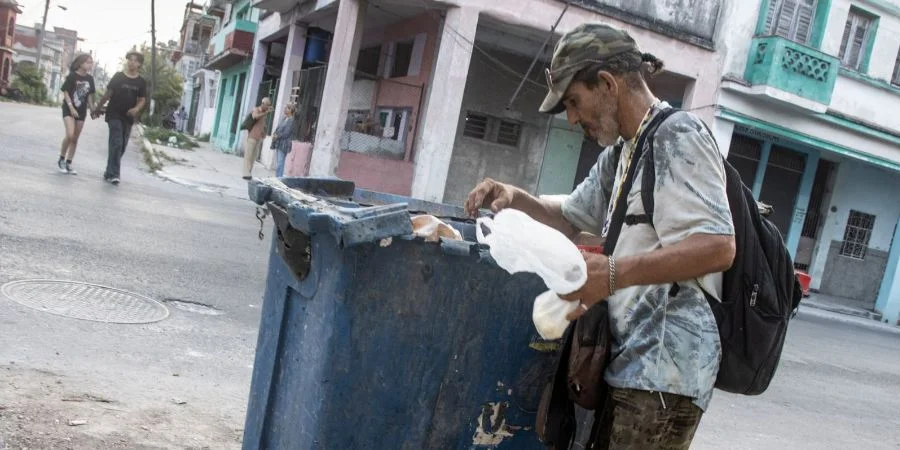
The NGO regrets the social fracture in Cuba, the deterioration of everyday life and the high levels of poverty suffered by the population on the island.
Miami, United States. – Cuban society is going through “the deepest structural crisis in its recent history”, marked by sustained recession, high inflation, infrastructure collapse (water, energy and banking), accelerated loss of purchasing power and increasingly restricted access to basic foods.
This is how the article holds “(Re) Live the crisis in Cuba: Anatomy of a fractured society”published by the NGO Food Monitor Program (FMP), which compares the current situation with the call Special period And he points out that, according to independent estimates, the poverty rate exceeds 80%.
FMP recalls that the special period – after the fall of the Soviet block – collapsed GDP by more than 35% and cut in 40% the average caloric consumption, with a national epidemic of neuropathies linked to malnutrition. Thirty years later, it describes the situation as a polysis (economic, energy, demographic, monetary and social) without “effective structural support or promises of convincing recovery”, in a context of progress of state capitalism and with an official discourse that, according to the article, has gone from the “charismatic omnipresence” of the 90s to a style of “revictimization and hyperpersonalization.”
According to surveys cited by FMP, 94% of the homes visited consider that the government “is not interested in reverse the situation of food vulnerability” or that “they have tried, but they have not achieved it.” Only 6% perceive a state action aimed at improving that problem.
The text recalls that, when the ruler Miguel Díaz-Canel spoke in 2019 an “energy situation”, many Cubans interpreted euphemism as an omen of the return to the special period. Six years later, FMP states that the deterioration has exceeded the initial fears. The launch, two months ago, of the report “In Cuba there is hunger” – FMP National Food Safety Survey (2024) – fueled a network debate, where “the majority” said the current moment is the most difficult in the last half century.
FMP argues that the repetition of crisis has left measurable marks: an emigration that caused “a population loss of at least 18% of inhabitants”, the lowest birth rate since 1959 (7.2 births per 1,000 inhabitants) and 19,075 births less in 2024 than in 2023. 25% of the population is 60 years or older and the estimates point to 30% by 2030 by 2030 by 2030 for 2030 for 2030 for 2030, It places Cuba among the most aged countries in Latin America.
The article also warns of a sanitary worsening associated with deficiency diets. Between 2022 and 2023, malnutrition deaths increased 74.42% (it was the twentieth cause of death on the island). Previous pathologies – Diabetes mellitus, hypertension, cardiovascular diseases, nutritional deficiency anemia and chronic gastritis – keep “a significant relationship” with an insufficient intake of nutrients and with food patterns dominated by empty and ultraprocessed calories.
Prolonged food insecurity impacts psychosocial well -being (anxiety, depression, isolation, loss of self -esteem and cognitive impairment) and can be transmitted domesticly, also warns the FMP. Suicide has historically appeared among the ten main causes of death: in 1994 2,507 deaths were recorded; In 2020, already at the start of the current polysis, 1,548 were reported, “almost a hundred” more than in 2019. In the following four years, municipalities like October ten – one of the most populated in the country – registered a 23% increase in autolysis cases, according to the text.
The FMP describes “immediate relief” responses that cycle is repeated after cycle. In the 90s, frequent alcohol consumption reached “50% of the population”, with a high presence of homemade distillates; A decade later it was reduced to 7%. At the current situation, the use of synthetic and homemade drugs grew in a “drastic” way and affected minors: a 2023 studio – cited by the FMP – found that 80% of the subjects under the influence of synthetic drugs had between 15 and 18 years and 20% between 12 and 14. Twelve months later, the Ministry of Interior reported 83 cases linked to traffic and consumption —Mayormente de Cannabinoides Synthetic – with 51 young people and 72 minors involved.
From the 90s, the FMP identifies a “collective culture of survival” that today derives in “increasingly distorted survival mechanisms”, with an “extreme ethical pragmatism” and a “perpetual present” mentality that discourages long -term planning.
For the NGO, the “social somatization of the crisis” – or SCARING Collective – reveals the depth of collapse and the difficulty of reversing it with public policies if its dynamic is naturalized. “The lesson of the last decade is clear: the more citizens adapt to each crisis, the more durable the model that marginalizes them is made,” concludes the article.