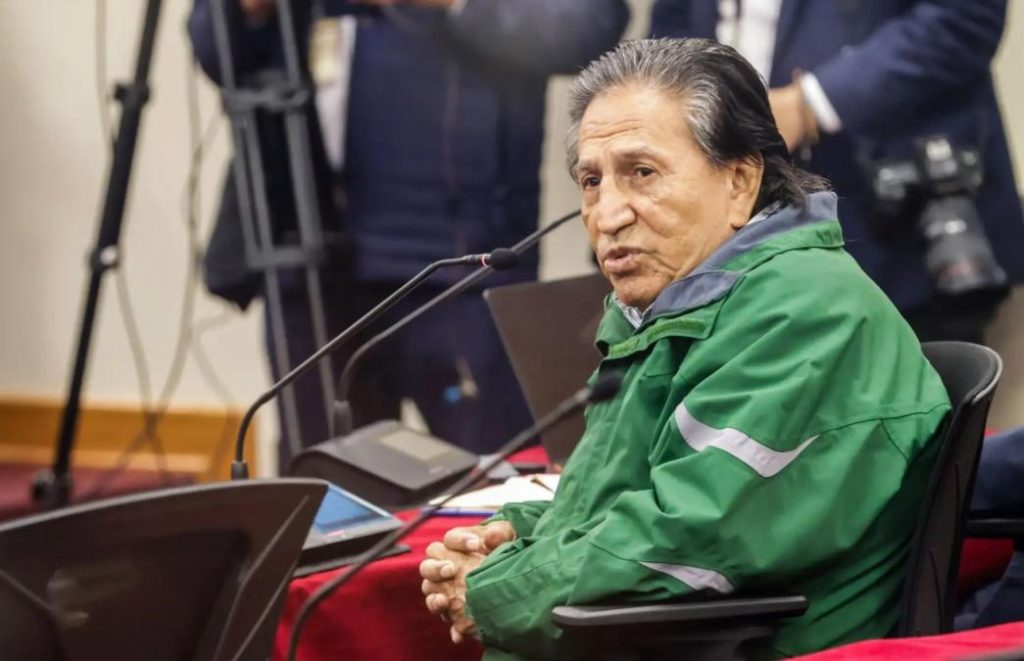
▲ “There are politicians who start gossip when the results do not favor them,” says magistrate Felipe de la Mata.Photo Cristina Rodríguez
Néstor Jiménez
La Jornada newspaper
Monday, September 8, 2025, p. 4
Felipe de la Mata, magistrate of the Electoral Court of the Judicial Power of the Federation (TEPJF), considers that it must pass at least a decade to verify whether the new way of choosing the judges was the solution to reform the PJF. “It will depend on the work carried out by each of the judges, magistrates and ministers, and that demonstrate their daily independence,” he said.
De la Mata, who was one of the members of the Superior Chamber who validated the last common process and ruled out that the accordions were reason to cancel it, explained that “there are politicians who start gossiping” when they do not agree with a resolution, as well as academics that “are actually politicians and propagandists of the opposition.”
In addition, he stressed that for the following judicial electoral process, scheduled for 2027, the evaluation committees of the three powers must be eliminated, or leave only one, so that there are no multiple criteria and methodologies of selecting candidates. He also urged to eliminate the thombola, because it limits the right of the candidates to be flag bearers.
Once the challenge phase has been completed, he admitted that for him it is “bad idea” to choose judges through vote, but noted that the ideology should not be imposed to resolve the validity of an election.
“It will be the time that tells us if it has been the solution in the face of the great problem. It will have to spend a decade to analyze sentences and realize if this was the time when the people of Mexico were made of their judiciary,” he said in an interview with The day.
He stressed that there are opinion studies that prove that with the previous system, the people did not feel represented by its judiciary, and it was “a very controversial system”, so “it seemed that it was a social need to look for other ways of legitimizing judges, magistrates and ministers.”
Regarding the project presented by its pair Reyes Rodríguez Mondragón, with which he intended to annul the election of ministers for an alleged massive strategy of distribution of accordions, he reiterated that the document never accredited a person in charge or there was evidence that the population was forced to suffer by particular candidates.
No one doubted the certainty that the final result was that of the vote, but that “the issue was that they distributed many papers.”
He explained that “it was irrational” to cancel the process “for suspicions”, as sought with the Rodríguez Mondragón project, which if approved had given the impression that “what was intended was to destroy it because it did not coincide with the method of democratic election of judges and magistrates, which would also have been irrational.”
He indicated that it had never been proposed to cancel a national election, and that to do so, 3 thousand 188 accordions that were not used were presented. “These new ‘hojitas’ were in the file, and not even matching each other; there were 51 types of guides. That is, there was not even a correlation between them.”
He insisted that he never clarified who ordered them to print them, who orchestrated the alleged strategy and aimed to coerc the vote. With irony, he asked if the accordions are awarded a “hypnotic effect” that forced the population to follow their indications. Nor were threats denounced to induce vote. “There was not a single identified citizen who had said: ‘They gave me the paper and I changed my vote because they conditioned me a program.”
He even stressed that he had to generate his own accordion, since the ballot was very complex. “It was almost impossible to vote differently,” he acknowledged.
Faced with the complicated rules of this process, which led to “one of the most difficult elections that has had to face me,” he said to use electronic suffrage to make them simpler.
On the criticisms unleashed by the endorsement of the majority of the TEPJF, he pointed out that they are not related to the certainty of the results, but to the system that was created, so “the complete system must be rethink”. And he finished: “What I have seen is that politicians are very gossip and love gossip. When something harms them they start a gossip to try to benefit themselves.”
Rumbo to the second phase of the Judicial Electoral Process in 2027, he said that the comical authorities will be “at the height of the circumstances”, regardless of the rules that are defined in Congress.