Little more than a week has passed since the Government presented to Congress its new financing law, with which it seeks Since then, comments and alerts have not ceased for the effects of this project.
In this debate it is already taken into account that the plan of the Ministry of Finance is clearOy points to an increase in collection with adjustments in VAT taxes and consumption on inelastic demand goods such as alcohol, cigarettes and fuels, in addition to expanding the taxable base towards sectors such as tourism, online gambling, software services and even low value imports.
See here: Mintrabajo will advance inquiries against Andrés DC after new incident with fire
While on paper the proposal looks ambitious, a recent analysis of the project, carried out by the Bank of Bogotá warns that the design of the reform contains less visible effects with which it would end up making the credit for homes and companies even more increase, just at a time when the Colombian economy dealt with high interest rates, pressure inflation and a fiscal deficit of 6.2% of the GDP.
Higher inflation, tougher rates
For these analysts, the first link in this chain is in inflation, a point where they indicate that with the rise in taxes to alcohol, cigarettes and fuels, it is estimated that the reform would raise inflation by up to 1.6 percentage points and Because of this, in 2026 the expectation of inflation close to 4% could end up exceeding 5%.
The tax reform project does not have great acceptance in Congress.
Chatgpt image
“This could lead to the Bank of the Republic to act more cautiously. While the tax adjustment should generate a single clash that monetary policy should dismiss, at times like the current one in which inflation expectations are not entirely anchored, there could be second round effects,” they said.
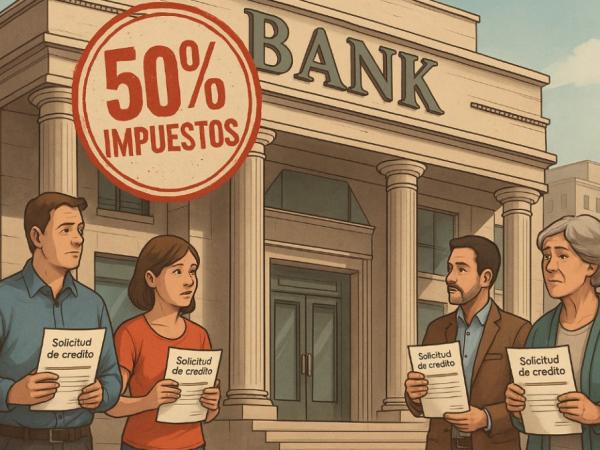
Secondly, they concentrated on the financial sector, arguing that the reform It proposes to increase the surcharge of rent to the banks of 5 to 15 percentage points, which would lead their total taxation to 50%, the highest in the world.
More information: Dollar expands their losses this Monday and is strengthened below $ 4,000
For the Economic Research Team of Banco de Bogotá, this jump is not a technical detail, since it translates into a higher operation cost for financial entities, which would inevitably move to users in the form of more expensive credits, greater commissions and less availability of resources.
“In 2024, the government proposed to lower the corporate income rate recognizing that Colombia is one of the countries with the highest legal income rate in the world when it is 35%, when in most countries it is between 25% and 34%. Although the 35% rate would continue for most sectors, an increase in surcharge to the financial sector of 5pp from 5pp at 15PP sector entities would reach 50%. Making Colombia 96% to 99% between the rent rates of 225 countries, ”they said.

Effects of tax reform on the middle class
Image generated with chatgpt
In simple words, banks would pay more, and to survive, they would have to charge more, so, in a context where families already allocate a good part of their income to cover debts and companies face difficulties in financing projects, this tax adjustment would work as a double bite that generates more taxes to the system and more costs for those who depend on it.
Less liquidity for households
In a third point, the report warns that the impact does not end there, since the reform It also falls strongly on natural persons, by eliminating deduction by dependents, reducing the threshold of the equity tax and increasing marginal rates for income and occasional gains will reduce the liquidity of households.
Other news: Patria Investments projects US $ 1.4 billion of private capital for Colombia
This is why the Bogotá Bank warns that this will directly affect private savings, one of the main sources to finance investment and credit in the country and make it clear that if households have less capacity to save because the State takes a greater slice of its income, the financial system will have less resources to mobilize towards loans, more incurrect the credit available.
Likewise, the productive sector is not well stopped either, since in addition to the changes in VAT and consumption, the reform equals the surfaces for coal and oil, sectors already beaten by the fall in production and regulatory pressure and according to the Bank of Bogotá, these measures discourage investment in strategic activities that still represent an important part of national income.

Minister Germán Ávila filed the Tax Reforma project in Congress.
Mauricio Moreno
“At the same time, the effective corporate income rate would rise from 35% to 36.4%, which would leave Colombia in the 99th of rental rates worldwide. With such a demanding tax scheme, the country becomes less attractive to investors, limiting the arrival of capital and further reducing financing opportunities,” they said.
The uncertain role of Dian and Ecopetrol
A nothing negligible part of the projected collection, which points to about $ 6.4 billion in 2026, would come from the so -called “efficiencies of the Dian”, a concept that has been in the eye of the hurricane in recent months, since many consider that there was the genesis of the recent fiscal hole.
Within that package a striking case appears and it is the demand against Ecopetrol For VAT to gasoline imports, which would give the treasury $ 2.9 billion in 2026, but from 2027 it would become an annual loss of $ 0.6 billion for the nation.
Also read: Colombian peso, the currency with better performance in the region in August
“This sway introduces a factor of uncertainty. If the main source of additional income depends on specific litigation and operations, the sustainability of the collection is questioned. And every time the tax revenues do not reach the expected, the country risk rises, further increases external financing and internal credit conditions,” says the report.
Thus, the diagnosis reiterates that the adjustment proposed by the Government falls exclusively in homes and companies, while public spending remains practically intact, and notes that this absence of Austerity measures makes the reform lose legitimacy and complicate its approval in Congress.

Tax Reform was filed before the Congress of the Republic.
Courtesy: Istock
The final result is a vicious circle in which the reform raises prices and subtracts liquidity to homes, which increases inflation and forces to keep interest rates, which makes credit more expensive. Credit increasing consumption and investment, reducing economic growth. And, in the midst of everything, the fiscal deficit remains high, which keeps the country risk premium high and the cost of external financing.
Daniel Hernández Naranjo
Portfolio journalist