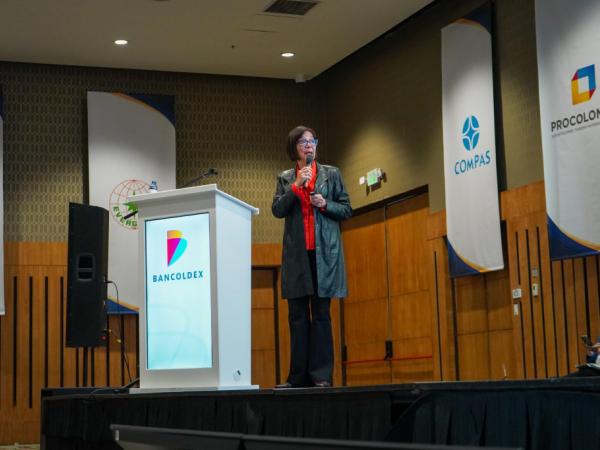
Fiscal sustainability was the center of the panel led by Astrid Martínez Ortiz, president of the Autonomous Committee of the Fiscal Rule (CARF) in the National Congress of Exporters, who warned that “Fiscal imbalance is practically the only one of the macroeconomic problems that we have to be accompanied by debt growth”
He explained that taxes are not enough to cover the current level of spending and that the situation requires discipline measures that return the country to a path compatible with the reduction of public debt.
(See: Tax would make logistics costs and subtract competitiveness from foreign trade)
Martínez stressed that the Colombian economy “is the one that has grown the most in the countries of the region since 2019 until now.” He pointed out that the rebound after the pandemic was largely due to the accumulated savings of households, which allowed internal demand growth in 2022, although subsequently income expectations were overestimated. That dynamic, added to the increase in spending, has left the country with a higher structural deficit.
“Expenditure grew 4.3% and revenue 0.3% between 2019 and 2024. That is the fundamental reason of the imbalance”, He said. Also, he stressed that although tax reforms have contributed resources, their effect is reduced because they must be shared with territorial entities, which limits the margin of the central government.
The diagnosis included the evolution of other indicators. Inflation, which reached 13% in 2023, has begun to descend, although the Bank of the Republic still does not observe a consolidated trend. The current account deficit, which in 2022 was 6% of GDP, returned to sustainable levels in 2023. However, andl Public debt growth remains a concern: the levels went from 55% to 61.3% of GDP, moving away from the limit set in the fiscal rule.
“If we reach such a large deficit, we will have to have a primary surplus of 1.8% of GDP. Growth is the only thing that will get us out of the fiscal imbalance”, Said the president of the CARF, who insisted that the functioning of the country is put at risk if current trends are not corrected.
(Read more: Petro asks Japan Prime Minister to streamline a commercial agreement firm with Colombia)
The expenditure grew 4.3% and revenue 0.3% between 2019 and 2024. That is the fundamental reason of the imbalance.
Courtesy Analdex
Another year that the Tax Collection goal will not be completed
The scenario for 2025 also shows significant challenges. Projected tax revenues will not be fully given, so an adjustment of 0.5% of GDP is required to achieve the approved deficit of 7.1%. The expenditure, on the other hand, will increase to exceed 24% of GDP, driven by inflexible items as operation. Cash availability remains in historical minimums, which limits the government’s maneuvering capacity.
As for the general budget of the Nation of 2026, the CARF warned that “5.7 points grows in real terms, without debt, that is, 10.6%, despite the promise of a budget without growth beyond inflation”The budget reflects planning problems, since the medium -term expenditure framework has been published after the approval of the budget, which remains coherence to fiscal design.
The updated financial plan raises primary expenditure at $ 18.2 billion, a point of GDP, which increases the primary deficit of 1.4% to 2% of GDP. Although the total deficit is maintained at 6.2% of GDP for an recomposition of income and lower interest, it worries that part of persistent expenses are financed with transient or uncertain resources.
For carf, The lack of resources to fulfill the tax goal of 2026 amounts to $ 45.4 billion pesos, equivalent to 2.4% of GDP. In addition, in 2027 the fiscal effort will be greater, since the adjustment required in the primary deficit will increase from 1.1 to 1.7 points of GDP in a single year.
“88% of total expenditure in 2026 will be inflexible and two thirds will come from constitutional or legal obligations”Martínez said, which further reduces the margin to reorient resources.
(Read more: Petro announces changes in the coalition of government after choice of new magistrate)

The 2025 medium -term fiscal framework raised a relevant but insufficient adjustment to guarantee the sustainability of the debt.
Courtesy Analdex
Do not throw over the fiscal rule overboard
According to the president of the CARF, in 2024 the fiscal adjustment process initiated in 2021 was interrupted, which led to the Autonomous Committee of the fiscal rule to warn that complying with the goals of the confis 2025 and 2026 requires adjustments of 0.5% and 2.4% of GDP, respectively.
The agency pointed out that in the short term risks of lower income and of greater primary expenditure persist, in a context in which the liquidity of the government in pesos remains narrow. “The fiscal rule must continue to be the medium -term anchor”Martínez emphasized, who stressed the urgency that the Executive manages reforms that allow increasing income and reducing expenses, as well as the inflexibilities that press public finances.
The 2025 medium -term fiscal framework raised a relevant but insufficient adjustment to guarantee debt sustainabilitywhile the divergence between the MFMP scenario and the General Budget of the Nation 2026 reveals serious fiscal planning problems and sends, according to the CARF, “an unfavorable sign.”
(Read: They ask to cut $ 37 billion from the 2025 budget, for exceeding reservations)
Diana K. Rodríguez T.
Portfolio journalist