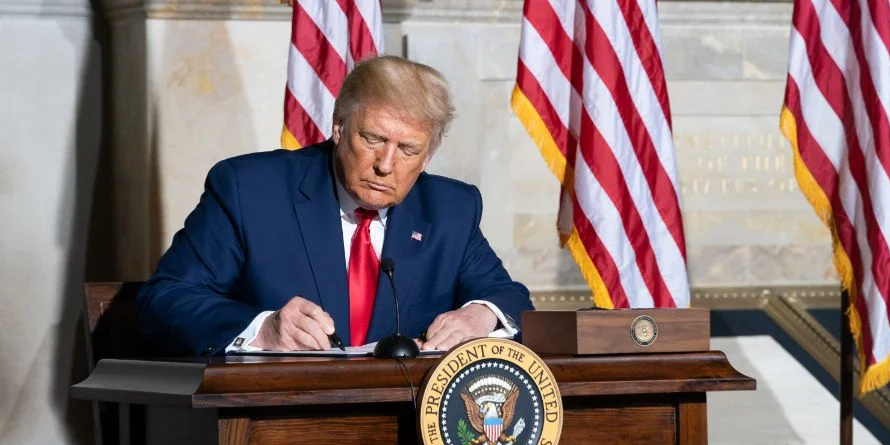
According to the “presidential determination” signed by Donald Trump the measure “results in the national interest of the United States.”
Miami, United States. – The White House extended for a year, until September 14, 2026, the exercise of certain faculties under the Commerce Law with the Enemy (Twea) applicable to Cuba, which includes certain exports from the United States to the island.
However, the legal basis of the embargo is maintained as implemented in the control regulations of Cuban assets (CACR). The decision consists of the “Presidential determination No. 2025-11”dated August 29 and published Thursday in the Federal Registry.
In the official memorandum, the president, Donald Trump, affirms: “Therefore I determine that the continuation of the exercise of these authorities with respect to Cuba for a year results in the national interest of the United States.” And he adds: “Therefore, in accordance with the authority conferred on me section 101 (b) of Public Law 95-223, I continue for a year, until September 14, 2026, the exercise of those authorities with respect to Cuba, as implemented by the control regulations of Cuban assets, 31 CFR Part 515”.
The document also instructs that “the Secretary of the Treasury is authorized and instructed to publish this determination in the Federal Registry”
The resolution is adopted in accordance with article 101 (b) of Public Law 95-223 (1977), which requires annually renewing the exercise of these powers. The text itself cites the previous determination of September 13, 2024, also published in the Federal Registry.
What remains in force
The CACR – originally emitted by the Office of Foreign Assets Control (OFAC) on July 8, 1963 under Twea – constitute the regulatory framework that governs transactions with Cuba, with numerous specific licenses and restrictions. THE OFAC He recalled in it Federal Registry that these regulations were promulgated under the Commerce Law with the enemy and that any modification must be consistent with other applicable laws.
In addition, the State Department Point out That the United States maintains an integral economic embargo on the Cuba regime, in force from the initial orders and proclamations of the 1960s.
The legal scaffolding of the embargo does not rest on the Twea: the Democratic Freedom and Solidarity Act for Cuba (Helms-Burton, 1996) Codified the embargo as it was in force and ordered that “it will be in effect (…) subject to section 204”, which limits its unilateral uprising by the Executive.
The extension now published replicates the annual procedure that in 2024 also extended these powers until September 2025, without introducing substantive regulatory changes in itself: the authorities that allow maintaining and administering the current sanctioning regime through the CACR are limited.