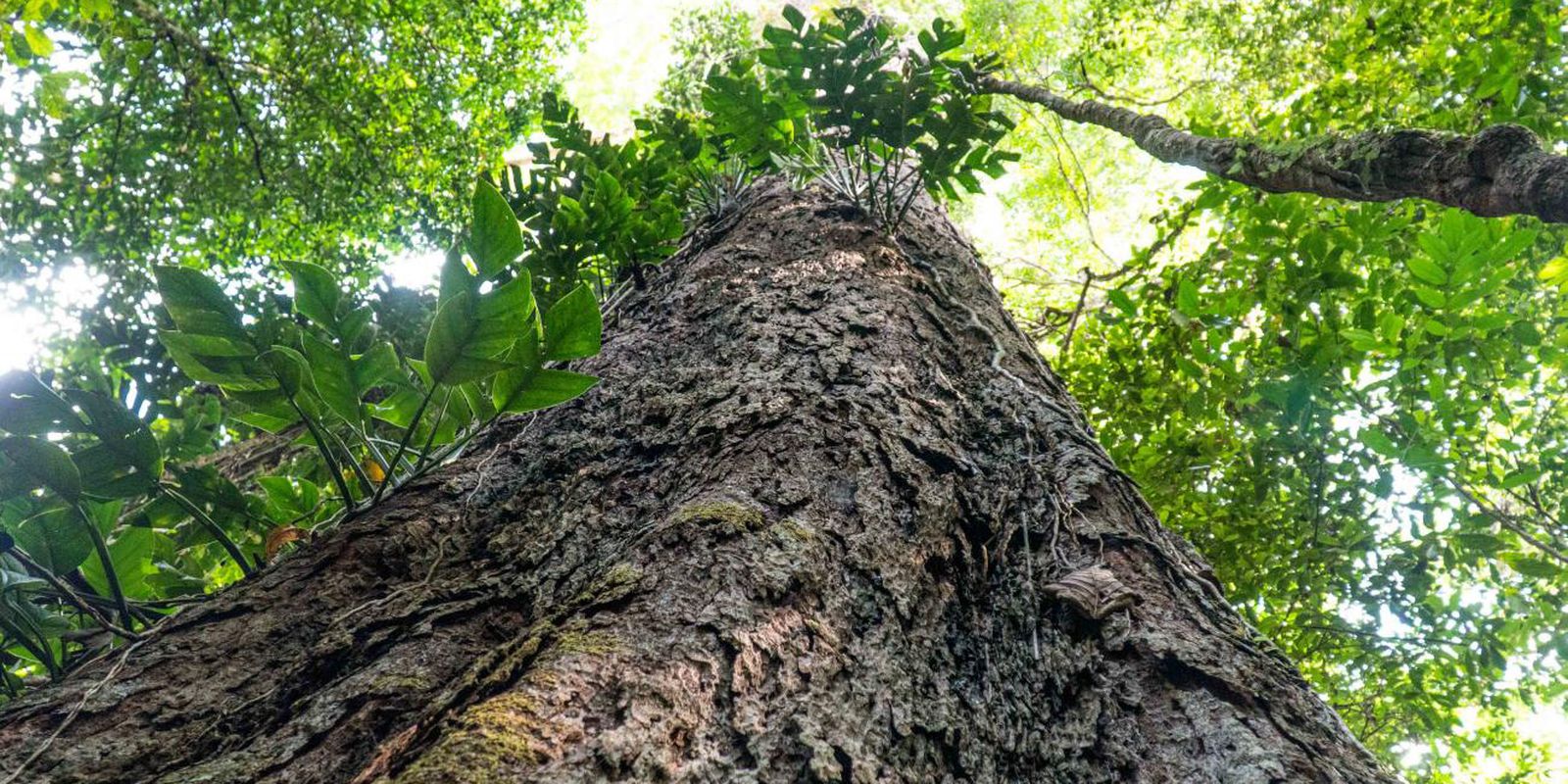
A huge ability to capture carbon dioxide (CO₂), an important role in the distribution of rainfall in the country and the attribute of keeping the history and cycles of the Amazon. These are some of the services provided by giant trees present in northern Brazil, especially Angelim-Red (Dinizia Excelsa). This Friday (5), Amazonian Day, experts heard by Agência Brasil highlight the importance of protecting these species, which can exceed 80 meters high.
The presence of these giant trees in the Amazon rainforest was evidenced by science recently. In 2019, the first copies were found and, In 2022, the location of an Angelim-Red 88.5 m high, equivalent to a 30-story building, revealed the largest tree in Brazil, in the municipality of Almeirim (PA).
In all, There were 20 copies with more than 70 m in an area that extends near the Jari River, on the border of the states of Pará and Amapá. The researchers who participated in the discovery immediately began studies to better understand the conditions that led to growth and the full potential of these reds-reds.
Studies
“These trees have almost double the size of the average heights of Amazonian species, which are around 40 to 50 meters. So we are talking about trees that absorb twice carbon and therefore can contribute twice to climate regulation,” explains the researcher at the Federal Institute of Amapá (Ifap) Diego Armando Silva.
Although studies are still underway, the researcher says some theses already point out the ways to be investigated. “An estimate we have here is that a single tree of this one represents around 80% of the installment biomass [área aproximada de 1 hectare] where this tree is inserted. ”
This estimate directly leads to a relationship that a single individual with these characteristics may be able to absorb 80% of CO₂ in all this area studied. But, according to Silva, much studies are still needed to better understand whether these trees also emit large volumes of carbon dioxide, how much they contribute to the capture and launch of water into the atmosphere and even to confirm their age.
“We received the interest of a group of researchers to do the age dating study of cedars, a species that can very clearly mark the growth rings around Angelins. They reached the approximate age of 260 years. From then on we have drawn that these red Angelins are around 400 to 500 years,” says the researcher.
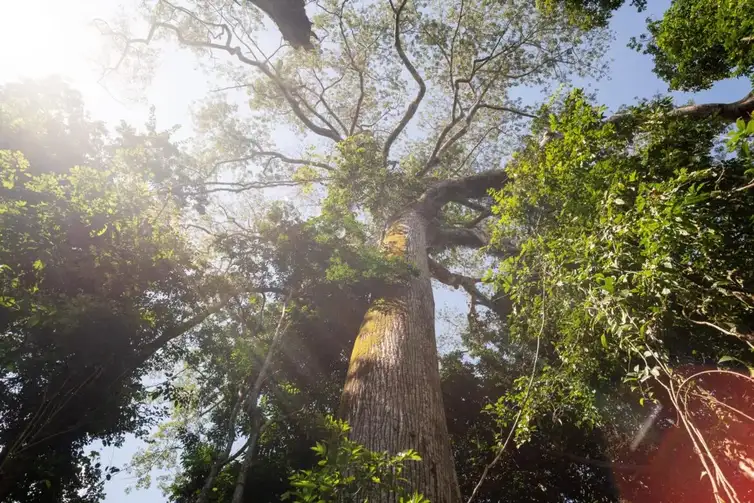
Angelim Red in the Paru State Forest in Pará – Photo: Sustainable Amazon Foundation/Disclosure
Threat
Although these giants keep answers to many of the questions about the biome, the mitigation of climate change and its impacts on the planet, Centenary trees may be threatened. Because they are located in an extensive strip, each occupies a territory with a different degree of protection.
While Brazil’s largest tree is in Pará, the second, 85.4 m high, is in Laranjal do Jari (AP).
“Although Amapá is a state notoriously covered by protected areas, we have two circumstances that draw attention. The first of these is that many giant trees are outside conservation units, and the second is that the commercial exploitation of Angelim-Red is allowed,” warns the executive director of the Non-Governmental Organization Pró-Uni-Kuczach Conservation Network.
Protection
The institution is part of the campaign protect the giant trees, led by the Institute the world we want, in partnership with environmental organizations and researchers. According to Ângela Kuczach, the Movement operates in the mobilization of civil society and has pressured the public power for more protection and so that future generations can know these copies.
“The largest Angelim-Red that exists today in Brazil is the third largest tree in the world. At the time it was discovered, it was inside a state forest, the parrot of Paru, which is a conservation unit that allows exactly the logging extraction. The category exists for this, for forest management,” recalls Angela.
The mobilization resulted in the creation, in September 2024, of the AMAZON GIVE TREES ENVIRONMENTAL STATE PARK (Pay)a 560 hectares integral protection conservation unit. According to Angela, the new categorization of the territory is an important advance, but alone does not leave the giant trees out of risk.
“We are talking about an area that has a lot of mining around, very threatened by deforestation, grabbing. [Cadastro Ambiental Rural] Overlapping, which we identified there in 2022, ”he says.
Car’s Voluntary Declaration is an instrument for private properties that cannot be applied to public areas such as conservation units. In the year the fraudulent statements were identified, a 23% growth in deforestation in the Amazon, and the Paru state forest was the third hardest hit in the category, According to data from the deforestation alert system analyzed by the Amazon’s Institute of Man and Environment (Imazon).
Process
According to the president of the Institute of Forest Development and Biodiversity of the State of Pará (Ideflor), Nilson Pinto, the actions for implementation of pay are already underway. “We made a public notice, so that people enable themselves, entities, authorities and residents, to compose the Management Council. We are in this process now. This is fundamental, because it is the board that will approve the management plan, prepared by the team of our institute, with the support of the Sustainable Amazon Foundation,” he says.
The state agency is responsible for the management of Pará Conservation Units. According to Nilson Pinto, Inspection in the Paru and region forest already fulfills a strong role of protection.
“The Paru state forest is very well preserved. What we have there, normal in a state forest, which is basically destined for forest management, we have several companies doing forest management under the supervision of IDEFlor and very little deforestation, very little,” he says. For the manager, the difficult access to the giant trees site adds extra protection to the specimens. “There are some occurrences that we permanently fight mining. In flota Paru, not in the state park. They are not even close to the giant trees park, where there is no deforestation,” says Nilson Pinto.
Solutions
For Ângela Kuczach, it is necessary to advance in the next steps of protection and seek science as an ally for new discoveries that allow the tipping of giant trees outside the identified territory. “We can have the largest giant tree not yet discovered, and it may be threatened because it may be out of a protective area, a conservation unit,” he says.
Researcher Diego Armando Silva stresses that, in addition to the new discoveries, it is necessary to advance in the research and monitoring of the giant trees that science already knows.
“The first steps are the creation of the Management Committee and the Management Plan, where will possibly be the trees visitation plan, environmental education, research and information management, which contributes significantly to a minimal structure so that we can do effective research and have the ability to receive researchers from different regions of Brazil and the world,” says Silva.
The Secretariat of Environment of the State of Amapá was sought by the report of Brazil agencybut until the publication of the matter there was no answer. The space is still open.