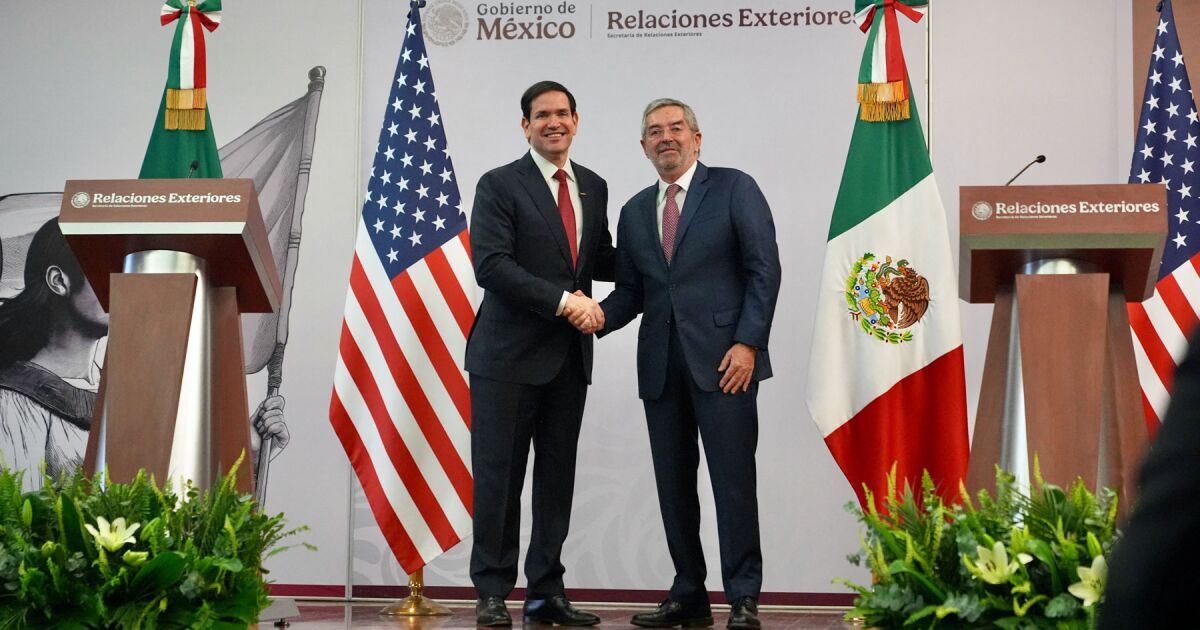
This pattern is not new. In 2019, during the administration of Donald Trump, Foreign Minister Marcelo Ebrard accepted the “Stay in Mexico” program and the deployment of the National Guard as a migratory police, under the direct threat of tariffs. That negotiation, headed by Mike Pompeo, was presented as pragmatism, but was actually a diplomatic claudication. Rubio’s recent visit confirms that the libretto is maintained: US demands change his face, but Mexico repeats the same capitulation logic.
Safety, asymmetric cooperation disguised as alliance
In the field of security, Rubio insisted that the fight against fentanil and Mexican cartels is an immediate priority for the United States. The Mexican government agreed to expand cooperation in intelligence, reinforce controls in ports and customs, and open spaces for indirect intervention of US agencies.
The problem is not to cooperate – something indispensable in an environment of transnational threats – but in doing so without clear conditions of reciprocity. Mexican diplomacy avoids confronting the other side of the phenomenon: the massive flow of weapons that crosses from the United States to Mexico and that feeds violence. By not placing this point with the same firmness, the Sheinbaum government validates a deeply unequal cooperation scheme.
Migration, capitulation under another name
In migration, the pattern is even clearer. Mexico agreed to reinforce control on the southern border and administer returns, consolidating its role as the third safe de facto country. The political and social cost is assumed by Mexico: militarization of the border, management of migrant camps and humanitarian wear.
Washington obtains the immediate benefits in electoral code while the Mexican government is caught in an operational function that wears it without strengthening its diplomatic position.
Invisible agreements
Behind the public speeches, the visit showed commitments that confirm the lack of Mexican strategy:
– Greater Margin of Action For US agencies in national territory, disguised as technical cooperation.
– Reinforcement of migratory containmentwith Mexico as a shock absorber of the political problem in Washington.
– Linking of the energy agenda with the safetywithout a firm defense of national strategic interests.
– Far from setting limitsMexican diplomacy yielded on three critical fronts without building effective counterweights.
Conclusion: A reactive and complacement foreign policy
Rubio’s visit was not just a demonstration of the Washington agenda; He presented the inability of the Mexican government to sustain a firm foreign policy. Sheinbaum, as Ebrard before, privileged the cooperation narrative on the defense of national interests.