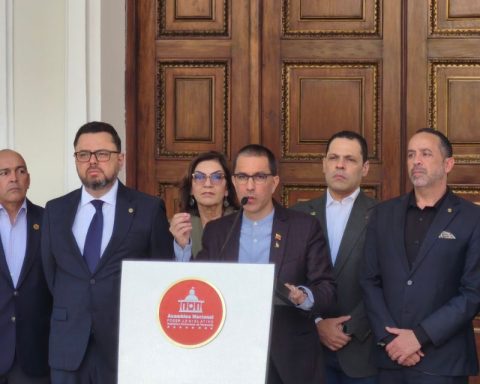
Regarding the commemoration of the 80th Anniversary of Victory in the Resistance War of the Chinese people against Japanese aggression, the historian, political scientist and deputy of the National Assembly, Juan Romero, highlighted the historical and geopolitical meaning of the great parade made by the People’s Republic of China.
During an interview in the El Mundo program in context, Romero said that this celebration shows the eastern discipline of the Asian giant, capable of reborn from poverty and positioning itself as a world power in multiple sectors. “The parade demonstrates how China has raised the name of its nation, improving the quality of life of its inhabitants and consolidating itself as a state of peace.”
The parliamentarian highlighted “part of the representation we see is the issue of discipline and the ability of Chinese culture to adapt, expand and at the same time close to absorb what you have to absorb.” In this regard, he stressed that between the 1930s and 1940s, the Japanese empire undertook an indiscriminate military offensive against the main Chinese political forces, affecting both the Nationalist Party of Shanghai (Kuomintang) and the Chinese Communist Party (PCCH).
Given this threat, the communist leader Mao Zedong proposed a strategic reorganization, recognizing that the common enemy was decimating all the national forces equally. In response, he raised the formation of a unified front to face Japanese aggression.
Romero considered that this historical experience is particularly relevant to the current situation of Venezuela, where a possible external aggression is perceived. “As in the Chinese case, the defense of the nation requires overcoming internal differences and articulating a strategic unit that allows to face common challenges.” He added that, as well as Shanghai and Mao, they knew how to put the national interest against ideological divisions, today Venezuela is called to build broad consensus in defense of their integrity, sovereignty and future.
The deputy also explained the importance of the two strategic lines of action developed by the People’s Republic of China for conflict resolution in international geopolitics. In this context, he stressed that China’s Gross Domestic Product (GDP) exceeds 15 billion euros, reflecting unprecedented economic, industrial, industrial and educational development, with automated cities supported by artificial intelligence.
Finally, Romero questioned the narrative promoted by the United States and Europe about the defeat of fascism, noting that its role has been overvalued to the detriment of other fundamental actors such as Russia and China. “In the specific case of China there is something interesting, especially if we make a rereading based on the threats faced by Venezuela today. Recall that the Japanese, since the second decade of the twentieth century, began a dangerous process of expansion, which was even allowed by the Americans and the English themselves, leading to the taking of Mongolia and subsequently to the demolition of the old Chinese empire.”
VTV/RIRV/EB/DB/