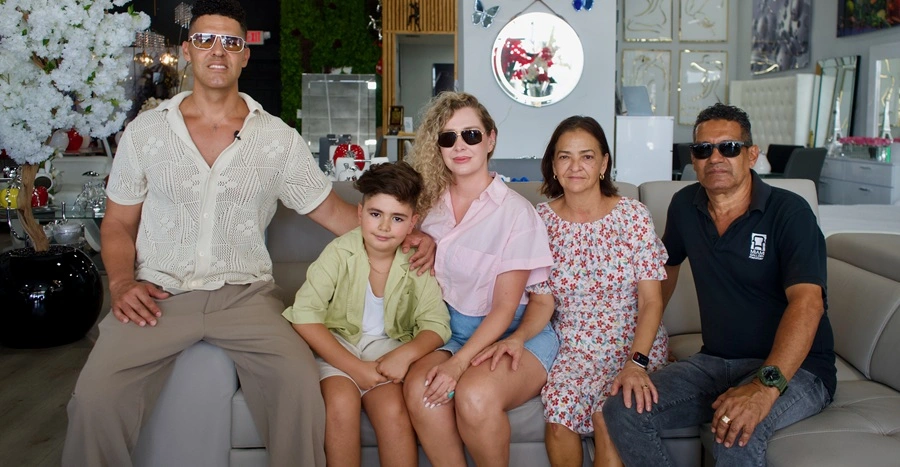
He is Otoniel Valdés, the owner of Miami Gallery Furniture, and this is his story.
Miami.- He was born in Old Havana, in the Barrio de Jesús María, where he learned to make a living since childhood. What for many was “being bisne”, for him was the beginning of a business mentality that years later would lead him to make his way in the United States. After emigrating in 2007, he went from working in an inch to have his own furniture store, importing merchandise directly from Asia. He is a Cuban, who together with his family, has worked a successful path.
He is Otoniel Valdésthe owner of Miami Gallery Furniture, and this is his story.
Where were you born and how was your childhood in Cuba?
“I was born in Havana, in the Jesús María neighborhood.” That neighborhood taught me the good and the bad. Thank God I had my mother behind me showing me the right thing. Jesús María is a business neighborhood all the time, there is sold from everything. As a child I learned not to stay with anything: if they gave me a sack of mamoncillos, instead of eating them I sold them. The same thing happened with the Chivichanas I did with my grandfather: instead of playing with them, I sold them. Everything that fell into my hands I tried to turn it into money.
How did that environment influence your way of thinking?
“In Cuba they called her” bisne “, and they saw him as something negative. But for me it was the Business School. I learned to transform things that did not serve useful, to recover pieces, to solve. It was a constant training in business creativity.
If you had a business in Cuba, Otoniel, why did you decide to emigrate?
“He triggered a moment when I had the normal: a car, a little house, the best thing that could be had there. But everything was with fear. If you had something, you had to invent that “your uncle of outside.” You could never speak freely about your achievements. My uncle, who lived here in the United States, told me: “In Cuba life is in black and white, in the US it is in colors. Here you will have to work, but without that fear that they take what you have.” That decided me. In 2007 I went out with my wife, we passed through Panama, Guatemala and Mexico until we reached the border.

How were your first jobs in the US?
“I worked at a chemical warehouse, but I felt locked up.” Then I got work in the Hialeah’s in. There it was done: driving, sweeping, loading, delivery to West Palm Beach. Over time I thought: “If I can do all this for others, I can do it for me.” And I rented a small place in the inch.
What did that stage mean for you in the in?
“It was hard.” I spent 9 years there. There was melancholy for Cuba, my parents were there, and many times I felt stagnant, without advancing. But I also learned to use networks. I started selling in Craigslist and then on Facebook. I realized that with a good photo I could attract customers, but when they saw that I was in the inch they lost confidence. Then I decided to make the leap to my own store.
How did you open your first store?
“A day I went through 29 and I saw a place.” I rented it while I still had the stuff in the in, but soon I understood that I had to decide. I closed my thumb, although many told me I was crazy. In 2018 I officially opened my furniture store. From there I started traveling to Fairs, to import directly from Asia, and to work with influencers to attract customers.
What role has your family played in this whole process?
-Fundamental. I have been with my wife for 24 years, she is the economic axis of everything: organizes the accounts, taxes, financial discipline. My parents work with me today; Even my mom, with social networks, attracts customers to business. And my son motivated me to learn more about technology, because I understood that I couldn’t stay behind.
What does success mean to you?
“For me, success is not just money, but feeling calm, happy, with my family nearby and a stable business.” The important thing is discipline, because what works today does not work tomorrow. You have to always reinvent yourself.
If you look back, is there anything you had made different?
-Yeah. Have studied more. I always wanted to be a graphic designer, but I thought you had to be a genius for that. Today I know no, that oneself limits itself. I would have wanted to have more academic tools, although I also believe that the street gave me another school.
Otoniel, do you think you would have succeeded in Cuba?
-No. There everything is control, fear and bureaucracy. Here, with effort and discipline, you know that what you have is yours. No one comes to remove it for a bad opinion of a CDR. That makes a difference.