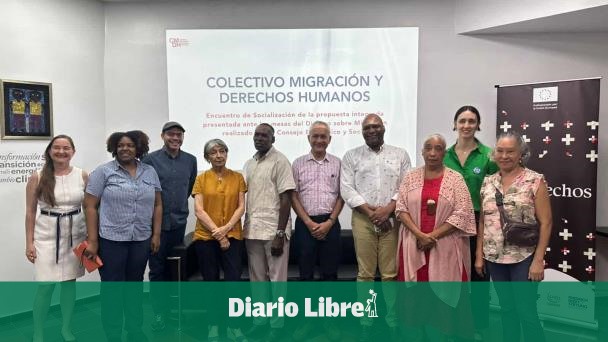
He MIGRATION AND HUMAN RIGHTS COLLECTIVEcomposed of various organizations and articulations of the social sector, in monitoring of the process convened by the Economic and Social Council (CES), is developing a socialization process with the social sector motivating and enriching its contributions to guide a immigration policy integral and sustainable in the Dominican Republic.
The proposals seek to provide the state of technical and political tools to face the immigration situation with a Human Rights Approachavoiding populisms that distort the real opportunities to achieve Short, medium and long term solutions.
During the National dialogue On migration, in the context of the Haitian crisis, the group emphasized that the migration It cannot be addressed only from the security perspective. “It is a structural phenomenon that supports essential sectors of our economysuch as construction, agricultural and domestic workwhose contribution has been historically invisible and overexploited, “said social representatives.
At the Labor Affairs Bureau, they highlighted the need to guarantee full rights to the Immigrant workersespecially women dedicated to domestic work and of care. The Historical debt with the cañeros and its descendants, affected by the lack of pensions and restrictions in nationality. The group proposed to review the 8-20 hiring principle, improve safety, hygiene and salaries conditions, and encourage training through Infotep, both for Dominican and foreign workers.
Dialogue table
At the table of Border developmentit was proposed that border management combine Infrastructure, technology and respect for human rightsavoiding indiscriminate militarizations that affect communities and Binational tradein addition to safe logistics corridors, mobile windows and diversification of commercial destinations to protect border producers and merchants.
At the table of National securityhighlighted the need for an integral approach that combines Technological and military control, Integencial Coordinationorderly management of migratory flows, and on the Dominican-Haitian border, stressed the importance of consolidating a system of Integencial Coordination that involves Army, Navy, National Police, Migration, Customs, Cesfront, DNI and other entities, standardizing processes and databases.
As for the irregular migratory flowthey proposed segment contingency plans By social sectors, Train staff in Human Rights and migration. The interoperability of databases would allow effective monitoring, always respecting due process, creating a binational observatory of risks and crises and a national regional intelligence agency specialized in Haiti and the Caribbean, in order to anticipate scenarios of mass displacements, economic crises, logistics blockages or threats of armed bands. The institutionalization of risk analysis will allow transforming vulnerability into response capacity.
The group emphasized the need to balance Sovereignty and International Cooperationthrough a National Safe Humanitarian Cooperation Protocolregulating the participation of international organizations without compromising the Dominican jurisdiction. They also reiterated that guarantee rights to the immigrant population It does not decrease opportunities for the Dominicans. “Improving the working conditions of a sector strengthens the entire working class,” they emphasized. Among the complementary agreements, it was included to maintain fluid communication with IOM, UNHCR and OAS, reform Law 137-03 on trafficking in persons and illicit migrants.
It is remembered that the National dialogueheaded by the President Luis Abinaderand the participation of former presidents Leonel Fernández, Hipólito Mejía and Danilo Medinaseeks to lay the foundations for a long -term vision policy (2025–2045), which integrates security, economic development, Human Rights and regional stability, to consolidate the Dominican Republic as a reference in immigration management and integral security.