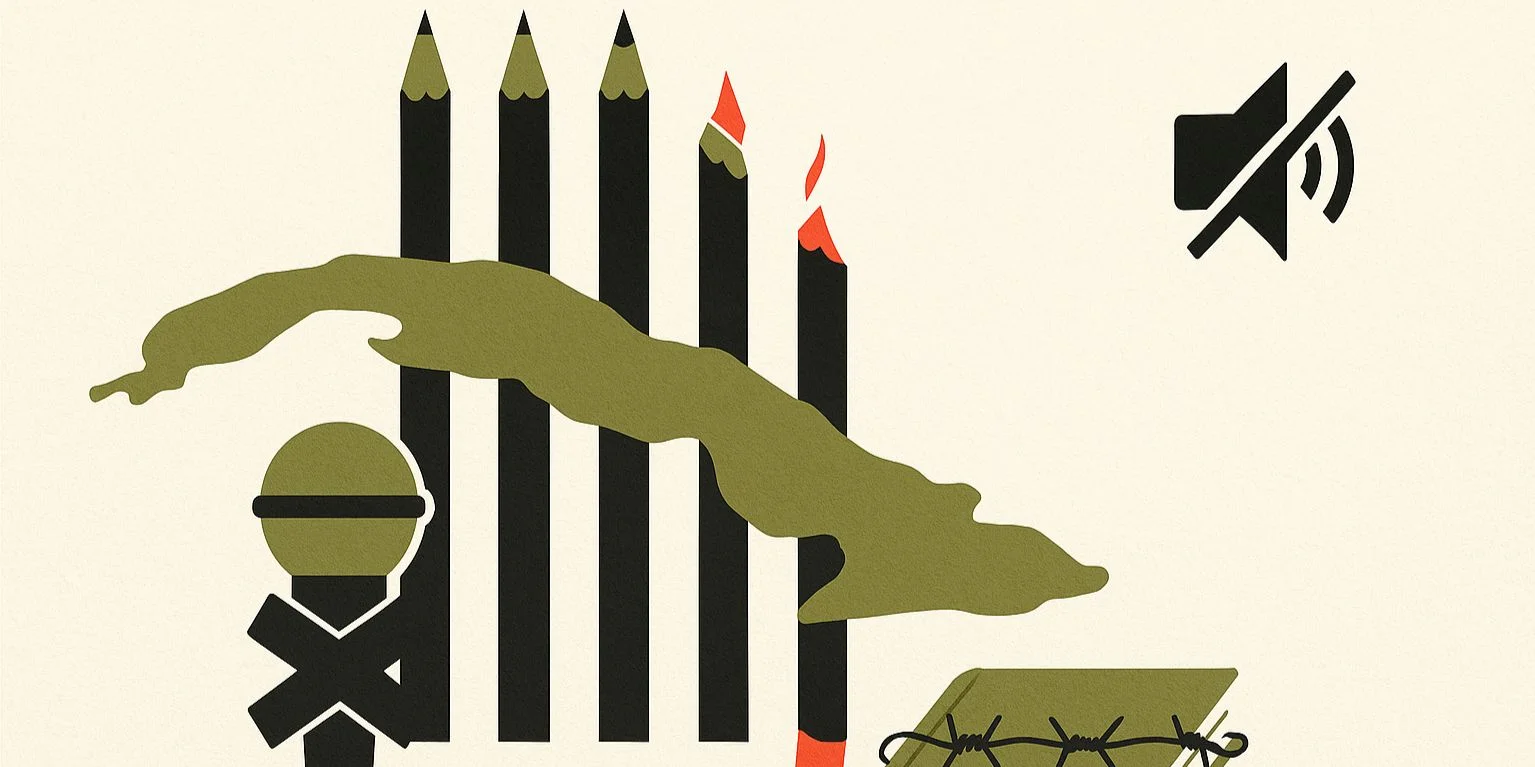
The repression has increased and the dissatisfied Cubans continue to pay for their boldness.
Miami, United States. – The dictatorships, authoritarian regimes and government estates sustained outside the democratic margins bother the accusations, civic demonstrations and complaints against their statue quo.
Cuba – his people and the spirit of their nation – has suffered for 66 years the imposition of a model of human rights violations in various aspects, where the prohibition to think and express themselves with freedom and low items of total legality has been one of the most visible crimes committed until today by the Castro brothers and their heirs until today on the throne of Olive Green.
In a rapid review of almost seven decades of censorship we know that the repression of intellectuals has risen since the prohibition of free press, the suppression of newspapers and magazines, closure of printers and existing editorials before 1959 and the forced taking of all the means of mass dissemination under the iron umbrella of the communist party of Cuba (PCC) was on the rise until the threats, imprisonment, public harassment, public harass expulsion to exile from writers and intellectuals to date.
The machinery of the Ideological Department of the PCC, supported by the State Security Forces (DSE), together with an aberrant and managed legal and legal apparatus have left little space for free expression from writing, the independent editorial promotion or any form of intellectual development outside structures that function as puppets of the Ministry of Culture, such as the Union of Journalists of Cuba (Upec), the National Union of Writers and Artists of Cuba (UNEAC) or the Brothers Saíz Association (AHS).
Legality, against the strings
A legal framework covered by the Criminal Code Reserve penalties up to 20 years or more for those who, exercising their total universal right to free expression, disseminated in or outside the country texts, ideas, civic proposals or works of art whose content does not come to the so -called principles of the socialist (communist) character of the Constitution of the Republic.
In a brief list pass the names of those appear writers whose literary performance took them to jail “Or later they kept writing between bars or began writing there,” and that civic position brought additional reprisals. Herberto Padilla, Reinaldo Arenas, Ángel Cuadra, Jorge Valls, Ernesto Díaz Rodríguez, Néstor Díaz-De Villegas, Carlos Victoria, María Elena Cruz Varela, Jorge Olivera Castillo, Manuel Vázquez Portal, Raúl Rivero, Ángel Santiesteban to two of the most recent cases: that of The poet María Cristina Garridoimprisoned after the protests of July 11, 2021 and the writer José Gabriel Barrenechea.
Try to get a book to be published outside the Island-Cárcel, participate in a literary contest The case of the writer Leandro Eduardo “Eddy” Campawho sent his book Star and other poems A contest in Venezuela and cost him his freedom in the 70s of the last century – creating and participating in the noble adventure of a magazine or literary group, associating, disseminating ideas or standing face to official policy are the most common ways to earn a direct passage to the horrend complicit and citizens intimidated under an oil repressive machine … always, with the contest of enemy states of freedom, some of them even enjoying their permanence in the community of free and democratic nations of the West.
How does the world look at us? Two opposite poles
International and global organizations such as the UN, Humans Rights Watch, Freedom House, Humans Rights Firth, Amnesty International, the International Pen and others, although they have denounced and demanded directly to the military clique that governs in Havana, little have been able to do before the vileness of turning the face or turning their backs that hold universities, large publishers, large publishers, large editorials, cultural organizations, cultural organizations and Governments in the European Union, Asia and the United States themselves in cases where for not losing the prebendas of their trips through the Havana Malecon, a stay at the Santa María or Varadero beach, or simply participating in the literary saraos prepared by the Cuban regime for institutions and representatives of silence and the gag.
Winners of the Nobel Prize for Literature such as Gabriel García Márquez, José Saramago and Nadine Gordimer – among other raised figures of the letters – preferred to claim to the United States the end of the economic embargo from the Cuban regime than to mention a single name (except in cases of some relative) of harassed independent journalists and writers, sentenced to prison, prevented from leaving the country or even forced to leave the land All kinds of horror methods for the simple fact of expressing their free opinion, bringing it to paper and disseminating it among its peers.
Amnesty International has been denouncing and insisting that “Cuban authorities must withdraw all positions for Silence to protesters and critics“, In addition to” no one should be forced to choose between abandoning their own country or facing abusive criminal charges for which it should never have been prosecuted or imprisoned, “says Human Rights Watch and Amnesty International in a joint statement, similar to many other calls for attention.
The contestant artist Luis Manuel Otero Alcántara and rapper Maykel Castillo Pérez (winner of two Grammy Awards) have been imprisoned for four years by the simple fact of demonstrating peacefully and having refused to follow the official line of providing his art under government huts.
New forms of expression. Systemic repression
When they emerged Video tape And the Internet, the Havana regime knew that their only concern were only the filmmakers in 35 millimeters. When the hatching of digital magazines and Blogs Online, a creativity hydra emerged before military boots against the same Palace of the Revolution. The emergence of social networks brought with it an adjustment in repression at the legislative level. Now “there are laws that penalize freedom of expression in Cuba: among them the Decree-Law 370 on the computerization of Cuban societyhe Decree-Law 35 on telecommunications, information and communication technologies, and the use of the radio spectrum; as well as him Criminal Code”, He indicates A report of the portal Yucabite.
Because what do the infoactivist Yoan de la Cruz have in common, the Youtuber Sulmira Martínez, Anniette González and Mayelín Rodríguez Prado, for just citing a few examples?
De la Cruz broadcast live on Facebook the beginning of the mass protests of July 11, 2021 since his town in San Antonio de los Baños in Artemisa; Sulmira, who calls “Salem de Cuba”, published memes, jokes and continually questioned the official government policy; Anniette, from Camagüey, wrapped in the Cuban flag, took pictures, mounted them in a collection and uploaded them to their Facebook profile, while Rodríguez Prado was one of those that under an uncomfortable blackout transmitted through social networks the protests made by the inhabitants of Nuevitas, Camagüey, in August 2022. The latter received a sentence of 15 years in jail.
The free expression modes have changed from the messages in paper balls that came out from jail in the 60s and 70s, to independent magazines, blogs and digital newsletters to satire, memes and messages of challenge on the different social networks platforms. With this, the repression has increased and the dissatisfied Cubans continue to pay for their boldness.