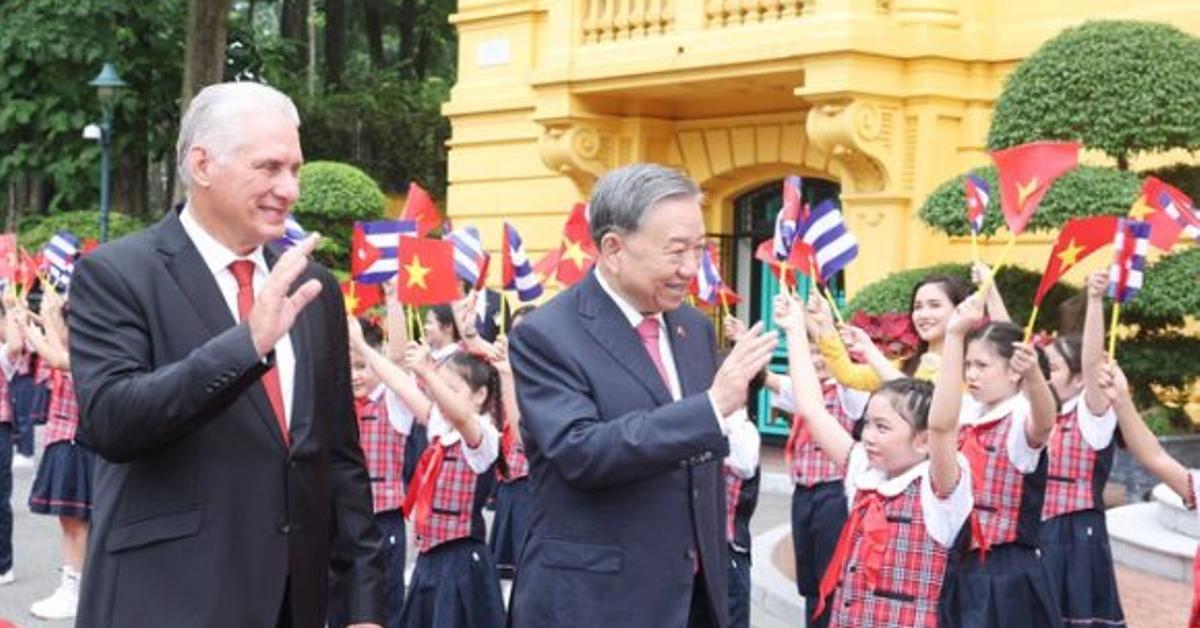
Madrid/In full Official visit of Miguel Díaz-Canel to Vietnama country that has gained ground in Cuba – literally even, when one of its companies became land tenant on the island – Cubadebate Publish one Interview with former ambassador Fredesman Turró That, unintentionally, it is very revealing about how both communist nations have followed divergent paths and have reached opposite results.
If it were a very poor country that received financial assistance from Cuba, Vietnam has opened to the market economy and has become a society in full development that helps an impoverished Cuba and clinging to centralized planning.
“Cuba sent an annual aid of 10,000 tons of sugar, doctors and some advisors; and in full war two poultry genetic centers and a vacation genetic center were built,” says Turró, who arrived in Vietnam in 1968 – with just 18 years – with nine other students. The group was part of a compromise formalized by Raúl Castro, then Commander, during a visit two years ago to the country and in which he met with Ho Chi Minh.
“It was really a very, very emotional visit. In his speech, Raúl would say that even Cuba would be willing to send volunteers to fight next to the Vietnamese,” he says. The Asian leader, who died in 1969, never came to know Fidel Castro – who did not visit Hanói until 1973 – although, according to Turró “there are innumerable anecdotes that show the love, the respect they had.” The Cuban sent, he affirms, ice cream Coppelia to the Vietnamese leader and “species of bull frogs so that Uncle Ho would raise them in the pond near the humble cabin where he lived, in the area of services of the presidential palace.”
“It was really a very, very emotional visit. In his speech, Raúl would say that even Cuba would be willing to send volunteers to fight next to the Vietnamese.”
The former ambassador recounts, with epic, Castro’s first visit to Vietnam, which occurred in full war, being “the first foreign politician to visit southern areas, a short distance from the enemy.” The Vietnamese, abounds, “remember her with a lot of gratitude and admiration for the daring that the commander had, because that was really dangerous, but also because of the decision of the Cuban leader to be built and donate to the area a hospital.” Cuban doctors are currently working on it, although the regime has not specified in recent dates how many toilets make up the contingent.
In the middle of the interview, the conversation revolves around Vietnam’s conversion and how it went from being a poor country and without basic services to the emerging economy that is today. According to Turró – who recognizes not knowing about economics and just telling what he lived -, the country’s first error was to try an industrialization similar to that of the socialist field countries in Europe, when he lacked the necessary bases for it. Therefore, they decided to take another course.
“They adopted a market economy with state control, not a wild market economy, while they decided to maintain social policies (…). In poor areas they built infrastructure, electrified, they applied new policies for the peasant stands out.
/ Latin press
The former official also puts his finger on a sore, which has been claiming the producers, accounts and small entrepreneurs of the island for a long time.
The development of Vietnam, based on these changes in their economy, have taken it, highlights, to be “in recent years (…) fundamental to win, to overcome the difficulties we have in Cuba. As we know, it is the second investor in the special area of Development Mariel (ZEDM) and the second commercial partner of Asia. “And he adds:” It has helped us and helps us in several projects that are key, as in rice plantingcorn; their companies in the ZEDM produce essential items. “In addition, at the moment, the country He has raised $ 14.8 million in donations for the island.
Turró, asked why measures could adopt Cuba to penetrate the Vietnamese market, acknowledges that “having more initiatives, being more creative” and stresses that the Cuban part must understand that in the Asian country there is free competition and can cost a lot to do business. “If a Cuban company is going, for example, to sell coffee – which is not the case – you have to know that you must compete with several brands of Vietnamese coffee, including foreign coffee brands,” he says, at the same time that he remembers that competition, in fact, encourages and encourages.
“The purchase of medications in Vietnam is by tender. You have to go to a bidding process and, this is not secret to anyone, those tenders are sometimes won by great pharmaceutical transnationals, which dominate global trade,” he admits.
The political will, however, partially opens roads to Cuba. That is why among the activities of Díaz-Canel in Hanói has been the inauguration of the high technology plant for the production of Genfarma medicines, the mixed company fruit of an agreement between BCF SA-one entity of the state group Biocubafarma-and the Vietnamese Genfarma Holdings.
“We have the purpose of, in the short term, to produce hemoderivated there. It will be another extraordinary fact that will give technological sovereignty to Vietnam not only in the case of vaccines and biotechnological products of very high added value,” he told the official press Mayda Mauri Pérez, president of Biocubafarmawhich added that this “will have, in a decisive way, a high impact on the health of the Cuban population, because everything we do with Vietnam will have a return to our basic picture of medicines; that is, with the participation of Vietnamese we will have financial resources that will allow us to produce on a large scale and meet both the demand of its population and that of ours,” he said.
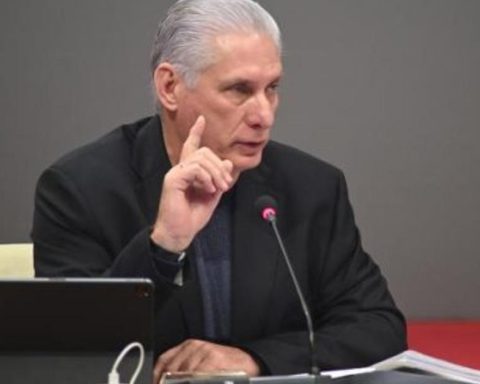
Díaz-Canel stressed in Hanói that “this is the fastest mixed company we have achieved”, since it was agreed during the visit of President to Lam to Cuba in September 2024
Díaz-Canel He stressed in Hanói that “this is the fastest mixed company we have achieved”, since it was agreed during the visit of President to Lam to Cuba in September 2024, which demonstrates the efficiency of Asians, which are also achieving some important advances in sowing rice on the island.
The Cuban part He has pledged to give preferential treatment to its Vietnamese members, who had expressed their discomfort due to the inefficiency of their interlocutors on the island. In 2024, the Agri VMA company – with several businesses on the island, including its presence in the ZEDM – sent a letter to three Cuban government ministers requesting to access 300,000 dollars frozen in its International Financial Bank account. The company assured that it needed these funds to import raw materials and maintain its production, which had been reduced to 10% due to the shortage of inputs, and reminded its role as an animal feed supplier.
Shortly before the arrival of Díaz-Canel in Hanói, the Cuban Vice Minister of Foreign Trade and Foreign Investment, Deborah Rivas Saavedra, was in charge of filing the roughness and assured that Cuba “is open and ready” to adopt measures that facilitate Vietnamese investment projects.