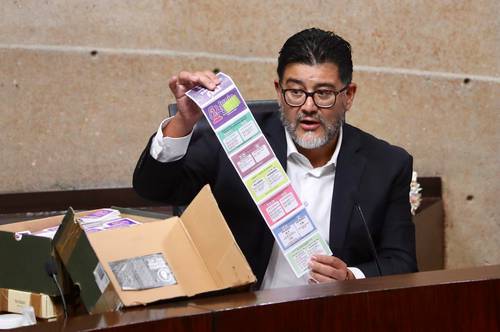
▲ Magistrate Reyes Rodríguez Mondragón shows guides on which the vote for the Court was supposedly based.Photo Luis Castillo
Fabiola Martínez and Néstor Jiménez
La Jornada newspaper
Thursday, August 21, 2025, p. 9
With three votes in favor and two against, the Superior Chamber of the Electoral Court of the Judicial Power of the Federation (TEPJF) endorsed the election of ministers, considering that the mere existence of accordions or the “suspicions” of illegality are not enough reasons to annul the contest of June 1, as Judge Reyes Rodríguez Mondragón and Janine Otálora Malassis proposed.
“Rodríguez) converts the call accordion operation In a paranoid plot, conspiracy of coercion to the electorate, without meritorious evidence for it. Rather than evidence an illicit, generalized operation, with real effects on the electorate, in the sense of coercing them or depriving them of their decision -making capacity at the time of their vote, the project reflects a forced and superficial interpretation of the facts, ”said magistrate Felipe de la Mata.
The conclusion was backed by their colleagues Felipe Fuentes and Mónica Soto, who with different nuances warned that annuling the election of those who, as of September first, will integrate the Supreme Court of Justice of the Nation (SCJN) would be an “institutional coup” to Mexican democracy.
Thus he closed the first judicial election in Mexico: in the midst of a long session, almost seven hours, during which the magistrates were seen to vehemently defend their positions.
Copies of the famous accordions reached the plenary, first when Rodríguez Mondragón put a couple of boxes beside him with these guides and presented them as evidence of the existence of “an illicit, coordinated and generalized strategy of distribution”.
In his opinion, the above elements were sufficient to annul the choice of ministers, by constituting prohibited propaganda – determined in the electoral results -, illegal financing and serious violation of the constitutional principles.
Moreover, he proposed to declare “legislative omission” in the definition of this commission, give view to the INE to investigate the event and delve into the consequences for Mexico to validate a process with these characteristics.
He explained a decalogue of circumstances, including statistical reasoning, as a central argument to reach their conclusion: the accordions were not used spontaneously by the voters, but as part of a distribution strategy of at least half a hundred models, whose result was successful to the extent that the names registered in the guides coincide, he said – with those of the nine winning ministers.
“The mathematical probability that this coincidence occurred on citizen initiative, individual and without any coordination is practically zero; in addition, internationally recognized measurement rates, such as Herfindahl-Hirschman and the concealment allow to assess the concentration of votes in a single combination of candidacies; these indices analyze the competitiveness and homogeneity of the suffrage to detect possible patterns. Votation, ”he said.
And that first serve, almost half an hour, received equal or older replicas of his colleagues, who did not give him the benefit of the doubt, did not even accept to order the INE to make the investigation, but for minutes of exposure no one stopped.
Of the bush, frequently laconic in his interventions, he answered with 100 questions.
“Did you really, a paper in your pocket to help vote, which is unknown if it was distributed and if it was effectively used, much less generalized, it became an illegality that threatens democracy and the validity of the choice? The project fills us with doubts,” he said.
Then he emphasized that although there were accordions, it is not known who ordered them to print and less their influence. “Who did we attribute them to? Were the governments, opposition parties, the officials, the candidates, the unions, the businessmen, the organized crime, the churches, the federal, state or municipal powers? Who did them? Nothing says the project.”
He also stressed that this Electoral Court annuls only in extreme cases, as a last option, to the degree that in 30 years of existence has invalidated 73, most local type and three government. Even the 2006 presidential was not revoked, “although serious violations were accredited, as a campaign black, Illicit intervention of the Federal Executive, use of social programs and intervention of business subjects ”.
In the intervention of the president magistrate, Mónica Soto, the copies of accordions also came to light, when he asked the speaker to reach one of the “packages” that led to the table, but the comment of the speaker did not sympathize with him.
“We cannot say that there are no accordions,” said Soto raising the papers.
Reyes Rodríguez said:
–The you have in your hand is the winning accordion
– Is this good?
– I hope you have not gone to vote with that …
– Was what what? I didn’t hear it.
– I hope that when you were to vote they would not give you that, but that is the winner.
–Magistrate, with that attitude we are not going to dialogue, because its positioning is not legal and I ask for the full presidency.
Thus concluded the analysis of hundreds of challenges filed from the minute one of this episode, after the publication of the constitutional reform decree in judicial matters.
In total, since last September the Superior Chamber received 963 judgments, although from the day of the election day it was learned that the matter of spinal discussion would be related to the accordions.
The electoral judges dedicated themselves to analyzing the scope of these voting guides used in an unpublished and complex process, to define 881 positions of the Judicial Power of the Federation between 3,400 candidates.
In the end, green light was given to all contests, including that of ministers of the highest court in the country.