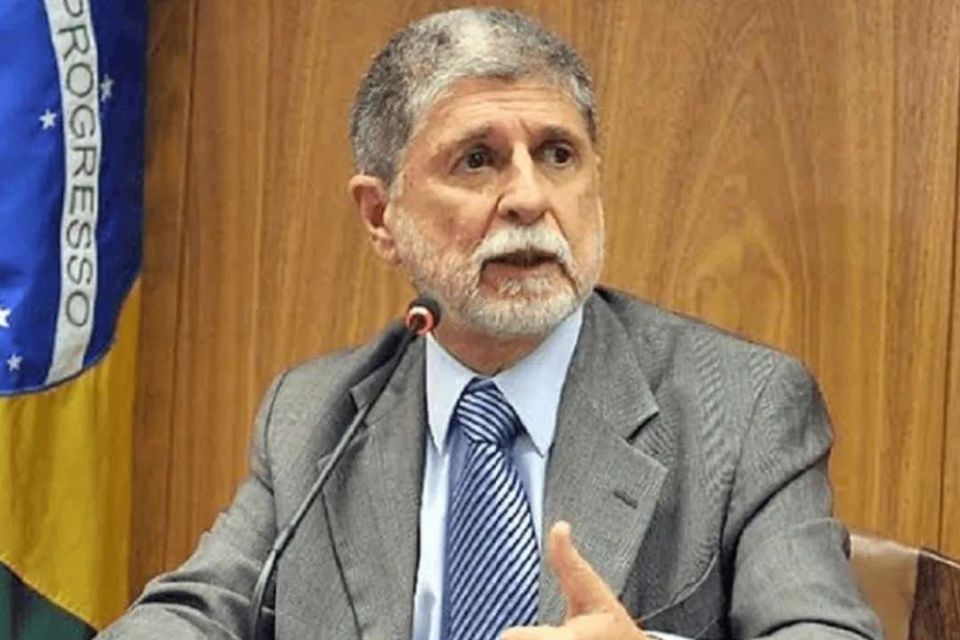
The Advisor for International Affairs of the Presidency of Brazil, Celso Amorim, explained that his “concern” goes through “the risk” that could imply that US military mobilization with the excuse of “fighting organized crime, which must be fought, but with cooperation between countries and not with unilateral interventions”
The Advisor for International Affairs of the Brazilian Presidency, Celso Amorim, said on Wednesday, August 20, his “concern” for the displacement of three US warships in the Caribbean, near the territorial waters of Venezuela.
Amorim, who was a chancellor between 2003 and 2010 in the first two mandates of Lula, clarified, however, that he would not make “no political trial” about the US decision to position those ships in the Caribbean.
According to the White House, the intention is “Use all power” from the United States to stop the “drug flow” to your country, which it accuses, among others, Nicolás Maduro.
The White House spokeswoman, Karoline Leavitt, said that “Maduro’s regime is not the legitimate government of Venezuela, it is a drug trafficking poster,” and that the Venezuelan is “a fugitive leader,” accused in the United States of drug trafficking. “
*Also read: Guyana denounces that most of the drug that enters the country comes from Venezuela
Amorim explained that his “concern” goes through “the risk” that this military mobilization could imply with the excuse of “fighting organized crime, which must be fought, but with cooperation between countries and not with unilateral interventions.”
The former minister stressed that “the principle of non -intervention is fundamental” and has been “historically” one of the pillars of Brazil’s external policy.
He also reiterated that the Brazilian government, although he has not recognized the result of the presidential 2024, maintains with Venezuela “a state relationship.”
This relationship is based, among other factors, on the existence of a community of 20,000 Brazilians residing in Venezuela, a country from which it has also arrived in Brazil in recent years about half a million refugees, Amorim said.
“It is a neighboring country, the neighbors are not chosen,” he said, to point out that Brazil “recognizes states, not governments.”
With information from EFE agency
*Journalism in Venezuela is exercised in a hostile environment for the press with dozens of legal instruments arranged for the punishment of the word, especially the laws “against hatred”, “against fascism” and “against blockade.” This content was written taking into consideration the threats and limits that, consequently, have been imposed on the dissemination of information from within the country.
Post views: 534