In the funds of the archive of our cultural center, in the stationery of Cintio Vitierwe find these letters:
National Library, Director
Buenos Aires, January 2/1959
Dear poet:
I have taken so much to thank his beautiful work that he implies
So much elevation and intelligent work, that I can at the same time congratulate it
for its free tank and wish that the New Year is venturous and prosperous to
You and for your homeland.
Jorge Luis Borges
S/c Maipú 994.
National Library, Director
Buenos Aires, November 10/1959
Distinguished friend:
First of all, discourage me for not having written before, my eyes are the guilty, four years ago I cannot read or write, dictate is not the same … I appreciate their shipments and the interesting reading they have given me; also his kindness in the requests formed, which attached very grateful. As these lines will arrive in the last month of the year, my best votes have been taken to the new one, for that 60 that I hope to give our homelands such an agitated peace and prosperity.
Very cordially, yours always
Jorge Luis Borges
S/C MAIPÚ 994.
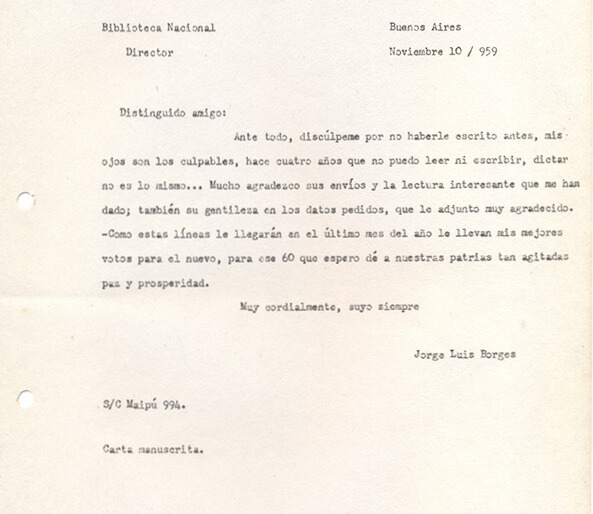
We gave us great pride and joy to find this brief correspondence. They are handwritten letters, and therefore, in all likelihood, dictated. Thus, we have to take for many its few lines. And on the other hand, we someday trust to recover the shipments of the tiny that Borges mentions.
Better to comment, I would like to complement these cards with three moments of a conference that offered Cintio in 1994 in the church of San Juan de Letán.
They are not few, or minors, the disagreements that are obvious when studying the intellectual and poetic relationship of Cintio with Borges. But ultimately, as can be seen in these words of the Cuban, all possible disharmony is dragged by the main current of poetry, which should always flow among all writers, and among all men:
[…]
A valid way of reading Borges is to read it against it, because he was against. His apparent complacency or resignation with himself was the simple mask of his disagreement; But it can also be said that his self-disagree was the strongest argument of his self-complacency. Reading it against it is reading it in your favor, almost pampering it. And when we say “simple” mask we say it borgeously, with all the premeditation of their improvisations and their adjectives, of their jokes. We perhaps touched on a nerve point of his literary being: the rejection of his own simplicity with the eternal cyclical story of the complexity of everything. Complexity in which the poet unbridled while the writer affirmed it as the white flag of the defeated. Then the words was given – and especially to the punctuation of the words – so disarmed that they let him pass as to a poet, as to a child, but he was the capricious child who wants to have or say the last word, and then the words surrounded him by putting him on, closing him. Thus surrounded, the astonishment feels, the slight anguish as ingrapsy of being involved in that game by which only the wisdom of, forever and as a sign is reached, impose it.
[…]
With Borges Latin America, in literature, in literature, his brightest essay of modernity that does not correspond to him. The false battle designed by Sarmiento – “Civilization against Barbarie” – had in him his last skirmishes and quintesencies. He wrote the Facundo So many times, in favor and against, that he became part of his oblivion. His ignorance of Martí, his disdain for the American tropics, who with such love received his work, could not be unpunished. Borges was incomplete, but with incompleteness that did not add necessary, but sufficiency. When Lezama died, he said to ignore him and that Argentina and Cuba were very diverse things, with obvious pejorative spirit that decreases it. We do not appreciate that statement or so many others that, certain or not, exact or not in the journalistic giggle, they adhered to their image without him protesting them, and could do it. He cultivated the interview as a fun genre, without having fun. We thank you, however, the integral decency of your work, having saved intimacies that do not concern us, the Borges flavor, the quality of your memory, its funny enumerations, the teaching of your word totally aware of being nothing more than a bifronte word in the American desert. Convert that awareness, that absolute lucidity, that ontological modesty, into a foundation stone, depends on us, its debtors.
[…]
Written these lines, the words said by Borges come to my hands upon receiving the Cervantes award; For me, at this time, his latest words of symbolic value, and so moving because of the unarmed, because of the armed of a stripping that leaves us as defenseless as he, really dazzled. The poet always has the last word; Do not write, the lawyer, the ingenious. Precisely with the greatest ingenious, the ingenious Hidalgo, he came back in his finals, and so he said, he did not write:
“… I remember the first time I read the QuixoteBack in the 1908 or 1907, and I believe that I felt, even then, the fact that, despite the deceptive title, the hero is not Don Quixote, the hero is that manchego hidalgo, or provincial lord we would say now, that by force of reading the subject of Brittany, the matter of France, the subject of Rome the great Whoever, that hidalgo that imposes that task that sometimes gets: to be Don Quixote, and that in the end he verifies that it is not; In the end, Alonso Quijano is again, that is, there is really that protagonist who usually forgets, this Alonso Quijano. ”
This Alonso Quijano, this Borges in person, stripped of the image of Borges, which I saw back from so many illusory adventures, in a provincial scenario of poet Buenos Aires. It was in Morelia, the pink city like the walls of its stores, its suburbs. The American pink human, the endearing poverty of the ours that is surrounded, defends, hurt, between goodness and irony as a blind transhumant, like Borges, the son of Darío, when he said naively, invulnerable:
“… I am very touched by the fact of receiving this honor from a king, since a king, as a poet, receives a destiny, accepts a destiny and fulfills a destiny and does not seek it, that is, it is something fatal, beautifully fatal, I do not know how to say my gratitude …”.
Who, dear Borges, mysterious king who walked among us.