I see no strange or difficult (receive children from Gaza), but some issues should be taken into account: if culturally it is the best refuge for those children. I don’t know if there would be any other country with whom they had a better geographical, cultural, linguistic closeness. ”
Rafael Ricardo Soler, professor at La Salle University.
In an interview with Political expansionSoler Suástegui explains that it is much “easier” than the refugee – in this case of Palestine – adapts to another country if there are cultural, religious and linguistic similarities, among others.
“If I have a person from Honduras who probably speaks Spanish, who shares a series of western cultural issues, food and religion, it would be much easier for that person assimilating to Mexico and would be easier. It is a practical issue. Thus, the refugee person would adapt more or less quickly,” he abounds.
Blanca Alba Albateacher in international studies, warns that it is not clear under what conditions the children of Gaza would be established in Mexico, because at other times – such as the Spanish Civil War – the authorities involved civil organizations to create the conditions and spaces necessary to receive them.
It is not clear which civil society groups or who can do this process (of protection of children). It would have to be the Mexican State, but it has no physical institutions that are dedicated to the protection of refugees. ”
Blanca Algarra Alba, teacher of Tec de Monterrey.
Algarra Alba agrees that the eventual reception of Palestinian minors represents a challenge for both the authorities and for the beneficiaries themselves, due to the characteristics so dissimilar between Palestine and our country.
The initiative
The proposal that Mexico receives orphans for the war conflict in the Gaza Strip was launched by the president of the Senate, Gerardo Fernández Noroña, after, he said, he received videos of minors from Palestine asking for help.
“I believe that we can do an action that is not symbolic. There are orphaned boys and girls in Palestine, we should welcome them in our country, as President Lázaro Cárdenas did at the time,” said the morenista.
When consulted on this initiative, President Claudia Sheinbaum said she was willing to review it and commissioned the Secretaries of Foreign Affairs, Juan Ramón de la Fuente, and of the Interior, Rosa Icela Rodríguez, to analyze the approach.
“We would have to review if it is the case,” Sheinbaum added at his Mañanera conference.
First Palestinian family in Mexico
Although from the federal government it is analyzed to receive orphaned children for the war, civil organizations and the Legal Clinic for Refugees of the Ibero -American University have already managed to bring our country to our country to a first Palestinian family.
This is the ABED family, originally from the Gaza Strip, which arrived in Mexico as a refugee fleeing the conflict in that region.
In May, this family composed of 18 people, including older adults and children, arrived in the country to meet with Shadi Abed, who already lived in Mexico since 2018.
In March 2024, Shadi Abed began the procedure to bring his mother, brothers and nephews, with the support of civil organizations. His family arrived in our country after a year and a half of trying to leave Gaza, and after passing through Egypt and Jordan.
“Thank you Mexico for helping us save our lives,” were the first words of the family upon arrival in Mexico.
The Mexican Commission for Refugee Aid (Comar) granted humanitarian refuge to the ABED family, while the National Migration Institute (INM) granted permanent residence and humanitarian visas to settle in Mexico.
‘It was a tortuous and complicated process’
Axel González, a lawyer at the Legal Clinic for refugees from the Universidad Iberoamericana, explains that it took more than a year to bring the ABED family to Mexico, because during the process to receive refuge they found several obstacles and obstacles.
In an interview with Political expansionGonzález points out that those 18 people- who were in the Gaza Strip- arrived under the figure of family reunification.
He explains that in our country this figure is recognized although, to materialize it, a procedure of months must be followed before the Mexican Commission for Refugee Aid (Comar).
Once the person has the recognition of refugee, he can request the reunification of his family in Mexico, which implies bringing it as a refugee.
“It was a very tortuous and complicated process, full of legal and material barriers. Once these procedures are started before the region, the law requires refugees to have economic solvency and a fenced family bond,” he explains.
He details that the process before the region took seven months, but they occupied another five months to evacuate Gaza’s family and arrive in Mexico, since the Mexican State does not undertake to bring the families of refugees, but only recognize the right.
“That is, (the Mexican State) does not give them the tools to bring people because it does not help them financially, it does not pay flight expenses or lodging or negotiations with other states to evacuate families. All that we did on its own,” he says.
The 18 members of the ABED family are found in Mexico City; Some receive health treatment because they arrived with malnutrition.
“Several members arrived with malnutrition and carrying health problems for not having enough foods in Gaza and due to lack of medicines. All these situations led them to states of malnutrition and health problems,” warns.
This family came with the legal support of the Legal Clinic for Refugees of the Ibero-American University and the economic support- through collections- of the Gaza Collective in Mexico. Axel González lawyer reveals that he has no other case related to people in Gaza.
UN reports ‘alarming’ figures
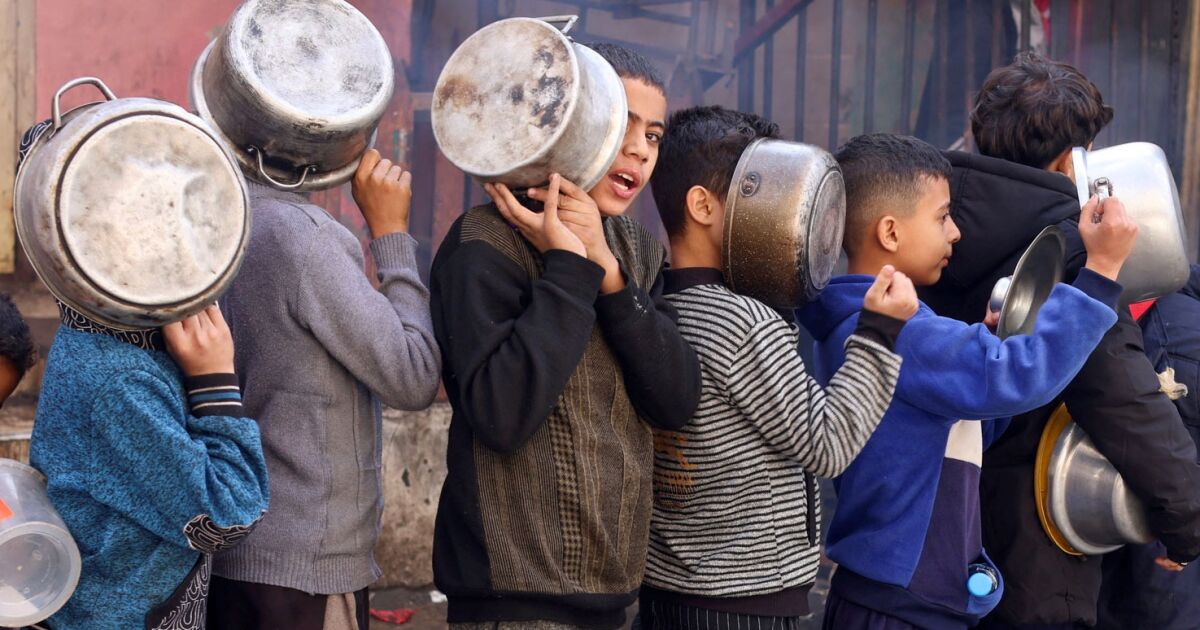
According to data from the UN agency for Palestinian refugees the number of dead children for malnutrition and hunger in Gaza already sopasses the 100.
“This bleak figure also adds to the more than 40,000 children reported as dead or injured due to Israeli air bombings and attacks,” reported United Nations on August 13.
“To date, there are at least 17,000 children not accompanied or separated from their families and one million deeply traumatized children and without access to education,” he added.
The UN also reported That the number of malnourished children in the Gaza Strip increases “at an alarming pace”, since there are 5,119 children between six months and five years that were hospitalized in May of this year to receive treatment due to acute malnutrition and, from them, 636 suffer from severe acute malnutrition.
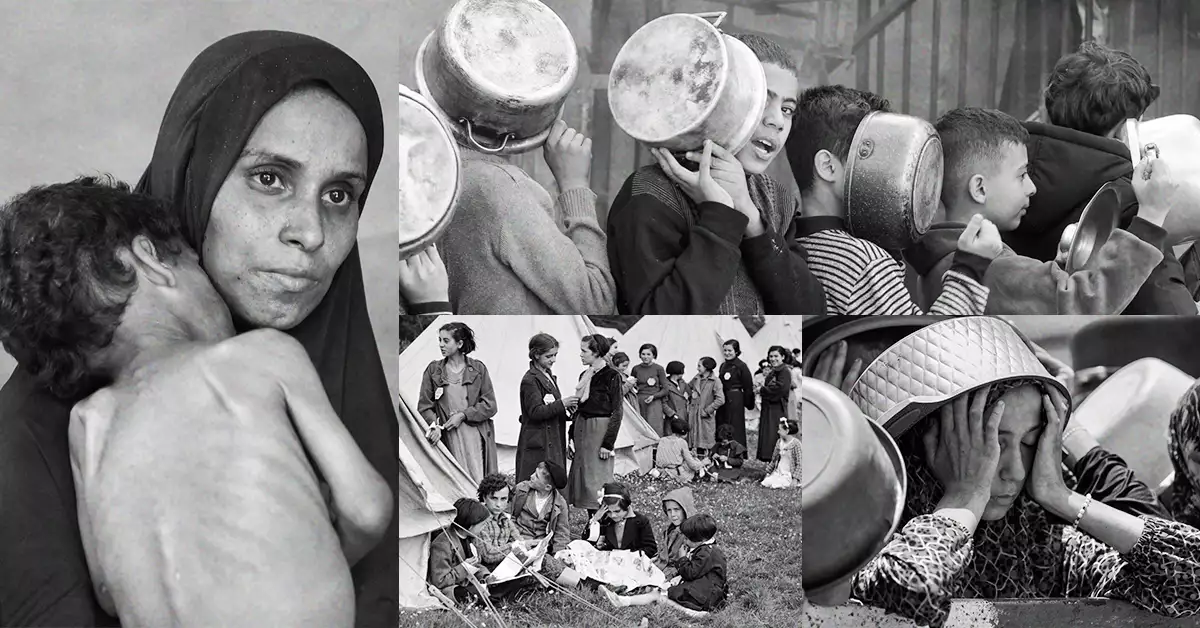
(Photos: AFP/Reuters/Getty Images)
“These children need constant and supervised treatment, drinking water and medical care to survive, all of which is increasingly scarce in Gaza today,” reported United Nations.
“In just 150 days, from the beginning of the year until the end of May, 16,736 children, an average of 112 children a day, have been admitted to receive malnutrition treatment in the Gaza Strip,” adds the report.
The lack of food and water is because bombings have destroyed or damaged the essential water, sanitation and health systems in the Gaza Strip, which has limited the ability to treat serious malnutrition; This is because only 127 of the 236 treatments centers work.