The Aragua train has quickly become one of the most infamous criminal groups in Latin America and the Caribbean, becoming a security priority for the governments of the region. The insightcime organization publishes a thorough study of the organization
The Aragua train has quickly become one of the most infamous criminal groups in Latin America and the Caribbean, becoming a security priority for the governments of the region. The United States has designated it as a terrorist organization and accused of orchestrating an invasion.
However, Nicolás Maduro ensures that his government has eradicated the Aragua train in Venezuela. So what is the truth about the band? Is it an expanding criminal power or simply a successful criminal organization?
After three years of field work in various countries, Insightcime He presented an investigation that sheds light on the Aragua train: its evolution, its current tactics and the possible transformations that it could experience in the future.
Here we leave you of three chapters of the investigation:
Bolívar, a new sanctuary for the Aragua train?
The leadership of Yohan José Romero, aka “Johan Petrica”, inside the Aragua train dates back to his role as Pran in 2010. In 2015 it was believed that he had died during a police operation in Aragua, but years later he reappeared in the Bolívar state, linked to the control of illegal mining in the town of Las Claritas, whose gold deposits are among the largest and largest profits
With the creation of the Orinoco Mining Arch in 2016 and the change of governor in 2017, the balance of power between criminal unions was modified. The new governor, Justo Noguera, opened space to Petrica as an interlocutor, progressively displacing Juan Gabriel Rivas, aka “Juancho”, who until then dominated the area. From that moment, “Petrica” strengthened its links with political sectors and began to consolidate its control in mining.
In September 2023, after the intervention of the Tocorón prison, members of the Aragua Train, including its top leader, aka “Niño Guerrero”, called Héctor Rusthenford Guerrero Flores, found refuge in the Claritas. That same year, a operation weakened the faction of “Juancho”, who was later arrested in Brazil in November. Although his extradition to Venezuela was approved in 2025, he managed to escape during his house arrest, which left the free road to Petrica as undisputed chief of the mining enclave.
In parallel, the Supreme Court of Justice (TSJ) recognized in 2024 that the organization continued to operate in the country under the command of “Petrica”, contradicting the official version that the band had been dismantled. That same year, on the eve of the presidential elections, Las Claritas dressed in official propaganda and the inhabitants were pressed to vote for Nicolás Maduro, evidencing the connection of the union with political power.
By 2025, “Petrica”, who is also known in the area as Darwin Guevara, had established himself as the main leader of the clarites, where he combines the illegal mining business with social and recreational activities that replicate the community control model exercised by the Aragua train in Tocorón.
Although the enclave offers security and criminal income, its isolation and the agency of agreements with military and officials limit the expansive capacity of the group in Venezuela, which is why its projection points more and more to the outside, especially Colombia.
Separating the fiction of the reality of the Aragua train
The United States has spread the narrative that the Aragua train represents a growing threat to its national security, even accusing Maduro of directing it and using it to introduce drugs in its territory. However, there is no solid evidence that the organization controls significant loads of cocaine or that it has a coordinated strategy of expansion to the US. However, the participation of members in crimes such as traffic, microtrafficking and extortion in different countries of the region, many times autonomously and without a centralized command is noted.
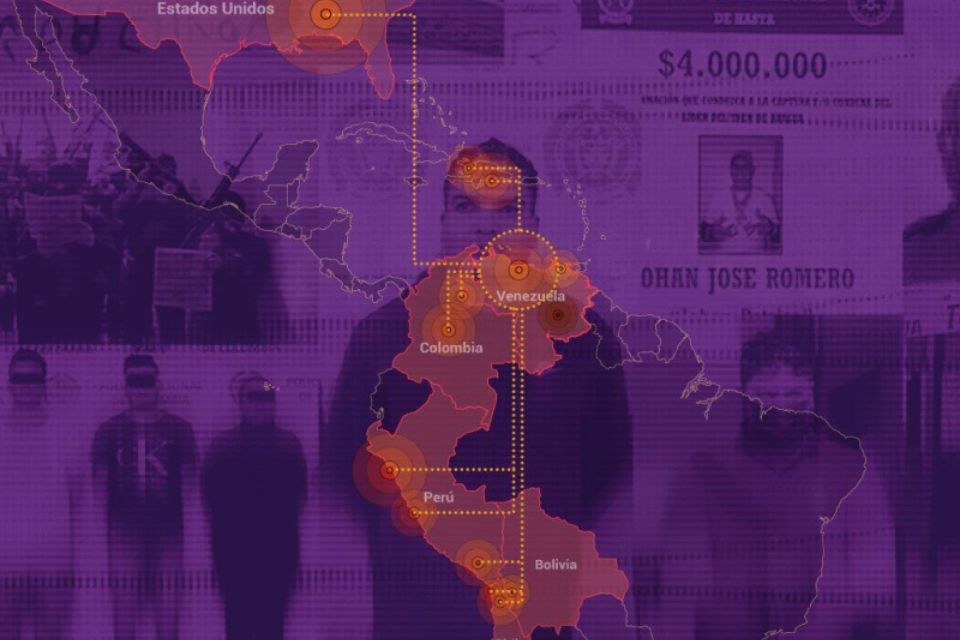
“Guerrero Niño” and Johan “Petrica” are still released. Both move inside and outside the country: Guerrero would have traveled to Colombia and Mexico, while “Petrica” frequently crosses Brazil, although it remains mainly in Venezuelan mining territory. The ability to move without being detected reflects that they still have criminal infrastructure and support networks. Even so, the international siege has intensified: the United States sanctioned “Petrica” and offers four million dollars for information that allows its capture.
The dismantling of Tocorón weakened the centralized structure that once coordinated the different factions of the Aragua train. Today, cells operate with greater autonomy in Colombia, Peru and Chile, countries where more than half of the identified leaders have been captured, thanks to growing cooperation between security forces. In addition, imitative bands that use the name of the organization proliferate to instill fear, but are not related to its founders.
Insight Crime investigation found links between Maduro and organized crime, particularly through agreements with mining unions and armed groups such as the National Liberation Army (ELN) and Dissidces of the FARC. Even the participation of a Aragua train cell in the kidnapping and murder in Chile of former Militar Ronald Ojeda, a case that, according to the Chilean Prosecutor’s Office, would have direct connections with the Minister of Interior, Justice and Peace, Diosdado Cabello, is even investigated.
Thus, the Aragua train is at a turning point: weakened, fragmented and with an old guard in Decline, but still capable of operating thanks to redoubts such as clarites and political protection.
The demonization of the Aragua Train by the Trump administration seems to be more motivated by political issues than for a growing threat to the national security of the United States.
*Also read: InsightCrime: Pentagon official directed center that misinformed on the Aragua train
The future of Aragua’s train
Both the central leadership and the group’s cohesion have been beaten with the loss of their operations base in the Tocorón prison in Aragua and the capture of their leaders in Colombia, Peru and Chile. Everything indicates that Aragua’s train is in decline.
The future of the band will depend on several factors. One of them is their ability to survive the coordinated offensives of security forces, both national and international. Unlike historical criminal structures such as the ELN in Colombia, the Red Command in Brazil or the Sinaloa cartel in Mexico – which managed to resist decades of pressure in their countries of origin – the Aragua train faces the difficulty of being fragmented in scattered cells abroad, which increases its vulnerability.
Another key factor will be the continuity of Venezuelan migratory flows, which were the main platform for expansion of the Aragua train in the region. The persistent crisis in Venezuela, added to the permanence of Nicolás Maduro another six years in power, points to migration will continue. Although countries such as Colombia, Peru, Chile and the United States show growing signs of saturation or rejection of Venezuelan migrants, new routes could lead to Brazil, Argentina, Uruguay or the Caribbean. This scenario offers opportunities for the organization to expand its radius of action, especially since its last bastion in Las Claritas, Bolívar, under the command of “Johan Petrica”, with direct connections to Brazil and Guyana.
Maduro’s position will also be decisive. After the fall of Tocorón, the Aragua train went from being tolerated to the enemy of the State, although the faction of “Petrica” maintains protection in Bolívar, Maduro could opt for an offensive to eliminate the band or, on the contrary, use it as a geopolitical tool.
Two other critical scenarios are prisons and drug trafficking. The Aragua Train, which was born as Pranato in Tocorón, retains a strategic knowledge of how to convert prisons into operations centers, and there is already evidence of presence in prisons of Colombia, Peru and Chile. If they manage to control these spaces, they could reproduce their prison model and extend their influence.
In short, the Aragua train seems to be sentenced to fragmentation and wear, but its name will remain alive as a generalized label to designate Venezuelan criminals abroad. His future as an organization depends on the capture of its remaining founders, “Niño Guerrero” and “Johan Petrica.”
To read the full text, do Click here
*Journalism in Venezuela is exercised in a hostile environment for the press with dozens of legal instruments arranged for the punishment of the word, especially the laws “against hatred”, “against fascism” and “against blockade.” This content was written taking into consideration the threats and limits that, consequently, have been imposed on the dissemination of information from within the country.
Post views: 275