“Once you pass through Cuba, you can go anywhere and survive,” said the student.
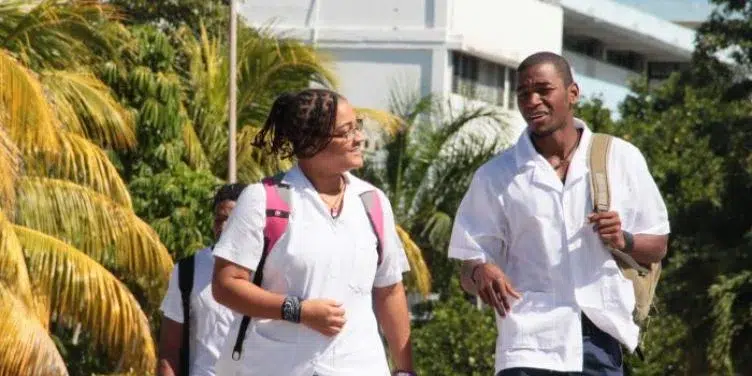
Miami, United States. – Jamaican students of Medicine in Cuba described a panorama of frequent blackouts, lack of water, shortcomings of basic products and the additional challenge of studying entirely in Spanish and far from their families, in A report appeared in the Jamaica Observer This Mondaythat puts the focus on the daily difficulties faced by foreigners on the island.
Kelsey Clarke, who gets ready to start his second year of Medicine in Girón (Matanzas), said: “My experience as a medical student in Cuba is full of countless challenges, but it is something that is worth it – it is in the short or long term. Jamaica Observer.
The young woman stressed the emotional and logistic weight of studying without a family network and in another language. “I lost my father last year and be away from my family for 10 months and then return to face that challenge [antes de] Returning to Cuba to try to continue school, it is a lot to balance. But everyone is making sacrifices, so you have to do yours, ”he said.
But that’s not all: “Another challenge [en Cuba] are The cuts of light. We have scheduled blackouts of like eight hours a day. It’s a lot, but you have to do what you have to do. It affects the study because, personally, I like to be comfortable when I study: I need the light and the fan, ”he explained.” Here, heat and mosquitoes make the conditions the opposite of comfort when you try to approve an exam that is important for the progress of your career. “
Dominique Whitely, sixth year student at the University of Havana and Bilateral Jamaica Scholarship (2019), reinforced the idea that conditions demand resilience. “It is difficult to study medicine, but we always say that it is 10 times more difficult to study medicine in Cuba. Another thing we say is that once you pass through Cuba, you are prepared for life. There are so many things that you have to face (the blackout is one) … we also have a shortage of water. In the campus, especially during the summer, sometimes we have to bring tank trucks, we have cubes and we have to collect water and store it. Sunday Observer.
Whitely said that scarcity reaches essential items: “Some things, people take them for granted. When we just arrived in Cuba there was a shortage of simple essentials such as sanitary paper and toothpaste; even if you had the money, the fact was that the article simply was not there.” From that precariousness, he said, they derive learning: “You learn to improvise; sometimes you don’t have the resources you need. They are good life skills. You learn to think quickly, which is good in the medical career … once you pass through Cuba, you can go anywhere and survive.”
On the blackouts, he described effects that directly affect the training: “When you know that the blackout will come, you can prepare. If it is sudden, there really is nothing you can do. It is frustrating, especially as a medical student, because when there are blackouts the internet is inaccessible. If you want to investigate something, you cannot. You probably want to load your laptop and your phone, and all that is affected.”
Despite the difficulties, Whitely highlighted a central academic advantage: early contact with patients. “That is different from many other medical faculties in the world. From the first year we make health checks … From the beginning you feel as a doctor,” he said.
Another Jamaican student, who requested anonymity and also studies the sixth year, agreed in the high rigor of the race and the limits imposed by the electrical crisis: “The conditions are not the most ideal, given the situation with the electrical crisis (…). I have a energy saving bulb in my kitchen and I studied under that light until it goes out and until the computer goes out. That would be the time when my study ends.”
The young woman warned that she would not recommend this route to whom she is not prepared to study completely in Spanish and endure constant obstacles: “to people who are not fully equipped to come to Cuba to study medicine, I would not recommend it … if you are not passionate about medicine and for taking care of people, I do not recommend it. You are going to face multiple obstacles and, often, you will feel that you want to give yourself.