Contrary to what was expected in the market, the Colombian economy closed the second quarter of this year with a modest balance, in which 2.1% grew Annual, according to the preliminary figures published by the DANE this Friday, August 15.
Although this data marks a rebound with respect to the 1.7% observed for the same period of 2024, it was below market expectations; which mostly expected an advance of more than 2.5%. Likewise, the impulse continues to depend on few engines, mainly the consumption of households and the dynamism of trade and services; while mining and construction continue as the great injuries of productive activity.
Outstanding news: Inflation in Colombia: What keeps it outside the target range, between 2% and 4%?
In terms adjusted by seasonality and calendar, the Gross Domestic Product (GDP) increased by 2.5% per year and 0.5% compared to the first quarter, confirming a moderate growth trajectory, which has been extended for more than a year. The accumulated of the first semester was 2.4%, which leaves the country on an intermediate path in front of the euro zone and several OECD economies, although below its estimated potential.
#Pib📉 In the second quarter of 2025PR, the Gross Domestic Product (GDP), in its original series, grew 2.1%, compared to the same period of the previous year. pic.twitter.com/wrqk2btlnv
– Dane Colombia (@dane_colombia) August 15, 2025
Commerce continues to pull
When reviewing these data, discriminated by sectors, it is clear that three major activities concentrated a good part of the expansion of the second quarter, starting with trade, transport, accommodation and food services, which grew by 5.6% per year and contributed 1.1 percentage points to GDP.
The projections suggested that this indicator would be higher than it was finally seen.
Chatgpt image
Within this group, the retail and higher (+8.8%) and air transport (+14.0%) highlighted, although accommodation and restaurants barely rebounded 1.4%after several quarters of weakness.
Meanwhile, agriculture, livestock, hunting, forestry and fishing advanced 3.8%, with strong contribution of livestock (+8.1%) and fishing (+25%); that ratify the good moment of this sector, although coffee, which had been the protagonist in recent months, this time fell 15.8%, subtracting dynamism from the whole; While in general all agriculture contributed 0.4 percentage points to GDP.
See here: Inflation in Colombia: What keeps it outside the target range, between 2% and 4%?
Public administration, education and health, which had also promoted the economy as a fundamental actor, this time barely grew 1.8%, equivalent to 0.3 percentage points of national growth. Within the group, market education and no market showed positive behavior, while health grew marginally.
Finally, other sectors such as artistic and recreational activities (+7.5%), real estate (+2.0%) and financial (+2.8%) contributed more moderately and although they had acceptable behavior, they put again on the table the debate of the slowness with which GDP progresses and the lack of a reactivation plan.

The projections suggested that this indicator would be higher than it was finally seen.
Chatgpt image
Two anchors for growth
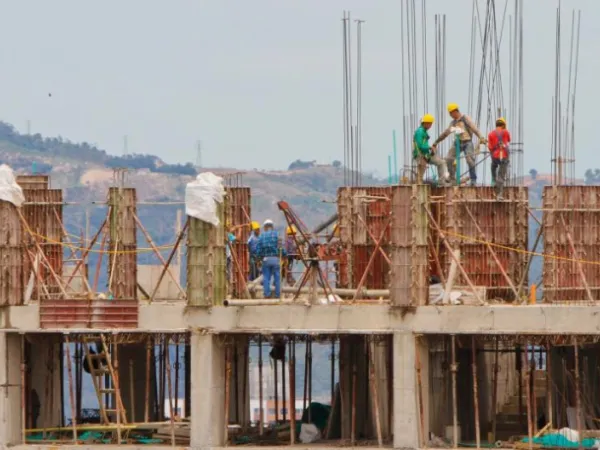
Going to the red notes of the DANE report, it is worth noting that in the second quarter of 2025, the growth of GDP was limited by two key sectors that were mining and construction; The latter being the big surprise, since it was expected to reach a better balance in the April – June period.
On this occasion, the statistical authority said that the exploitation of mynas and quarrys 10.2%fell, affected by the lowest global demand, prices volatility and internal licensing problems; While coal, metal minerals and oil registered marked falls, subtracting half a percentage point from the country’s economic result.
Related information: ‘Not once obtained an answer’: President of the Andi questions ‘silence’ of Petro
The construction also presented negative figures, with an annual setback of 3.5%; in which housing fell 10.6% and buildings 9.7%, reflecting the weakness of the real estate sector. Only civil works showed significant growth, with a 9.6% rise thanks to public infrastructure projects. Even so, the net effect of the sector on GDP was negative, subtracting 0.2 percentage points to total.
In contrast, the manufacturing industries achieved a slight advance of 0.9% and there, the growth in the production of textiles and food partially compensated the falls in metallurgy and oil refining; which reflects a weak recovery, dependent on specific segments, while others industrial subsectors continue to face adverse conditions in the domestic and external market.

The projections suggested that this indicator would be higher than it was finally seen.
Chatgpt image
Investment at low levels
The DANE also said that from the expenditure side, domestic demand grew 4.2%, driven by household consumption and public spending, since private consumption advanced 3.7%, highlighting the increase in durable, semi -dramable goods, recreation, transport and costumes.
Meanwhile, government expenditure rose 3.9%, led by collective spending and Individual market expense, although state market purchases decreased.
It may interest you: ‘The figures show that the change in the strategy worked’: Success group
With regard to investment, it must be said that in the second quarter it showed a moderate growth of 1.7%; that reiterates the shy advances of this indicator, which just exceeded 4%.
The purchase of machinery and equipment rebounded strongly, growing 11.6%, Modernization and increased capacity sign in some productive sectors. However, the investment in housing collapsed 10.6% and the one for other buildings fell 1.2%, reflecting the impact of high interest rates and the weakness of the construction sector.

The projections suggested that this indicator would be higher than it was finally seen.
Chatgpt image
External deficit increasing
Dane data reported that foreign trade returned to play against GDP; Since exports fell 1.6%, while imports grew by 9.7%, expanding the deficit of goods and services from 22.1 billion pesos in the second quarter of 2024 to 33.1 billion in the same period of 2025.
The strong entry of imported goods, especially consumption and transport equipment, contrasts with external sales affected by lower raw material prices and key market weakness.
Important facts: YouTube begins to implement new age verification system with AI
Thus, it can be said that the sectorial behavior of the second quarter reflects a two -speed economy in which a part is oriented to domestic consumption, which benefits from inflation in decrease, the increase in real income and the recovery of consumer confidence; But another, dependent on housing investment and Of natural resources exports, it continues to lag by structural factors.
Meanwhile, agriculture, trade and services support growth, but the decline of mining and weakness in construction and heavy industry limit global expansion.
Daniel Hernández Naranjo
Portfolio journalist