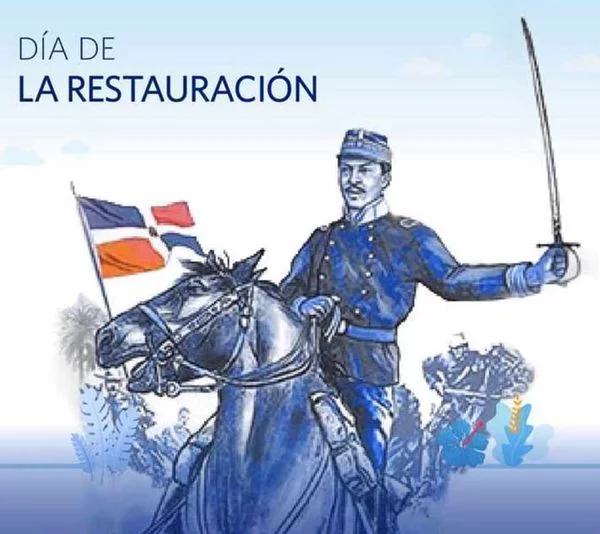
On the threshold of an unexpected political change, a spark of resistance ignites in the heart of the Dominicans. Discover the facts that triggered the Dominican Restoration War:
There is a version according to which in 1861 the Dominican people, fearful of a new Haitian invasion, wanted annexation to any European power, preferably to Spain.
That same version argues that General Pedro Santana, then president of the Dominican Republic, did according to that alleged popular yearning.
Nothing more uncertain, however, it is proven that the annexation to Spain was an act reproved by the generality of the Dominicans since before the fact is materialized.
On March 18, after Santo Domingo made the official announcement, in the town of San Francisco de Macorís an event that had fatal consequences originated: when the troops loyal to the government prepared to arrive the tricolor flag of the trinitarians, to raise the Iberian flag instead, a group of patriots tried to prevent the ceremony of change of flags.
The protest of the people gathered forced the military commander of the people to order the canyon of the square causing the death of at least three Dominicans.
In the city of Santiago, the officials summoned the population to attend the San Luis fortress where the formal announcement of the annexation would be made and the change of flags, but the vast majority of the people did not attend the call.
Shortly after, on May 2, in the nearby town of Moca, Colonel José Contreras – who is said to be almost blind – organized a small group of independentists with the purpose of facing Spanish troops cliffed in the town and proclaiming the Republic.
In view of the fact that the military chief of the people, General Juan Suero, was absent with part of his General Staff, the group of Contreras managed to take the strength and announce his opposition to the annexationist act. But the movement failed in its genesis, since the loyal troops of the Santana government reacted on time and both Contreras and several colleagues were reduced to prison, subject to a war council and sentenced to capital punishment.
At the beginning of June 1861, General Francisco del Rosario Sánchez, José María Cabral and Pedro Alejandrino Pina, heroes of the independence war and those who had been in exile for two years, moved to Haiti and from there organized an armed expedition to combat annexation, which they called “Revolution of the Dominican regeneration”.
With the support of the Haitian government, which presided over Fabre Geffrard, the revolutionaries penetrated Dominican territory along the southern border and circulated several political manifestos denouncing the betrayal of Santana, which Sánchez defined as a tyrant enemy of public freedoms, and calling the people to wield the weapons in order to restore the Republic of February, which had so many of the Republic of February.
Haitian support for the cause against annexation was due to a political strategy (since Haiti’s ideologues and legislators were an opinion that the presence of a European colonial power in the Spanish part of the island threatened its own sovereignty), in addition to no one that was also interested in obtaining certain political and geographical advantages, some of which, given the circumstances, apparently the prosecutor.
But Haitian support for anti -annexation expeditionaries lasted a very short time, since President Geffrard was threatened by a Spanish squad that had orders to bomb the host city of his government, which is why he was forced to abandon his fate to the Dominican revolutionaries.
Already in Dominican territory, the patriots learned that the Haitian government had left the agreed pact without effect, but although there were some defections, such a circumstance did not prevent Sanchez from continuing with their plans. Today we know that this armed expedition failed, but at the same time it had a transcendent impact because its tragic and fatal outcome shuddered much of the national consciousness of the time.
The Valeroso Sánchez, after being ambushed and injured during a brief fray that took place in the region of El Cercado, was arrested along with 20 more companions, and taken to the town of San Juan de la Maguana. Days later, on July 3, they were tried by a war council that without wasting time condemned them to the death penalty. The next day, this is July 4, 1861, they were shot at the San Juan cemetery.
When those deplorable events occurred, and the colonial authorities – with a seat in Cuba and Puerto Rico – had sent a large squad with Spanish infantry and marine soldiers, under the command of Brigadier Antonio Peláez and Campomanes.
Once in possession of the Military Plaza de Santo Domingo, Brigadier Peláez ordered that the main maritime cities of the island such as Samaná, Monte Cristi, Puerto Plata, Azua and, naturally Santo Domingo, were under strict military control. Santiago also, the second city in political and economic importance, was militarized.
The Spanish authorities soon realized that General Santana and his collaborators had lied to the supposed desire for annexation by the majority of the Dominican people. The first armed protests of 1861, as well as the indifferent attitude of the population, including numerous Dominican military gradually relegated to a secondary level within the Spanish military ranks, confirmed those fears and appreciations.
Analogous experiences had the former officials of the missing government of Santana, because to the extent that a new staff from Cuba and Puerto Rico arrived, it had to be appointed in key positions within the provincial administration.
By 1862, Santana, already aware of the serious political error he had made, was specified to resign from the position of Captain General of Santo Domingo; And with not little bitterness he had to recognize the degradation of which he had been subject: if all powerful of an independent republic had been once, he had now become a third category subordinate within the complicated administrative hierarchy of the Spanish crown.
In addition, the government of annexation implemented a series of measures contrary to the customs and habits of the Dominican people, while other measures of tax and administrative nature were adopted that significantly affected the interests of local merchants and the population in general. The situation, therefore, became unbearable.
And after two years, in February 1863, there were three new revolutionary movements that the Spanish forces repressed quickly and efficiently: on the 3rd in Neiba; on 21 and 23 in Guayubín and Sabaneta, simultaneously; and on Santiago.
The most resonance movement was precisely that of Santiago because important people of the town’s merchants were involved in the conjussion and because, in addition, some of its main leaders were sentenced to the gallows.
Although February’s insurgent movements failed to curdle, they planted the libertarian and effervescent germ of the independence revolution. The Spanish authorities sensed or, rather, they knew that it was conspired everywhere; that there was a generalized discomfort and that the vast majority of the people longed for the times of independence.
Thus, on August 16, 1863, fourteen patriots (including generals José Cabrera, Benito Mción, Santiago Rodríguez and Pedro Antonio Pimentel), who were in Haiti managing support for a new armed uprising, penetrated Dominican territory through the Northern border and occupied the hill of Capotillo.
There, without wasting time, they planted the flag of that immortal February, while giving the famous shout of Live the Dominican Republic! Thus began the glorious war of the Dominican restoration, which lasted two years.