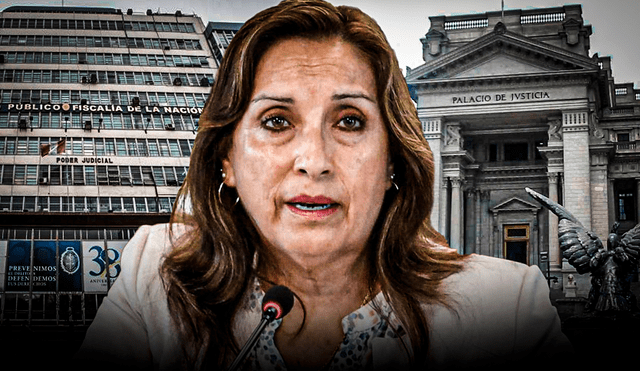
The President Dina Boluarte He promulgated a law that grants amnesty for members of the Armed Forces, the National Police and self -defense committees denounced, investigated and processed by human rights crimes during the internal armed conflict, between 1980 and 2000. The rule is official despite the fact that it disobeys the Inter -American Court of Human Rights (HDI) and has been widely criticized by national and international analysts, experts and organizations. However, this does not imply that it is effective unconditionally.
“The Amnesty Law It is not an autoapplication law. You have to fulfill a legal procedure, ”he says Carlos Riveracriminal lawyer and director of the Institute of Legal Defense. The application of the new rule requires that the defendants present their case and this be reviewed by judges and prosecutors, who are the ones who would finally approve impunity. For its part, the Prosecutor’s Officethrough a message from the prosecutors in human rights and interculturality, he declared that the norm is “legally unfeasible.”
You can see: International and relatives of victims of the Cantuta reject amnesty law: “It is a prize for criminals”
Judges intervention
Complaints for murders, extrajudicial executions, forced disappearances, massacres and violence against children, women and indigenous populations are among the More than 600 judicial processes Ongoing that they would be acquitted with the application of the law. But, for this, those who benefit must request a document called ‘Amnesty exception’, Rivera explains. From this, the judge or court must request a hearing.
“What the military or police asks is that the criminal process be filed. Therefore, that decision necessarily deserves an opinion of the accusing party and the aggrieved party. The prosecutor, the civil party and the lawyer of the defense of those investigated or processed will have to develop a debate in which it is exposed before the judge for what reason the law must be applied,” explains the lawyer. After the debate, the judge would issue a resolution.
The argument of Boluarte in favor of the law, which before being promulgated was approved by Congress, is “to recognize the sacrifice of the members of the Armed Forces, Police and Self -Defense Committees in the fight against terrorism and the defense of democracy.” While hundreds of relatives of victims have been demanding justice for years, the president judged them to be “on the side of those who violated the human rights of our compatriots.”
“The law undermines for decades of efforts that seek to guarantee accountability for the atrocities committed and further weakens the rule of law in the country,” said Juanita Goebertus, director of the Division of Américas de Human Right Watch, one of the international entities that opposes the norm.
You can see: Rosa María about Dina Boluarte and Amnesty Law: “Alberto Fujimori and Montesinos did the same”
A law similar to that promulgated by Fujimori
Rivera recalls that a similar law was promulgated by former president Alberto Fujimori in 1995. “When the amnesty law by Fujimori is promulgated, for the first time in our history, the norm was submitted to a conventionality control. Judge Antonia Saquicuray said it was incompatible with international law, with the rights of victims and that it does not apply,” he says. After ten days, the Congress of that time brought a second rule that exhorted its mandatory compliance, which was widely criticized.
“But that is from 1995. 30 years have passed and they have not passed in vain, at least in terms of constitutional and conventional law,” he observes. The lawyer argues that now the judges have greater instruments of a normative and jurisprudential nature to respond to a request for such magnitude.
“There has been a greater production of sentences that claim that amnesties for perpetrators of crimes against human rights is incompatible with international law. It affects the right of victims, additionally. It also affects the autonomy of the justice system itself,” he says.
You can see: In the same style of the 90s: Carlincura portrays how the Boluarte government operates in decision -making
Prosecutor judges the amnesty law as an unconstitutional
“We reiterate our position that this norm is legally unfeasible, violates essential constitutional principles and contravenes international obligations assumed by the Peruvian State in human rights,” he said Rosario Quico PalominoSuperior Prosecutor Coordinator of the Prosecutors in Human Rights and Interculturality, through a video in X. “This law essentially affects the fulfillment of the duties of investigating, sanctioning and repairing serious human rights violations,” he added.
He also announced that he will formally request the Prosecutor for the presentation of an unconstitutionality action against the law. “The prosecutors of the specialized subsystem, recently gathered for the analysis of this norm, reaffirm the institutional commitment to supremacy with constitutional supremacy, the right to truth, access to justice and the protection of victims’ rights,” he said.