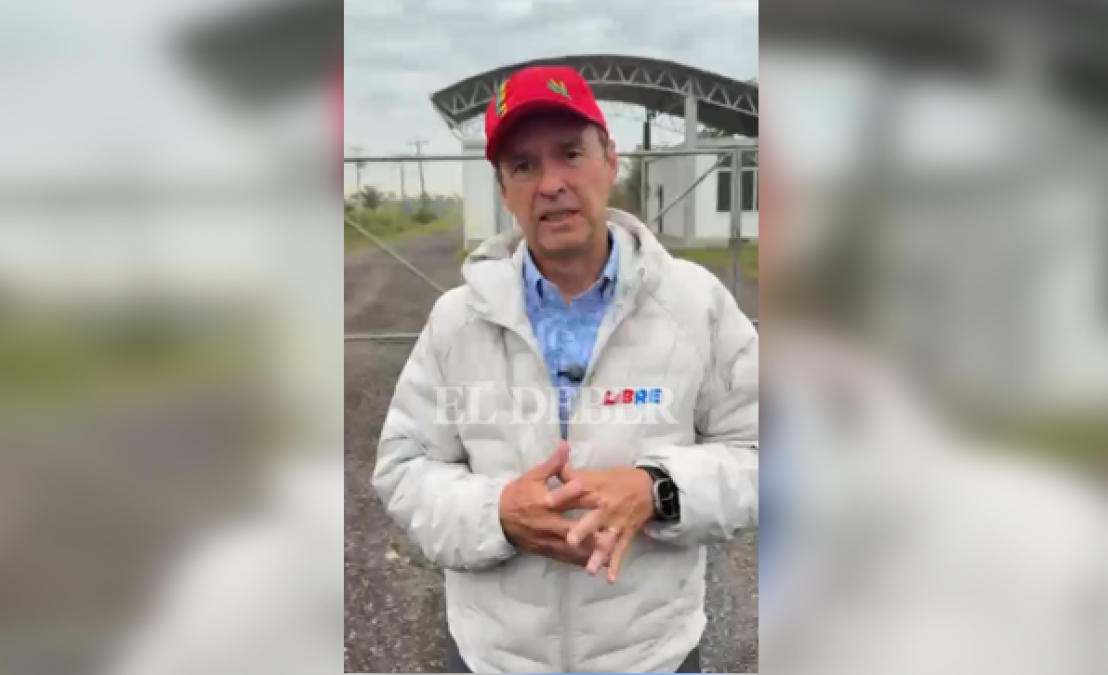
The former president and presidential candidate Jorge Tuto Quiroga took a tour of the Tropic of Cochabamba on Tuesday, where he denounced the closure of Chimoré airport since November 2024 and criticized the lack of state presence in a region that described as a key to the country’s agricultural production.
The visit included stops in Villa Tunari, Shinahota, access to Lauca ñ – where is the refuge of Evo Morales -, the Chimoré airport, Bulo Bulo and Yapacaní, the latter in Cruzanño territory but still considered a political fief of evidence.
Airport closure and political accusations
In a video recorded at 07:15 at Chimoré airport, Quiroga described as a “waste” that an infrastructure financed with public resources remains unusable, supposedly to prevent operations or flights from reaching the area where Morales resides.
“Potosí has no airport and there is one closed since November of last year … even to fumigate legal bananas crops, it cannot be used, less for national or international flights. It is blocked by the fears of a single person, ”he denounced.
The airport, inaugurated in 2007 to improve tropics connectivity and enhance its productive development, has been indicated on different occasions for its low commercial use and for alleged political or non -supervised purposes.
Productive and export chapare
During his passage through Bulo Bulo, Quiroga visited banana plantations and stressed that The region exports around 60 million dollars annually in that fruit. He proposed to open markets such as the European to multiply that figure by ten and turn the tropics into an exporting reference of legal products such as bananas and African palm.
“This is the Bolivia that we want to show the world: to leave behind drug trafficking, generate clean currencies and worthy jobs for all,” he said.
The candidate recalled that in his presidential management the production of cocaine in the area was reduced by 80% and that, at that time, the area cultivated with banana exceeded that of coca destined for drug trafficking.
Criticism of blockages and state absence
Quiroga questioned that the road blockages – refrequent in the region – affect the export of products and He claimed that the State does not guarantee the operation of its main aerial infrastructure.
“In other places so lacking the aerial interconnection, and here it is blocked … another demonstration that there is no presence of the State for airports to work,” he said, promising to reopen the terminal on August 17 if he wins the elections.
In its route closure, the ex -president said that The cochabamba tropics can become a productive engine in the country if it is committed to legal crops, exports and formal employment.
“We cannot remain an enclave where justice is shown and roads and airports are blocked; here bananas, African palm and all forms of production that guarantee opportunities for all can be produced,” he concluded.