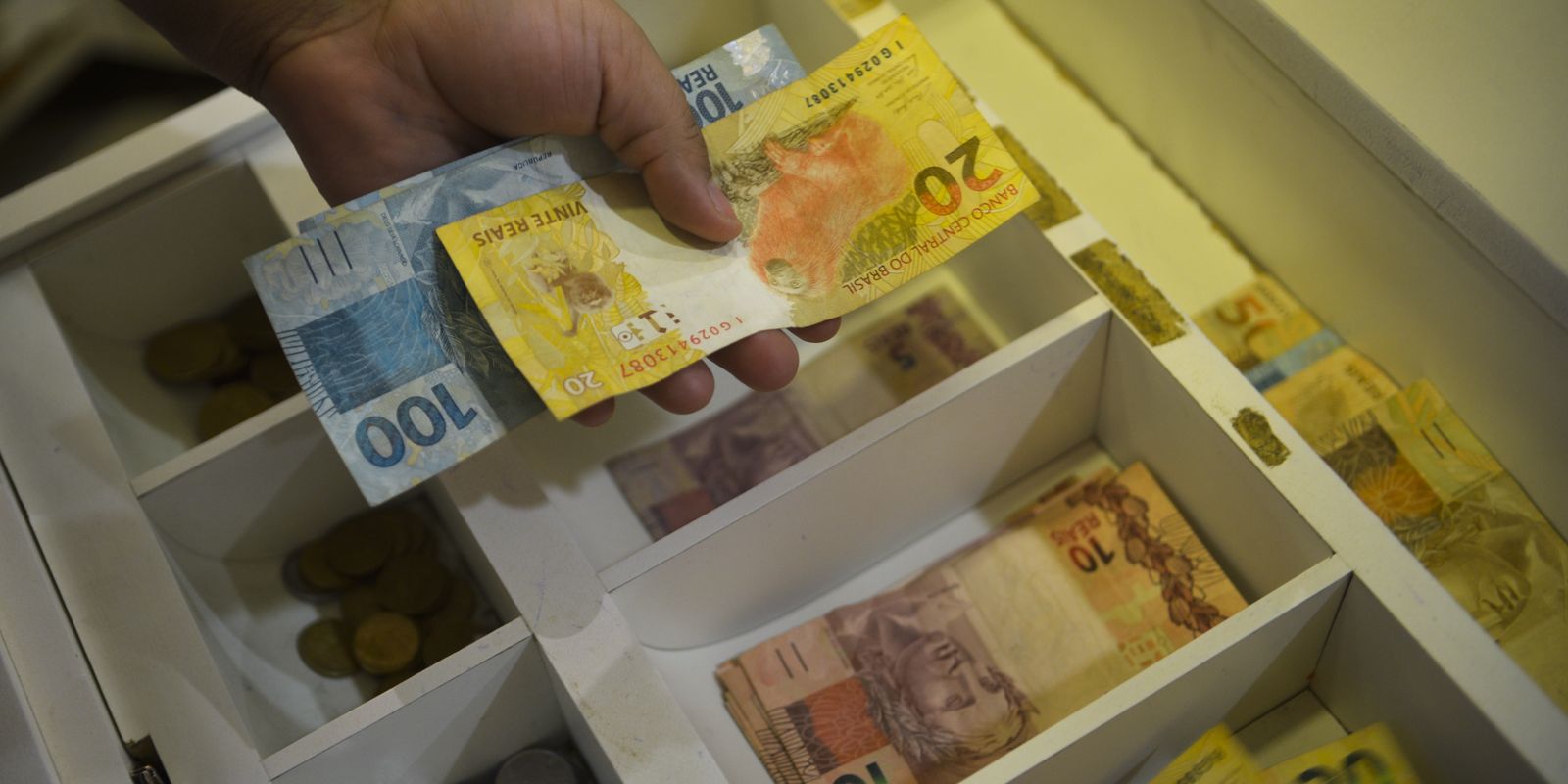
Inflation determined by the National Consumer Price Index (INPC) closed July at 0.21%. In twelve months, the indicator – which investigates the cost of living of families that earn up to five minimum wages – adds 5.13%. The data were released on Tuesday (12) by the Brazilian Institute of Geography and Statistics (IBGE).
IBGE found that in July, food products fell 0.38%. It was the second month in a row of average retreat in food prices. In June the fall was 0.19%.
Since February, when it rose 1.48%, the INPC has five followed falls. See how the groups behaved in July:
- Food and Beverage: -0.38%
- Housing: 0.86%
- Residence Articles: 0.14%
- Clothing: -0.52%
- Transport: 0.19%
- Health and Personal Care: 0.57%
- Personal Expenses: 0.97%
- Education: 0.06%
- Communication: -0.11%
INPC and IPCA: What is the difference?
Also on Tuesday, IBGE announced that the country’s official inflation, determined by the National Consumer Price Index (IPCA)was 0.26%, accumulating 5.23% in 12 months.
The difference between the two indices is that the INPC investigates inflation for families with income of up to five minimum wages. The IPCA, for homes with income of up to 40 minimum wages. Currently the minimum is $ 1,518.
IBGE gives different weights to the surveyed price groups. NINPC, for example, foods represent 25% of the index, more than in the IPCA (21.86%), as the lowest income families spend proportionally on food. From the reverse perspective, the airplane ticket price weighs less in the INPC than on the IPCA.
The price collection is made in ten metropolitan regions – Belém, Fortaleza, Recife, Salvador, Belo Horizonte, Vitória, Rio de Janeiro, Sao Paulo, Curitiba, Porto Alegre – besides Brasilia and in the capitals Goiânia, Campo Grande, Rio Branco, Sao Luís and Aracaju.
Adjustment
In addition to measuring how inflation reaches lower rent families, INPC is widely used as an index for calculating annual wage adjustment of various categories.
The minimum wage, for example, in addition to other metrics, takes the November annual INPC to reach the following year. Unemployment insurance, the benefit and ceiling of the INSS are readjusted based on December’s outcome.
According to IBGE, the investigation of INPC “aims to correct the purchasing power of salaries, through the measurement of price variations of the consumer basket of the lowest yield wage population.”