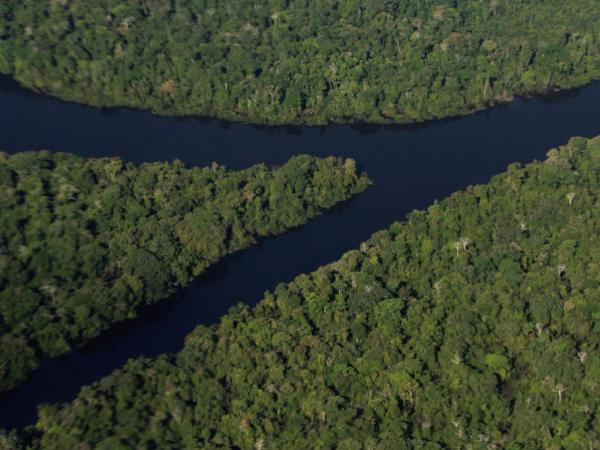
Colombia’s claim to Peru for the possession of A river island on the common border is a consequence of a natural phenomenon due to changes in the Amazon riverbed that have caused the emergence of new formations and that will require a thorough diplomatic work for their solution.
The following are the keys to understanding The origin of this controversy in the triple border area formed by the localities of Leticia (Colombia), Santa Rosa (Peru) and Tabatinga (Brazil).
(See: Peru’s government accused Colombia of aerial incursion on Santa Rosa Island).
Creation of the district of Santa Rosa de Loreto
The Peruvian Congress unanimously approved last June 12 “Creation of the district of Santa Rosa de Loreto in the province of Mariscal Ramón Castilla of the department of Loreto, with its capital the town of Santa Rosa“, which was published on July 3 in the Official Gazette El Peruano.
In response, Colombia presented two protest notes on June 20 and July 3, requesting the reactivation of The Permanent Mixed Commission for the Inspection of the Colombo-Peruana Frontera (Comperif) Well, according to the Ministry of Foreign Affairs, “The island of Santa Rosa is a formation that emerged in the course of the Amazonas River, after the only allocation of islands held between the two countries in 1929“
Therefore, “it has not been assigned to Peru”, according to Colombia, and “a process of assignment of common agreement between Foreign Ministry” must be made. Peru responded on July 4 with another diplomatic note in which he rejected “the terms” of the two Colombian notes and reaffirms “the legitimate rights of sovereignty about the integrity of our national territory.”
(See: Peru clarifies to Colombia that there is nothing to talk about sovereignty of Amazon Island).
The matter went from the diplomatic field to the politician on August 5, when President Gustavo Petro He accused Peru of appropriating “a territory that is from Colombia” on the Amazon river, with the consequent responses of his Peruvian counterpart, Dina Boluarte.
The Solomon-Lozano Treaty of 1922
Colombia and Peru invoke the “Treaty of limits and river navigation between Colombia and Peru“, known as Solomon-loan treatedeither, Signed in Lima on March 24, 1922 and that establishes “the border line” between the two countries, which includes “The ‘Thalweg’ of the Amazon River to the boundary between Peru and Brazil“
The thalweg is a method used to determine borders in international rivers and is defined by the midline of the navigable channel of a water course.
This treaty was ratified by the two countries in early 1928, year in which its technical application began.
The Mixed Demarcador Commission
The mixed commission in charge of demarcating the limits set in the 1922 Treaty He met in Iquitos (Peru) in October 1928, and in February and November 1929 for Define the line where the ‘Thalweg’ of the Amazonas and Putumayo rivers passes.
“A river always has a deeper channel that is where ships move to avoid running. In the Amazon river that deeper channel was defined in the year of 1928 and the deepest channel line was drawn in 1929“The Colombian former chancellor Julio Londoño Paredes explains to the EFE agency.
With respect to the islands of both rivers, the commission defined that “they will belong to the nation whose riverbank is closer to the island.”
(See: How Peruvian is Santa Rosa? This is life on the Amazon Island that Colombia asks for).
Consequently, The Amazonian islands of Zancudo number 2, Loreto, Santa Sofía, Arara, Ronda and Leticia, were assigned to Colombia, while Peru corresponded to the islands Tigre, Coto, Zancudo, Cocoa, Serra, Yahuma and Chinería, the latter in the center of the current dispute.
Santa Rosa de Loreto.
The Rio de Janeiro protocol
This agreement was signed in the former Brazilian capital on May 24, 1934 To restore the bilateral relationship after the war liberated by the two countries between September 1932 and May 1933 and that began when “a group of Peruvian civilians and military occupied the population of Leticia,” explains Londoño.
Said document, also called ‘Paz, friendship and cooperation protocol between the Republic of Colombia and the Republic of Peru’, It ratifies the 1922 treaty, compromises the two countries “not to make war or use, directly or indirectly, the force as a means of solving their current or future problems, as well as” to solve them by direct diplomatic negotiations “or, ultimately, in international justice.
(See: Santa Rosa, the small island that unleashed impasted between Colombia and Peru).
That’s why, The Rio de Janeiro protocol has been invoked by the two countries to justify its decisions at the current situation.

Santa Rosa de Loreto.
Changes in the Amazonas River
The current discrepancy is due to the changes in the course of the Amazon River that since the 70s has accumulated sediments at the height of Leticia, Capital of the Colombian Department of the Amazon, which runs the risk of being in a few years without exit to that water channel due to the emergence of new islets.
The Colombian government believes that “The so -called island of ‘Santa Rosa’, together with other river formations that emerged in the course of the Amazonas River after the only binational allocation of islands (…) carried out in the year of 1929, they have not been assigned to either of the two republics“
However, The Peruvian government considers that Santa Rosa is linked to the Peruvian island of Chinería and, therefore, is subject to its sovereignty and national jurisdiction, which exerts decades in total harmony with the Colombian neighbors of Leticia.
“The law by means of which it creates the so -called district of Santa Rosa de Loreto is a unilateral act of Peru that does not know the binational legal instruments, by incorporating an unpublished island …“He points out a statement read for Petro on Thursday in an act in Leticia.
Petro recognizes that the solution will take time And for now the word will have the comperif, which will meet in Lima on September 11 and 12.
EFE