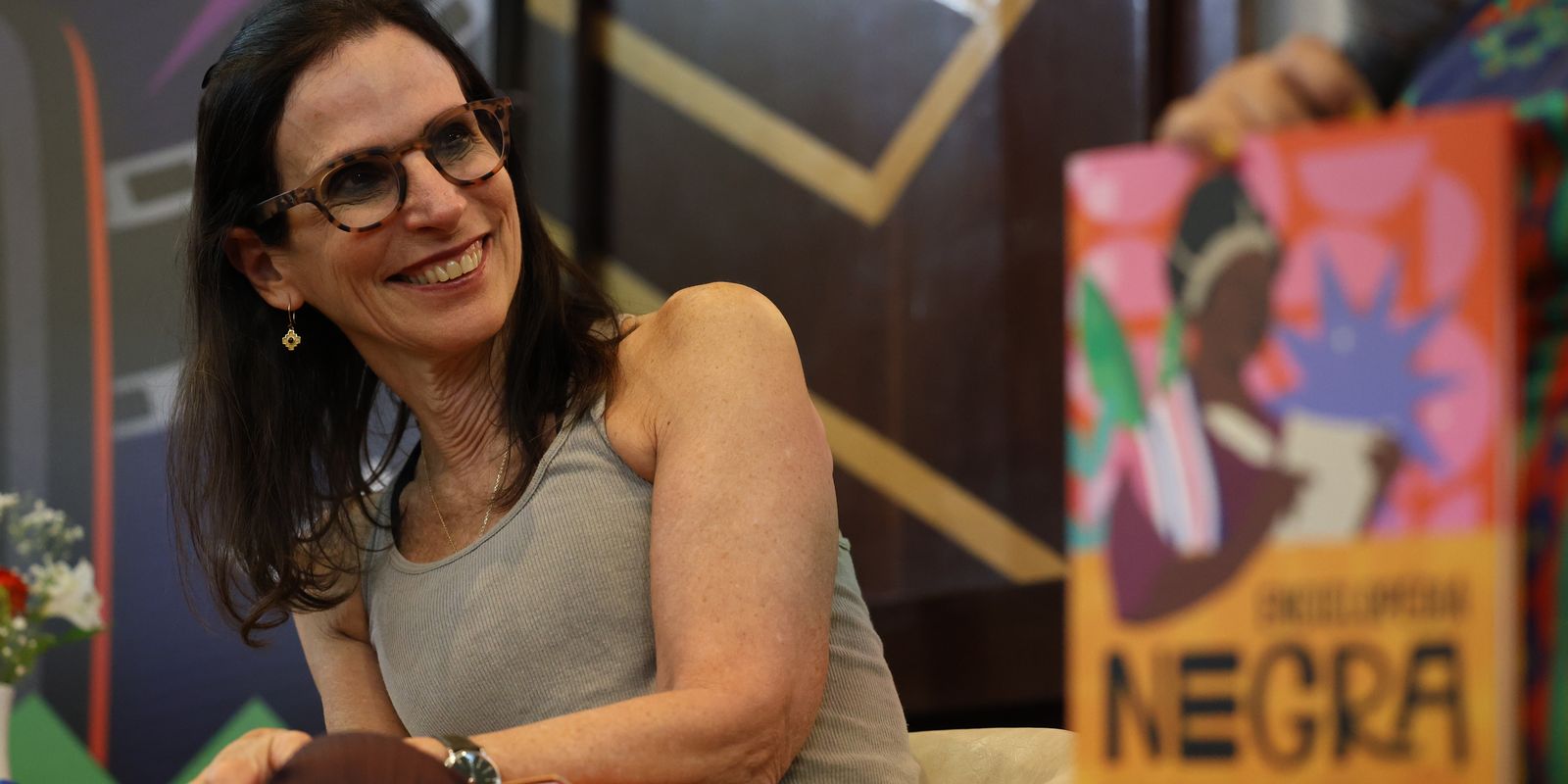
Winner of the Jabuti Award in the Human Sciences category in 2022, the book Encyclopedia Black gathered biographies of over 550 black personalities to restore the importance and black protagonism in the history of Brazil and which had been erased from the official narratives. The book also became an exhibition that passed through Brazil and Portugal.
After the success of this first work, now the encyclopedia also turns to young people. Launched in the middle of this year, the Black Encyclopedia for Young Readers He adapted the text to children over the age of nine and started to present 82 black personalities.
“Now it’s time to invite you to this great party for a wider, plural Brazil and where they fit all and all of us,” says the introduction of the book that was the result of a research prepared by Flávio dos Santos Gomes, Lilia Moritz Schwarcz and Suzane Lopes, who also made the illustrations.
In this new work, young people and children are invited to dive into the trajectories of black personalities that were gathered in themed pairs. The idea is to bring names that are distant in time, but close to their professions, struggles or experiences such as Minas Gerais sculptor Aleijadinho (1730-1814) and painter Maria Auxiliadora da Silva (1935-1974), two great Brazilian artists. Or as the writers Cruz and Souza (1861-1898) and Mário de Andrade (1893-1945).
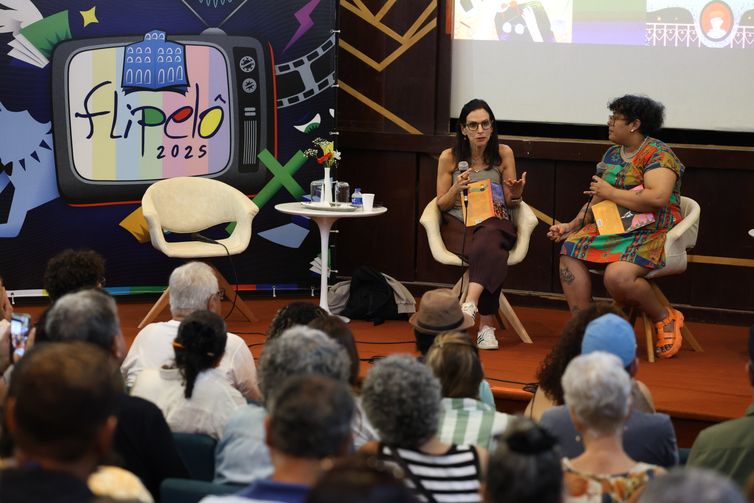
Writer Lilia Schwarcz and illustrator Suzane Lopes during the Pelourinho International Literary Party – Flipelô. Photo: Rovena Rosa/Agência Brasil
In the presentation of the book – which was held within the programming of the Pelourinho International Literary Party (Flipelô), an event that is held in the Historic Center of Salvador – the authors Lilia and Suzane pointed out that, being an encyclopedia, this is a project that is incomplete and endless, and can always present new characters. “The encyclopedia has a starting point, but it does not have an end point, as in the previous book. We want you to see these cases and do not imagine that they are the only ones and the most important. But we want these cases to encourage so many others of your life, your family.
In an interview with Brazil agency Shortly after talking to the Flipelô audience, Lilia Schwarcz said the new book is the result of good acceptance from the previous one. “This Black Encyclopedia project was very well embraced and has been [ainda]. And he created a tremendous capillarity, with many exhibitions and many artists, ”she said.“ And we thought it would be a beautiful idea to pass on to young people, ”he said.
The Black Encyclopedia for young readers, added Suzane, intends to ensure young people’s access to these narratives that are not in the official books. It is, according to her, “a journey of discovery about who we are and who are ours.”
“Black encyclopedia has come in my life impacting. It is a book of great responsibility for us to portray historical characters that were represented by white people in the past or wrong. So, we bring a more faithful, more positive reading of belonging and power of these characters. I think it is very important that the young audience has access, in a playful and positive way, the story itself,” she told the report.
One of the objectives of this project, Lilia points out, is that it reaches schools across the country arousing critical sense and opening the eyes of young people and children for plurality and diversity.
“Increasingly we have critical teachers, teachers who need material, teachers who are embracing the causes and talking about the causes, but often need this type of book to gain more vocabulary, to gain more criticism and to encourage children. So this is a project, as I said, an encyclopedia that has the beginning, but there is no end. The idea now is to reach schools, because, in my opinion, our future is in school.”
Academic jabuti
In this book, she analyzes the social and cultural phenomenon of whiteness from her symbolic and iconographic manifestations. To the report, the historian and anthropologist said that images of whiteness is “a book of life.”
“20 years ago I have been reading images at the University of São Paulo and at least 10 years in Princeton [nos Estados Unidos]. And all this time I was also changing. I was decolonizing the course, I was criticizing the very Eurocentric images, I was calling Brazilian and Brazilian artists and black artists and indigenous artists. This is a 20-year-old book and it took about three or four years to write it because I wanted to put a story that, not being continuous, was a story, somehow, chronological, ”she said.
*The team of Brazil agency traveled at the invitation of Motiva, sponsor and official mobility partner of Flipelô 2025














