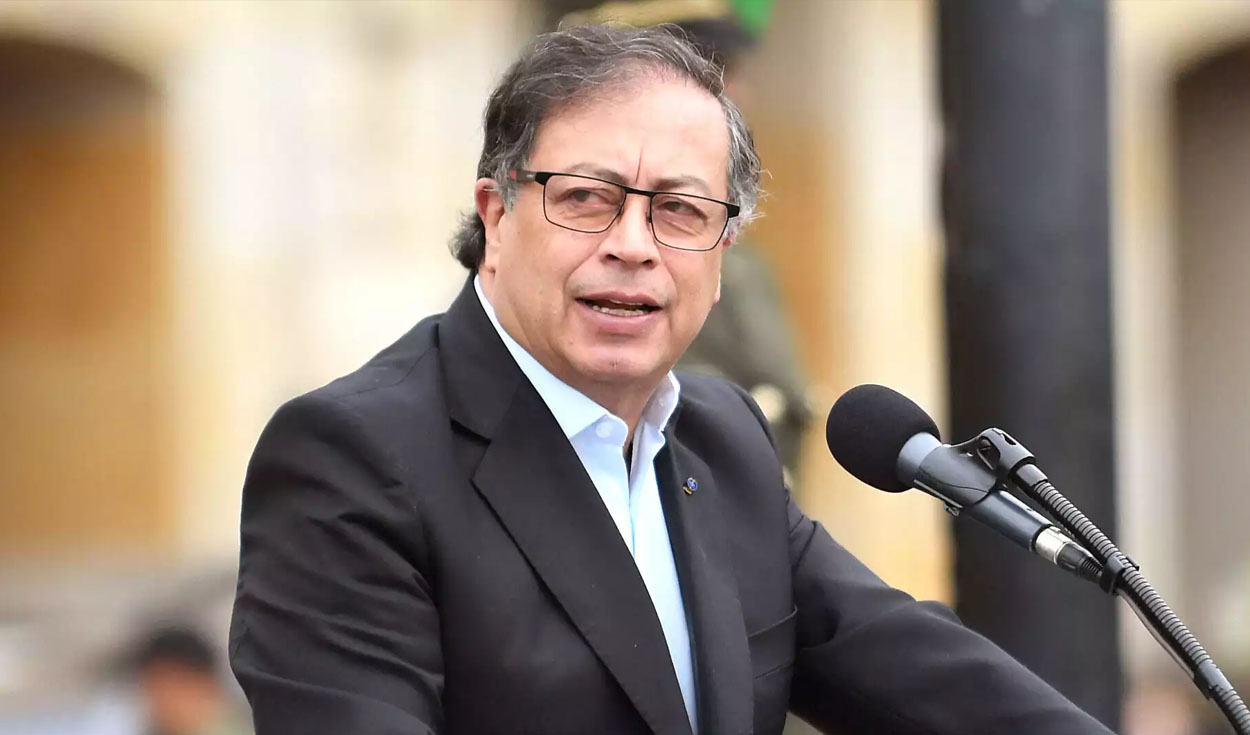
The antidote to cure the absence of the State in the Santa Rosa district (Loreto) was the tweet of a president. After Gustavo Petro accused Peru of appropriating this islandfive ministers went to the place to, symbolically, confirm Peruvian sovereignty. Dina Boluarte did the same announcing, from Japan, that “there is no border conflict” with Colombia.
The Executive’s certainty is accompanied by Congress. Unanimously, the Plenary approved the 18406 and 18407 motions that reject the statements of the Colombian president and support the government’s position.
You can see: Ministry of Education cancels professor for showing very bad conditions of study of children in Amazon communities
So much security is no accident. While the citizens of the district regret the lack of coverage of basic services from the Peruvian State, confirm that they belong to the country of the Blanquirroja. “We have always been Peruvian, but abandonment is total. They have never come to ask what we lack.” Declared for the Republic, Iván Yovera, former mayor of the Santa Rosa Center.
To this is added that, from Japan, President Dina Boluarte reaffirmed the sovereignty of Peru over Santa Rosa de Loreto and asked to remain calm: “It is Peruvian jurisdiction and is within our national sovereignty.”
In response, Petro blamed the Congress for breaking border protocol with Colombia, in an interview for The New York Times. “I am not going to blame the Head of Government because I do not have the itinerary of the bill; it is a decision of the Peruvian Congress that unilaterally breaks the Rio de Janeiro protocol,” he said.
In the midst of that strip and pull by both governments, the feeling has a legal history: the Solomon-Lozano Treaty of 1922 and the Rio de Janeiro protocol of 1934.
International treaties denied any border conflict
In 1922, through the Lozano-Salomón Treaty, Peru and Colombia set their borders, leaving the Chinería Island-in the Amazon River-under Peruvian jurisdiction according to the demarcation works that followed the agreement. However, around the 1970s, a natural phenomenon caused the southern chinería to detach, giving rise to a new formation called Santa Rosa Island, located in front of Leticia, in Colombia. That is the space that Gustavo Petro tries to be attributed, because he supports that he was not initially in the treaty.
For the Ministry of Foreign Affairs of Peru, this formation corresponds to the same territory that was awarded as a Chinería Island in 1929, while its Colombian counterpart argues that Santa Rosa is a different island, arising after the assignment process, and therefore without award to any country.
You can see: Popular Force maintains its leadership in Congress: it will lead key commissions in the last unicameral year
Meanwhile, the Rio de Janeiro protocol of 1934, signed after the armed conflict between Colombia and Peru, reaffirmed the limits established in the Solomon-Lozano Treaty of 1922 and consolidated the Amazon border between the two countries. It was established that the line that delimits territories is Talweg or deeper channel of the Amazon river
Regarding Santa Rosa Island, the protocol does not explicitly contemplate the islands formed after its signature. This aspect is used by Petro in his favor.
From the Peruvian side it is argued that this island was recognized as part of the national territory and that its sovereignty has been exercised continuously since then.
On the other hand, the Colombian government interprets that, according to the 1934 protocol, any new island arising after its signature must be subject to bilateral agreement. In this sense, they object that the unilateral creation of the Santa Rosa district by Peru would violate that treaty, since there was no negotiation.
This argument has already been disqualified by various internationalists.
The internationalist and teacher PUCP, Óscar Vidarte, supported the government’s position: “What Petro said does not have a real legal basis. There is a clear political intention to strengthen his internal image showing a defense of the territory,” he said.
He stressed that although it is not a “real threat or formal ignorance of the treaty”, it is a “speech that can alter public perception if it is not deactivated in time.”
Border protection deficiency and lack of basic services
Fortunately, for the moment, Peruvian citizens have not presented clashes with their Colombian peers. This media toured Leticia (Colombia) and could verify that they also support the position of the Government of Peru. “Santa Rosa belongs to Peru. Since I was born, I have thought that way,” said Raúl Flores, a 26 -year -old lytician.
“He (Gustavo Petro) is misplaced. He doesn’t know what he says. As we live in border (Leticia), we share culture and food with Peruvians,” said Edileusa Nina.
Even so, the Santa Rosa district presents deficiency in border protection and in access to basic services such as water and education. The regional governor of Loreto, René Chávez Silvano, warned that the surveillance positions of the National Police and the Army on the border are abandoned, which represents a strategic weakness for the country. “Our border territories need attention. Logistics investment is required to defend them,” he claimed in dialogue with this medium.
Regarding the access of basic services, the district ofSanta Rosa It lacks drinking water for its entire population. It has an installed treatment plant during the second government ofAlan Garciathis only supplies 30 % of more than 3 thousand inhabitants. This generates that many residents buy table water in Leticia, Colombia, either in bottles or in Sachets. The cost of a 5 -liter bottle borders 4 to 5 soles, which represents a considerable daily expense for families that consume between 10 and 15 liters per day.
The only health establishment in Isla is of noble material, but is not equipped, according to Yovera. “The conditions are precarious. They currently give references when medical attention is needed. Most people go to Tabatinga, inBrazilsince attention is faster and efficient, ”he said.
In the same way, the only school in the Santa Rosa district that includes the initial, primary and secondary levels was rebuilt seven years ago. Today I no longer supply more students. “The capacity is no longer enough for studies. Expansion is needed,” said the former mayor.
All these absences, finally, summarizes them very well Mauro Rodríguez, resident of Santa Rosa. “We seem invisible. Here there is no hospital, there is no complete school, and the authorities only arrive when there are cameras.”