Cataneo, a member of the Tio Taicuba, was a endorsement of Cuban popular music. ‘Cubanet’ talks with her daughter.
Havana, Cuba. -On July 11, 2013, he died, at age 96, an endorsement of Cuban popular music: Barbarian Alfredo Valdés-Cataneo Esquivel, better known for his artistic name, Alfredo Cataneo, member of the Tio Taicuba trio.
I had the joy of meeting Cataneo, because I was my neighbor for 50 years, in addition to my father’s great friend. His daughter Gladys agreed to answer this questionnaire about aspects of the personal and professional existence of Cataneo.
“Where was Cataneo born and how was your childhood?”
―It was born on December 4, 1916, in Jovellanos, Matanzas, in a neighborhood that Bemba tells him, where the Afro -Cuban religion had enough roots. His family was poor. There were six brothers, two females and four men. As a child, it was shoe shower and distributor of hateful canteens. From this last job they thrown him out because he ate the fried papitas of the canteens. He was so thin, that he was jociously called by his friends “Alfredito the Tísico.”
“How did you start in music?”
“Since she was 16, she sang tangos, who made a rage in Cuba at that time.” In Matanzas he made a duo with Evelio López Gavilán. After Manolito Rebull joined them, they came to appear at the Matancera station CMGH.
In 1936 he arrived at CMQ Radio by the singer and announcer Manolo Serrano. Tony Álvarez would interpret Payadas Argentinas, in a program where he was also Olga Chorens.
From 1939 he integrated the trio of tangos the harmonics, which acted in the RHC Cadena Azul de Santa Clara and sang with the La Plata Orchestra directed by Lorenzo Pego. In Havana, he also appeared at the same station, and in the Supreme Court of Art with the aforementioned orchestra. He would become an exclusive artist of the firm Cigarrera royalties the wedge. Already for the 40s, and the acquired fame, he was always dressed in white. In 1941 he won first prize in a contest for tango singers.

“How did you go to traditional Cuban music?”
―The Argentine music began to decline and, on August 15, 1941 (and clarified this data as the encyclopedia Ecured It has errors), founded the Taicuba quartet. They were López Gavilán, guitar and voice; Cataneo, accompanying guitar and third voice; Baz Tabrane, second voice, requinto; and Héctor Leyva, accompanying guitar and raw voice. They debuted in the program Bacardi. Later Gavilán separated and continued his way with a tango group. The Taicuba trio was then, who interpreted compositions by very recognized authors of our traditional music. He had a long career for more than 40 years, with many and successful presentations in different spaces on radio and television in Cuba, among them: Together at 9:00, Recital and Cuba album. It also appeared in the Adolfo Guzmán and other spaces contest.
Meanwhile, abroad was in the famous The Steve Allen Show of the CBS that was broadcast in the United States from coast to coast, in addition to Spanish television, the Italian RAI, and numerous more scenarios.
The trio visited the United States, Venezuela, Panama, Mexico, Sweden, Spain, Finland, Italy, Canary Islands, Palma de Mallorca, Holland, England, Germany and Monaco, as well as cities of France and other places in the world.
Its members also ventured into the cinema, in the movies Palmar romance, A Galician in Havana (with Niní Marshall) and in King and Queen.
Cataneo obtained more than 32 distinctions and recognitions, among others: Medal for the glory of Cuban culture, Raúl Gómez García, the tropical gypsy, the microphone of the radio, and as something special a recognition in the 86th anniversary of its birth, for providing for more than 25 years of uninterrupted work, the formation of values through music.
When health did not allow him to continue presenting himself at the “El Floridita” restaurant bar, Cataneo decided not to continue, even if he never retired. The trio disintegrated in 2005.
“Take me out of your life as a father, husband, friend …”
“As a human being and father, for me she was the best in the world.” Wednesdays I was always, with my mother, to the scholarships where I studied without missing once. If I’m still alive, it was thanks to him, because in 1975 I got a serious sick and he immediately took me to the Pediatric Hospital of Centro Habana, in the car of the late Dr. Abelardo Bush, and there they saved my life.
He was cheerful and very Jaranero. He was the greatest spontaneous humorist in Cuba. His jokes and jokes made the neighbors laugh out loud. People surrounded him to listen to him. He was very dear in the neighborhood; I always had a kind phrase for everyone. His rest day occupied him to call his friends and know about them.
My dad met my mother, Gladys Ferrán Morales, in a radio program, when she was 17 years old. Love arrived, and married on November 30, 1959, in the apple of Gomez, to the sound of the beautiful Tango No. 1. As witnesses of their wedding they had the great artists Guillermo Álvarez Guedes, Tony Álvarez and Olga Chorens.
I felt great love for animals. He paid operations, sterilizations, and provided food to street dogs and cats.

“He says the saying that” of such a stick, such a splinter. ” What his father bequeathed?
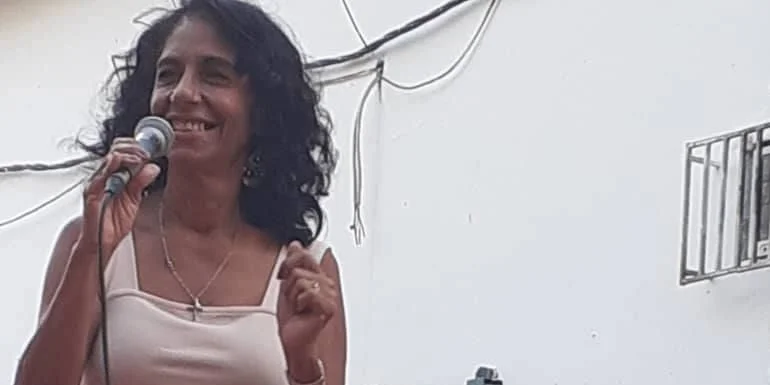
“My main influence in music comes from my father, but my grandmother Ana Luisa Morales Govín contributed, because she was a pianist and composer. At home we were always singing together, and insisted that I duo with a second voice. I touched ear piano since the age of five. I studied that instrument, I have composed songs and instrumental music since the age of 13. With that age he listened to Master Eddy Gaytán, and said he had a good start. I have sung with the Palmares de Cuba quintet and belonged to the CTC choir (Central of Workers of Cuba) for three years.
I composed a song dedicated to my father called Many more years And another to my grandmother who titled Lady Color of the Night. In total I have composed more than 50 songs and I have an record recorded with 10 musical numbers.
I adopted Gladys Cataneo as an artistic name, although my name is Gladys Caridad Valdés Cataneo Ferrán. I was born on January 24, 1964. I am a degree in physical culture, but I am the fruit of my father. Music is my life, it gives me wings, and flight.