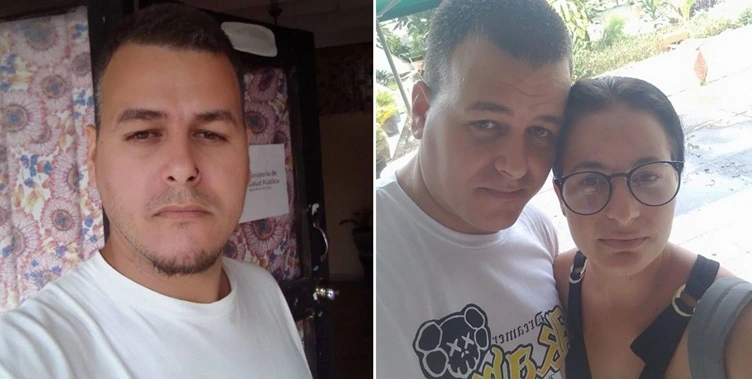
Aroni Yanko García Valdés, a nurse from Santa Clara, regained freedom after serving 18 months in prison for the crime of aggravated contempt.
Madrid, Spain.- Cuban nurse Aroni Yanko García Valdés was released this Monday, August 4 after fully complying with an 18-month prison sentence for the “aggravated crime”, after publishing a meme with images by Miguel Díaz-Canel, Raúl Castro and Manuel Marrero Cruz on Facebook.
García Valdés, 31 and resident in Santa Clara, was arrested on April 3, 2024 after going to a police citation. He worked as a nurse in the Polyclinic weeds and is the father of three children. His wife, Yunisley Suárez Rodríguez, denounced from the beginning the irregularities of the process, and has now confirmed the release in statements to Martí News.

“This Monday, August 4, she was released from prison for compliance, since they never wanted to give her probation,” said Suárez Rodríguez, who celebrated on social networks the return of her husband to the home: “Finally in freedom. Finally, together. Many thanks to all the people who accompanied us in this painful process.”
The meme by which It was prosecuted He showed edited images of the Cuban leaders and was considered by the Prosecutor’s Office as a serious offense against “the figures of the revolution.” During the trial, held in the Municipal Court of Santa Clara, García Valdés’ defense said that the publication did not constitute a crime. Despite this, the Court issued a conviction and refused to grant it probation, not even by fulfilling half of the penalty.
During the time the nurse remained in prison, his family was a victim of harassment. In February 2025, García Valdés’ house was burned in the early morning while they slept, which caused important material damage. Although his wife denounced the fact, the authorities did not offer protection or clarified the attack. She said then that her family had also received threats from state security.
The case of Aroni Yanko García Valdés adds to the long list of Cuban citizens convicted of exercising their freedom of expression in social networks, in a context of growing repression against activists, journalists, artists and common users who criticize the regime.














