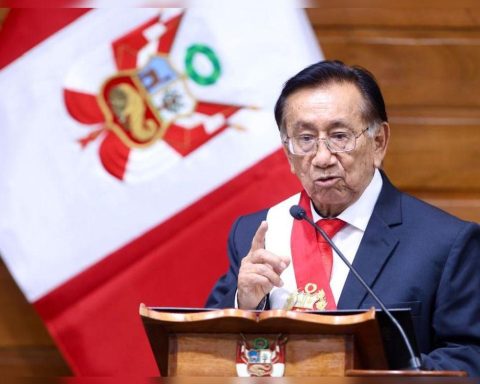
He Constitutional Court (TC) declared the demand for unconstitutionality that filed the Prosecutor’s Office next to the La Libertad Bar Association against the Law that empowers the National Police to lead preliminary research. While the resolution confirms that the conduction of preliminary investigation remains the competence of the Public Ministry, it also validates that the police act from the first moment a crime is known.
This decision substantially modifies the balance between the institutions that lead the criminal prosecution. In practice, it opens the way to greater operational autonomy of the PNP in a key stage of the process, under what the TC calls ‘legal conduction’ of the Prosecutor’s Office. This formula has been questioned by agencies and jurists, who warned a setback towards an inquisitive model.
The lawsuit filed by the Prosecutor’s Office, indicated that the law approved by the Congress and the Executive denatured its constitutional functions as the conductor of the criminal investigation since its inception, as indicated in article 159, subsection 4 of the Constitution. The entity also warned that the door opened that the PNP qualifies crimes, interrogates witnesses and issues reports with legal value without its effective supervision.
Despite the support of the entity, the TC concluded that the reforms do not involve an invasion of competences, but respond to a functional redistribution that promotes an alleged cooperation between both institutions.
You can see: Comptroller starts research on millionaire purchase of luxury vehicles for high controls of the PNP
TC argues that driving remains in the hands of the Prosecutor’s Office
The TC seeks to support, with this resolution, the reforms introduced by Law 32130 and the legislative decrees 1532, 1604 and 1611. These grant the PNP new powers in the initial phase of the criminal prosecution. However, according to the Court, these do not imply a assignment of legal conduction: the Public Ministry retains the power to grant value to the investigations carried out by the PNP, and the police report, precise, is not binding.
The TC argues that the role of the Prosecutor’s Office remains intact, both in the preliminary sub -cape and in preparatory investigation. According to the document, the PNP must account for the proceedings made to the Public Ministry, who will decide how to intervene. The police action, the court adds, must be governed by coordination protocols elaborated between both institutions, under the principle of functional collaboration, but without subordinating.
Despite these clarifications, the ruling recognizes that the changes must be applied in a way that respect the Constitution, so it requires an interpretation in accordance with the fundamental rights of those investigated.
You can see: Judicial Branch will decide if it includes popular renewal in case of illicit campaign contributions of 2014
An institutional setback disguised as efficiency
The Public Ministry said that allowing the police to investigate without fiscal mandate, qualify crimes and take statements without supervision, directly contradict the principle of legality and the current constitutional design. Although the TC ensures that these powers do not limit fiscal control, it worries that, in practice, police prominence derives in decisions already taken before the prosecutor intervenes.
The decision of the TC raises questions about the real capacity of the Public Ministry to guarantee impartial investigations. Although it is stated that prosecutors retain legal conduction, the risk is reduced to a merely symbolic role, while the PNP concentrates the operational power in the most sensitive phase of the entire criminal process.