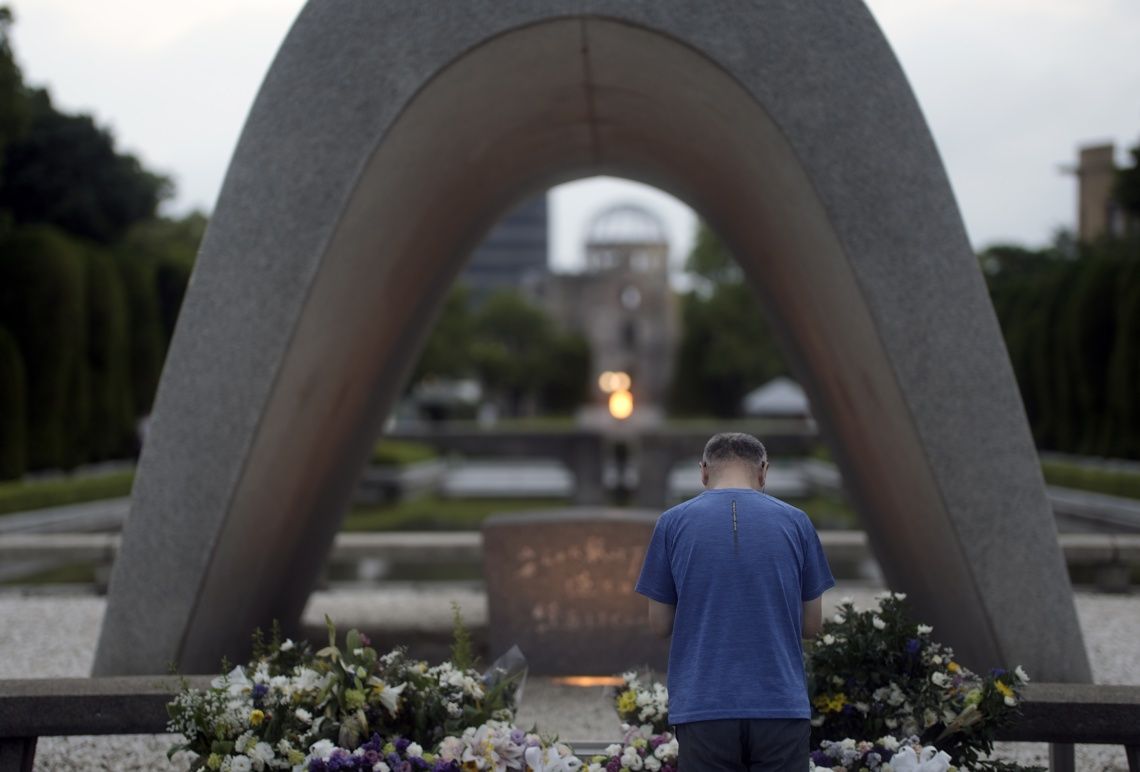
In a climate of recollection and expectation, the Japanese city of Hiroshima Ultima the preparations for the 80th anniversary ceremony of the United States atomic bombardment, which will take place this Wednesday, August 6 and that instantly charged the life of between 70,000 and 80,000 people.
The act, which will attend representatives from 120 countries and regions – a record figure – aims to send the world an unequivocal message against nuclear weapons in the midst of an international scenario of growing risks, where there is talk of a third worldwide world of a nuclear nature without the consensus that there will be no victors.
Security will be this year a central issue, given the presence of Japanese leaders and personalities together with diplomatic representatives of nations such as the United States, Israel, Palestine and Ukraine, among others.
As a protection, on Wednesday, access to the surroundings of the Memorial de La Paz Park, epicenter of the ceremony and sanctuary of the collective memory of the city will be restricted.
A city in trance
On the eve, Hiroshima is flooded with activities focused on peace and memory: conferences, concerts, a marathon for peace and, as is tradition, the emotional ignition of lantern floating on the Motoyasu River.
Thousands of people express their wishes of a world free of nuclear violence, in a delicate choreography of memory and hope.
While dozens of workers fix the last floral details around the Hiroshima Cenotaph, school musicians rehearse under the gaze of Mayor Kazumi Matsui.
Foreign visitors, many of them surprised by the magnitude of the event, share space with whom they arrive to pay tribute to the victims and learn, first hand, the voice of the survivors themselves: the Hibakusha.
Testimonies of the Hibakushathe living voices of horror
Although the bomb thrown by the United States on Hiroshima on August 6, 1945 killed tens of thousands in the act and many more in the following months, several thousand managed to survive horror, dragging with them physical, psychological and social sequelae for life.
The number of Hibakusha – Japanese third that means “survivors of the atomic bomb” or “people affected by officially recognized atomic radiation,” he descended this year below 100,000, a symbolic figure that adds urgency to the transmission of their stories.
Many of them, such as Kunihiko Iida, 83, have decided to take advantage of their last years to share their experience with visitors and students, both inside and outside Japan.
Iida, volunteer of the Park of La Paz, remembers with crudeness be a few 900 meters from the hypocenter when I was only three years old: the explosion, the abrupt silence, the blood, the death of her mother and sister just a month later for the ravages of radiation. “The only way to peace is the abolition of nuclear weapons. There is no other way,” he insists.
On the other hand, Fumiko Doi, 86, and survivor of Nagasaki’s bombing, remembers how his life was marked by the moment when the train on which he was traveling was delayed, moving away from the epicenter of the tragedy.
Years later, and motivated by Fukushima’s nuclear disaster, Doi decided to break the silence to alert about the destructive power of these weapons. “If one falls in Japan, we will be destroyed. If they are used more throughout the world, it will be the end of the earth,” he warns, underlining the urgency that the new generation does not forget this legacy of pain.
The emotional weight of memory, persistent fear of discrimination and even guilt accompanied numerous Hibakusha For decades, many of which were socially marginalized or blamed the radiation of hereditary problems in their families. But on this special date, his testimony resurfaces strongly and travels the world in search of a commitment renewed by global disarmament.
https://www.youtube.com/watch?v=kgbopndlbj8
Invisible wounds
The atomic bombs of Hiroshima and Nagasaki assumed a before and after for humanity, not only because of the immediate magnitude of death and destruction, but also by the devastating medical and human consequences that persisted for generations.
More than 200,000 people died in both attacks at the end of 1945, but the effects extended much further.
Among the short and long term sequelae are documented serious burns, blindness, eye injuries, acute radiation syndromes (vomiting, diarrhea, hemorrhages, alopecia), and a substantial increase in cases of leukemia and various types of cancer, especially lung, liver, stomach and colon.
Studies of the Japanese Red Cross and Radiation Effects Research Foundation confirm considerably superior rates of cardiovascular diseases, strokes, damage to tissues, immunological alterations and posttraumatic stress, even decades after exposure.
Stigmatization and fear of transmitting these evils to the offspring have been a heavy family and social burden.
Although recent investigations point out that the magnitude of genetic damages has been somewhat less catastrophic than initially believed, the Hibakusha continue to live under the shadow of possible late sequelae, including recurring anxiety and depression.
The United States has never offered a formal apology for the atomic bombings of Hiroshima and Nagasaki in 1945.
The predominant narrative is that the attack was justified to accelerate Japanese surrender, although there is still a historical and moral debate on the proportionality and impact of nuclear bombs on an exhausted Japan.