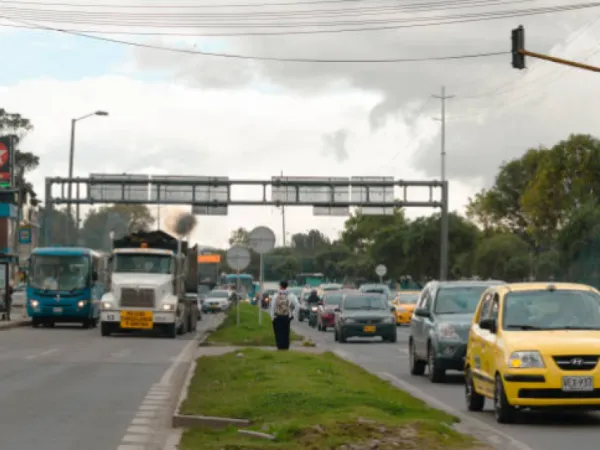
The monitoring of the indicators of the transport sector within the National Development Plan (PND) 2022-2026 reveals significant advances on some fronts, such as non-concessioned primary roads and access to sea ports, but also shows worrying delays in aspects such as road safety, reduction of polluting emissionsnon -concessioned airport infrastructure and load logistics.
Can read: At least two more trains of the Bogotá subway would be dispatched from China this year
José Stalin Rojas, director of the Logistics and Mobility Observatory of the National University of Colombia, said “The advance of the transport sector to the PND goals is not homogeneous. While the progress can be highlighted in the primary roads, the access channels to the maritime ports and the air services routes, the delay in the issues of death by road accidents at the national level and the decrease in logistics costs is worrying.”
According to national planning data, with a cut to December 2023, the death indicator in road accidents shows an indicator reduction by 4.70%, still distant from the goals set. In the same way, the percentage of tons of CO2 mitigated by the transport sector reaches only 24.75% as of December 31, 2024. For Rojas, “In the issues of non -concessioned airports and decreased CO2 emissions of the transport sector, progress has been made, but not enough to achieve the goals proposed in the PND.”
Other indicators with 2025 cut indicate that, for example, The progress in the rehabilitation and maintenance of non -concessioned primary roads reaches 139.88% with a cut to May 31, and its improvement reaches 74.72%, as of June 30, while LAs essential air service routes in operation record a progress of 77.08% at the end of last June.
However, the figures are not equally favorable in Regional roads and ancestral roads, whose progress barely reaches 24% with a cut on June 30, as well as in the physical infrastructure of non -concessioned airports, whose progress is void (0%).
Also read: Bogotá Metro: When will the first train that already left from China arrive in Colombia?
Regional roads and ancestral roads, whose progress barely reaches 24%,
Istock
Logistic costs and renewal of the cargo automotive park: without incentives or results
From the perspective of the load transport sector, the operational and financial challenges are significant. Nidia Hernández, Executive President of the Colombian Federation of Cargo Transporters by road (Colfecar), said that “From Colfecar we see with concern that despite the fact that Colombia has the second oldest automotive park in Latin America, the lack of incentives persists to achieve the renewal of the cargo automotive park towards cleaner technologies and that allow lower fuel consumption.”
One of the critical points indicated by Hernández is the loss of the benefit of VAT CREI for small owners, and the proposal of the Ministry of Transportation of increasing the contributions to the Fund for the Promotion of Technological Ascent (FOPAT). As explained, the fourth draft modification to Decree 1079 of 2015 proposes to raise this contribution “From 0% to 25% for vehicles under 10.5 tons and 15% to 25% for vehicles greater than 10.5 tons, which would definitely paralyze the renewal of the cargo car park.”
Logistic costs represent another pressure factor. In the National Logistics Survey 2022, the percentage of logistics cost on sales was 17.9%, compared to a 13%goal. Since then, Hernández explained, “The cost of transport has only increased.” He explained that “The increases in the last year and a half in the main items of transport grow to more than two digits: the fuel by 16%, the wages by 22%, the tolls by 30%, added to the reduction of the workday that has increased the cost of the extra hours.”
In addition, he warned about factors not included in the calculation, such as “The hidden costs derived from the more than 2,115 blockages for dissatisfied communities in national roads from January 2023 to date, the wave of insecurity that does not allow 24 hours to travel in several departments, armed stoppages, terrorist acts against the transport sector and road closures due to infrastructure failures or causes of nature.”
The union leader also highlighted the need to advance infrastructure and review the normative loads: “We must continue working on improving road infrastructure, facilitating that they continue to advance and that the works are completed, reconsider the hyper regulation that has exacerbated in recent years and that makes transport operations more complex and expensive. The most important thing is that the State provides security guarantees to be able to exercise an activity that is strategic because it allows the country’s supply.”
It may interest you: On rails?: How is the government plan going to reactivate iron system

Port access channels, aerial infrastructure and iron network: pending challenges
Istock
Port access channels, aerial infrastructure and iron network: pending challenges
Juan Martín Caicedo, president of the Colombian Chamber of Infrastructure (CCI), presented a detailed analysis of several indicators of the sector, through the program “Infrastructure.” Although he recognized important advances, he warned about the need to look beyond the general figures.
In the case of access channels to sea ports, the progress is 100% according to the official report as of June 30, and about it, Caicedo said that “Such result must be read cautiously.” He explained that “The indicator does not show a worrying reality that the channels of access to the ports of Barranquilla and Buenaventura face today, where it is necessary to urgently promote the allocation of resources that allow to meet the growing dredging needs, given the current levels of sedimentation.”
On the Barranquilla Canal, the union leader indicated that “It is required to advance promptly in the allocation of additional resources to guarantee dredging in the remainder of this validity, as well as ensure the resources projected for 2026”. As for the Buenaventura channel, he said “It is essential that this government culminates the technical studies, protocolize previous consultations, modify the environmental license and define the source of financing for its effective tender and execution”. He added that “This strategic project for our country does not have resources allocated in the draft General Budget of the Nation 2026”.
Regarding the infrastructure of non -concessioned airports, the CCI warned that the advance is void and “It reveals apparent administrative, budgetary and technical deficiencies within the Invías and the aerocivil that prevent the effective execution of these projects.”
As for the iron mode, The structured and/or awarded railway indicator reaches 28.92% at the end of last June, mainly represented by the La Dorada – Chiriguaná project, Awarded through Private Public Association. Caicedo stressed that, “While it is true that in some cases the iron system turns out to be efficient, this must be seen as a complement not a substitute for other transport modes, in particular, the road”. He pointed out that “The structuring of these ferrous projects must take into consideration the generation of load so that it is, in effect, sustainable over time.”
Paula Galeano Balaguera
Portfolio journalist