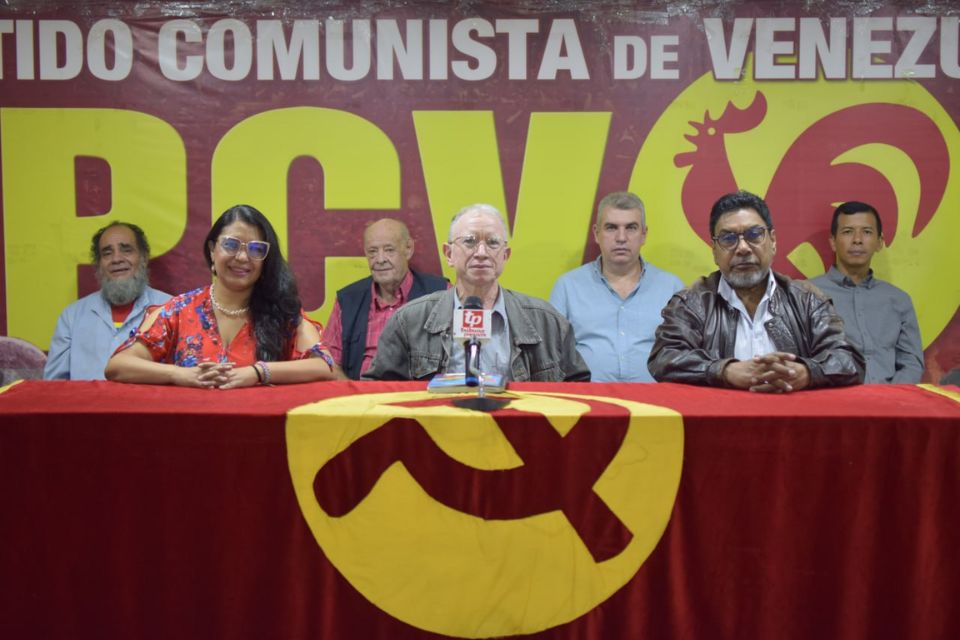
The political bureau of the Communist Party of Venezuela said that “agreements are being signed on their backs to the people and the most serious thing is that those who should account for it with cynicism and threats”
Pedro Eusse, a member of the Political Bureau of the Communist Party of Venezuela (PCV), warned about the irregular and harmful character for the national sovereignty of the announced return of operations of the American oil company Chevron.
“It is alarming that agreements of this size are known by informal routes and do not undergo public scrutiny,” Eusse warned in a news conference.
The communist leader criticized the recent statements of the vice president of the United Socialist Party of Venezuela (Psuv), Diosdado Cabello, who described as “stupid” to whom they question the conditions of the agreement with Chevron and said that it was a “private” agreement between the administrations of Nicolás Maduro and Donald Trump.
«We remind that citizen that the Constitution establishes that any contract of public interest must be debated and approved by the National Assembly. It is not a private business, ”Eusse said.
*Also read: Venezuela is among the worst countries to exercise labor rights, according to CSI
The PCV denounced that the current government arbitrarily manages and opaque the economic issues of public interest, acting “as if it were its private farm.”
In that sense, he reiterated his rejection of the so -called “anti -lock law”, which Eusse described as “an unconstitutional instrument that has served for looting, corruption and to hide agreements that injure national sovereignty.”
“Here are signing agreements on their backs to the people and the most serious thing is that those who should give account dispatch it with cynicism and threats,” he said.
The Communist Party urged the popular and union forces to “strengthen” the struggle for the restitution of the full validity of the Constitution and by an oil policy that guarantees transparency, public debate and the protection of national interests.
*Journalism in Venezuela is exercised in a hostile environment for the press with dozens of legal instruments arranged for the punishment of the word, especially the laws “against hatred”, “against fascism” and “against blockade.” This content was written taking into consideration the threats and limits that, consequently, have been imposed on the dissemination of information from within the country.
Post views: 149