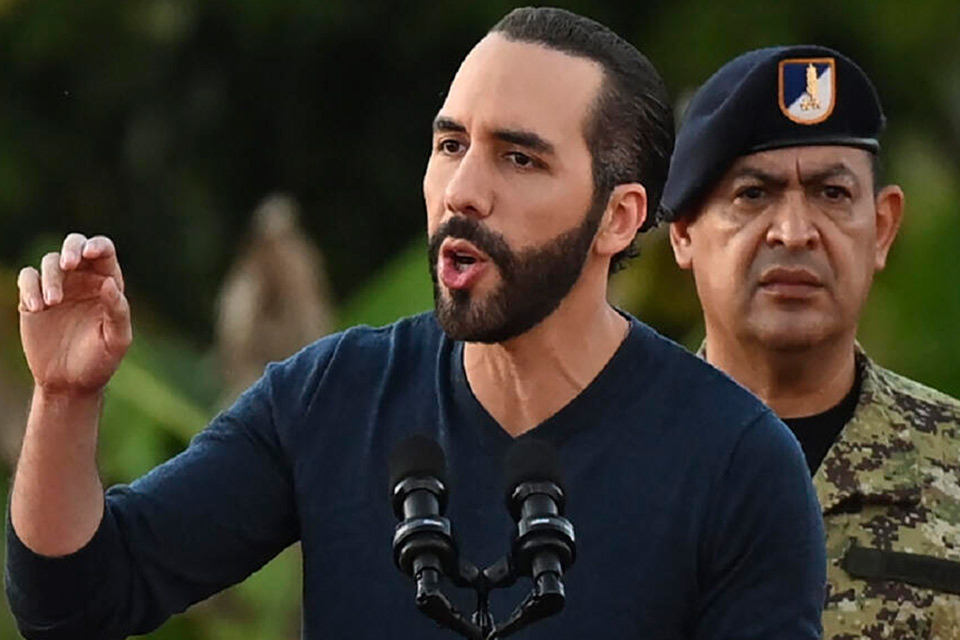
Organizations make an urgent call to the international community and the human rights protection bodies to “maintain active surveillance over El Salvador, urge the rule of law and compliance with international human rights obligations”
A group of more than 20 organizations, among them the Center for Justice and International Law (CEJIL), the Washington Office of Latin American Affairs (WOLA) and the Robert F. Kennedy Human Rights Foundation, expressed on Monday, August 4, what happens in El Salvador, where Congress approved the indefinite re -election, “it is part of a pattern of strengthening of the authoritarianism.”
The Legislative Assembly, dominated by the official party new ideas (Ni), approved and ratified, in a single day on July 31 without an previous analysis or debate, the reform to articles 75, 80, 133, 152 and 154 of the Constitution, with which President Nayib Bukele has the free way to opt for a third consecutive mandate.
The organizations indicated in a statement that “the Legislative Assembly has ceased to be an autonomous body” and “acts fully aligned with the interests of the Executive Power, without allowing dissent or democratic debate.”
They stated that, since 2021, the New Ideas Party, founded by Bukele, “forms a supermayer that has allowed constitutional reforms to approve, appoint magistrates and the attorney general, and dismantle institutional pillars without democratic debate or counterweight exercise.”
*Also read: Bukele denies “end of democracy” in El Salvador after reform for indefinite re -election
“What happens in El Salvador is not an isolated event, it is part of a pattern of strengthening of authoritarianisms that has been consolidating in Central America years ago and that bets on the weakening of the principle of separation of powers,” they warned.
Organizations make an urgent call to the international community and the human rights protection bodies to “maintain active surveillance over El Salvador, urge the rule of law and the fulfillment of international human rights obligations.”
“We urge multilateral organisms to activate their monitoring and pressure mechanisms against these authoritarian reforms, conditioning their cooperation to respect for human rights and democratic principles,” they added and urged democratic governments to pronounce “firmly” against “these setbacks already collectively defend the constitutional order and the rule of law.”
These organizations are added to others, such as Amnesty International (AI), which on Monday have spoken on this issue and have expressed concern about what they consider a weakening of democracy in El Salvador.
President Bukele defended the immediate re -election on Sunday and pointed out that “90 % of developed countries allow” indefinite re -election.
“90 % of developed countries allow the indefinite re -election of their head of government, and nobody flimps,” he said in X and indicated that “but when a small and poor country like El Salvador tries to do the same, suddenly becomes the end of democracy,” he wrote in an X message.
So far, the president has not made public his intentions to run for a third consecutive mandate.
With information from the EFE agency
*Journalism in Venezuela is exercised in a hostile environment for the press with dozens of legal instruments arranged for the punishment of the word, especially the laws “against hatred”, “against fascism” and “against blockade.” This content is being published taking into account the threats and limits that, consequently, have been imposed on the dissemination of information from within the country.
Post views: 24