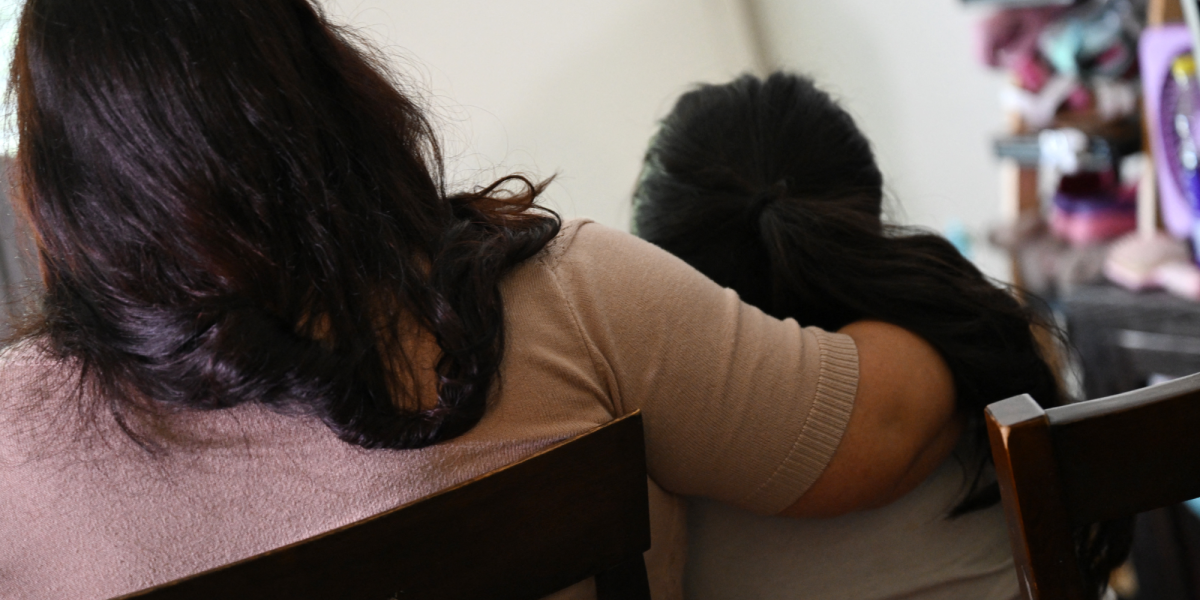
When her husband was arrested by the immigration police, In early July, near Los Angeles, Martha had to separate abruptly from the father of her two daughters. But also He lost the entrance that allowed him to keep his home.
“He is the pillar of the family, (…) he was the only one who worked,” says this undocumented Mexican woman who prefers to speak under pseudonym. “It is no longer there to help us, to support me and my daughters.”
Photo: AFP
At 39, Martha suddenly joined the group of people in a precarious situation fighting for Avoid ending in the streets of Los Angeles Countya region with prohibitively high housing prices, which has the largest number of homeless people in the United States after New York.
His apartment 65 square meters in good park, a suburb of the Californian megalopolis, Cuesta $ 2,050 (38,660 pesos) per month.
To cover their most urgent needs, he found a night work in a factory for which he receives the minimum wage. It gives them to stay afloat, but not to cover all its obligations.
“I have to pay the car insurance, the phone, rent and expenses of them,” he lists, pointing to his six and seven -year -old daughters, who need useful for the new school year. “There are many expenses.”
“Storm”
How long can he endure like this, with just three hours of sleep after returning from the factory, before having to take care of his daughters? “I can’t tell you,” he murmurs with his lost look.
Los Angeles, where a third of the population is immigrant, has been destabilized by the intensification, since June, of the raids of the Customs Immigration and Control Service (ICE) To capture undocumented.
Squadrones of masked agents raided hardware stores, cars and bus stops.
As a result, more than 2,200 people were arrested in June, the 60% of which had no criminal recordaccording to internal ICE documents analyzed by the AFP.
The Anti -immigration offensive President Donald Trump It is hardly affecting Latin workers, who were already among the first victims of the housing crisis in the region, explains Andrea González, deputy director of the Clean Car Workers Center.
“A major storm is coming. It is not just about the detained people, but also those who remain free,” summarizes this 36 -year -old American. “The concern is for people to end in the street.”
His Organization helps more than 300 homes with economic difficulties whose income has collapsed, either because a member has been arrested or because they are too afraid to return to work.
The group has allocated more than $ 30,000 to help about 20 families to pay for rent, But covering everyone’s needs is simply “unsustainable.”
Financial aid
Aware of the problem, the local leaders of the Democrats are trying to establish some financial aid for the affected families.
Los Angeles County plans to create a specific background, and the city will also launch its own, financed with philanthropic funds, without resorting to taxpayers’ money.
So, Some families could benefit from cards With “a few hundred” of dollars, said Mayor Karen Bass in mid -July.
But for González these initiatives are far from enough. The aforementioned amounts often do not even reach “10% of the rent of a family,” says the activist.
The region should establish a “moratorium on eviction”, as was done during the pandemic, he argues.
Otherwise, the number of homeless people in Los Angelesthat today is 72,000, runs the risk of increasing again, after two years of slight decrease.
Photo: AFP
“What we are living right now is an emergency,” he warns.
A moratorium would reassure María Martínez. The undocumented husband of this 59 -year -old American woman was arrested in a car laundry in mid -June in Pomona, another suburb east of Los Angeles.
Since then, he has had to depend on the help of his children to pay for his rent of $ 1,800, which his disability of $ 1,000 fails to cover. “It’s stressful,” he says. “We barely survive.”
Photo: AFP