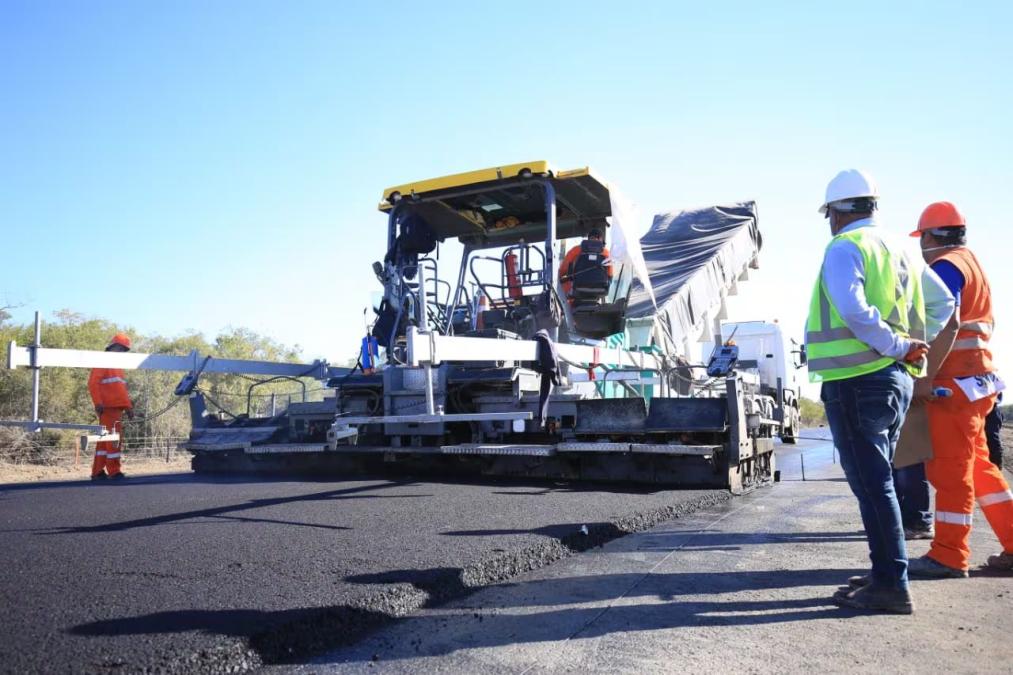
The project of Bioceanic road corridoran ambitious work that seeks to unite Brazil and Argentina with the ports of Chile, continues its construction In the heart of the Paraguayan Chaco.
According to an article from the Paraguayan newspaper Todaythe work advances with a strong Emphasis on sustainability and respect for the environment. However, this megaproject, conceived to connect the economies of the region, once again highlights the isolation of Bolivia.
The report of Today It highlights the advances in section 3 of the Py15 route, which crosses the Paraguayan Chaco from Carmelo Peralta to Pozo Hondo. The work, which is described as a “key piece of the strategic road that The Atlantic will link with the Pacific “, It includes several pioneer environmental actions.
One of the most outstanding aspects of the project is the construction of Fauna steps. These structures are designed to allow Wild animals cross the road safely, avoiding hitting and fragmentation of their habitats. In section 1, already finished, 13 of these steps were built. Section 2, in its initial stages, includes 15 crosses, while in section 3 the installation of 13 news is expected.
The environmental approach of the project is not limited only to fauna. Plans are also implemented Reforestation and Cultural Protection. The Ministry of Public Works and Communications (MOPC) of Paraguay is carrying out Workshops with indigenous communities and local authorities, with the objective that the work “respects the human and cultural environment of the Chaco.” In addition, training for workers are developed on the protection of environmental and archaeological heritage.
Bolivian position
The Bolivian government has reiterated its position that The country is part of the project, although it is not in the current layout that passes through Paraguay. The Minister of Public Works, Edgar Montaño, has claimed several times that “Bolivia is included in the bioceanic corridor” and that “It will never be excluded” due to its strategic location in the heart of South America.
In this sense, Bolivia has promoted a Bioceanic Integration Railway Corridor (CFBI) As an alternative and complement to the road layout, seeking interconnection through the railroad.
However, reality shows that the main route layout that unites Brazil, Paraguay, Argentina and Chile He is advancing without including Bolivia. Bolivian media and analysts have indicated that the lack of participation of the country is due to a combination of factors, such as the absence of effective public policiesthe Insufficient road infrastructure And, above all, the constant interruption of routes due to social conflictswhat has generated an image of Bolivia as a “tranca” country or an obstacle to free traffic.