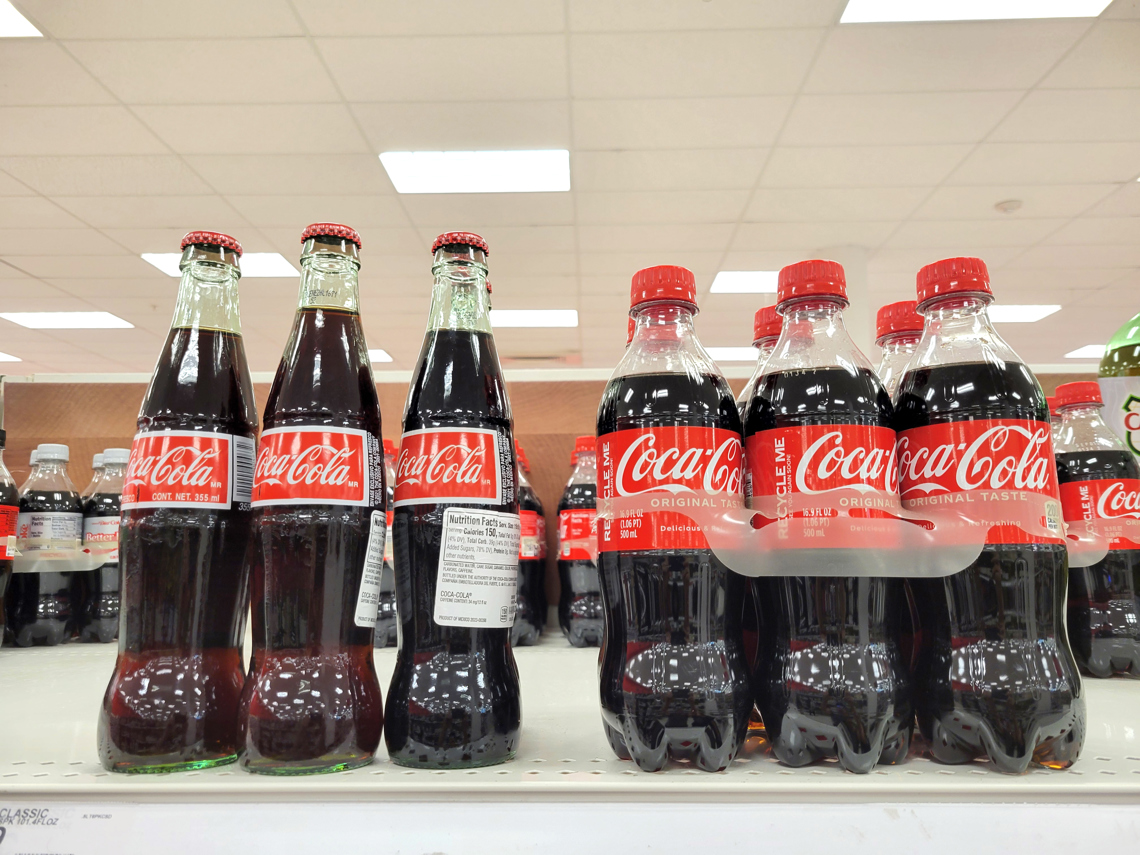
In a joint effort, President Donald Trump and the Secretary of Health, Robert F. Kennedy Jr., have been promoting an initiative that seeks to eliminate ingredients from the US diet, in particular the replacement of high fructose corn syrup with cane sugar in the Coca-Cola refreshment for the domestic market.
This announcement, originally made by Trump on July 16, 2025, represents a strategic step both in the defense of traditional crops, such as sugarcane in the state of Florida, the main producer of the United States and official residence of the president and his family, where he has a private mansion and club called Mar-a-Lago.
Coca-Cola access
The president reported through his Truth Social platform that after having conversations with the company, Coca-Cola agreed to incorporate cane sugar into their drinks sold in the United States.
“I want to thank all those who have authority in Coca-Cola,” he said, adding that this measure will be “simply better” for consumers.
The company, although it did not officially confirm the change of formula, announced the launch for the boreal autumn of a new version sweetened with American cane sugar, without altering the original recipe of its main product.
For his part Robert F. Kennedy Jr., who leads the Make America Healthy Again (Maha) government initiative, has publicly expressed concern about the effects of excessive consumption of high fructose corn syrup on public health, qualifying it as a factor that contributes to obesity and diabetes, chronic diseases that affect millions of American.
Maha has promoted reforms in food policies that seek to eliminate artificial and harmful ingredients, including processed dyes and sweeteners, with the aim of promoting diets based on comprehensive and natural foods.
https://www.youtube.com/watch?v=Rrwey150zui
Industrial and political interests in the background
The initiative also has a strong industrial and political component. Florida, a key state in the production of sugarcane, benefits from impulse to this natural product against the dominant corn syrup, which comes from a different agricultural region from the country, mainly the west medium.
Some corn sectors have already expressed concern because the change could affect jobs and the syrup production chain, arguing that there are no proven nutritional benefits by replacing one sweetener with another.
Experts in nutrition and food economy agree that from the chemical and caloric point of view, both cane sugar (sucrose) and corn syrup (glucose and fructose mixture) essentially provide the same.
The main difference lies in the proportion and way in which these sugars are presented, while the excessive consumption of any added sugar is the real health problem.
Kathleen Melanson, nutritionist at Rhode Island University, emphasizes that the damage is linked more to the volume and frequency of consumption than to the specific sugar source.
In the background of this change, Coca-Cola, a company founded in 1892, has faced internal competition in its US market due to the preference of some consumers by the Mexican version of their drink, made with cane sugar and is considered “more authentic” or “better” in flavor by a segment of the population.
The company has had to balance its production among sweeteners accessible at low cost, such as corn syrup, and products that respond to the demand for more natural and healthy versions.
Debates in the agroindustrial sector
Meanwhile, Trump’s decision to press Coca-Cola to return to cane sugar, instead of using corn syrup that is cheaper and produced mainly in the west medium, generates an industrial debate.
The Association of Corn Refiners has expressed that change would negatively affect thousands of jobs in the American food industry, reduce agricultural income and increase foreign sugar imports, all without any real nutritional benefit for consumers.
On the other hand, replacing corn syrup with sugar would imply, in that case, an increase in imports from sugar countries, which would make the productive chain increasing and would collide with policies that have been protected for decades to local producers with tariffs and quotas.
The interest of Trump and Kennedy also reflects an attempt to align public health elements with local and national economic interests, generating a debate about the future of ingredients in industrialized food and drinks.
The Maha initiative, which includes members of the Federal Cabinet and experts, evaluates the impacts of ultraprocessed food consumption on public health and proposes a transition to less harmful alternatives.
In the United States, per capita consumption of Coca-Cola is approximately 100 liters per person per year according to recent studies and data from 2024 and 2025. That figure positions the United States as one of the largest consumers of Coca-Cola in the world, although Mexico surpasses the US with a higher average, close to 160 liters per capita a year.
It consumed in almost all countries of the world, the US company reported this first semester an approximate net gain of 13.2 billion dollars in 2025, which represents an increase of 24.17% compared to the previous year.