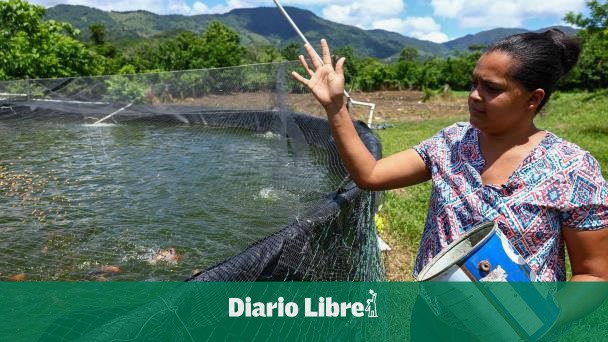
Despite the Gradual growth of the Fish and shellfish production In the Dominican Republic, the Aquaculture sector Face many challenges to fully develop and expand their abilities.
The Aquacultters They produced 6,749 tons – about 14.8 million pounds – between 2020 and 2024, with just over 3,000 tons harvested only last year, according to data from the Dominican Fisheries Council and Aquaculture (Codopesca). However, only in 2024, the country allocated 221.2 million dollars for the purchase of 58.9 million kilograms in fish, crustaceans and molluscs –58,920.82 tons–, which shows a wide gap between the local production and the Current demand.
“We are talking about a unsatisfied demand, and that the national production It has that niche, that is the commitment, to be able to fill this, for us to start consuming in the local market, and starting down the Imports that come from other countries, ”said the director of Fisheries Resources of the Dominican Fisheries Council and Aquaculture (Codopesca), Ángel Luis Franco.
Allocate more public money to support the Innovation of aquaculture projects existing, training specialized personnel and bringing better quality genetic lines would help the sector improve its competitiveness, observed the national officer of value chains in fishing and Aquaculture of the United Nations Organization for Food and Agriculture (FAO), Jeannette Mateo.
“One is needed Greater budget injectionupdate in terms of modernization and support in best genetic seedsthat is to say, fry”, Said the expert during her participation in the V International Congress of the Tilapia Industry (Expo Aqua 2025), which will be held until Friday at the Dominican Agro -business Board (JAD).
Indicated that the Disease prevention is crucial, due to what Vulnerable which are the Poultry farms When they appear.
“For example, if normally in a crop you have a 97 %survival, With a disease you can go down to 20 %30 %, handling it. That is, a disease can end the crop, ”he said.
Go up Tilapia production and falls from shrimp
According to the Director of Fisheries Resources of the Dominican Fisheries Council and Aquaculture (Codopesca), Ángel Luis Franco, 90 % of the national production It is focused on a single crop: the Tilapia. This due to its high demand and its affordable Production costin addition to being consumed by 40 % by the local market.
However, reality is different for Creole shrimpwhose production has been diminishing from the Covid-19 pandemic, a period in which demand decreased due to the prolonged closure of restaurants and hotels.
“The biggest producers of shrimp (…), due to economic decisions, the production model began to change and dedicated themselves to grow tilapias”, He explained.
Currently, alone Two farms nationally produce shrimpwith a production that ranges between 75,000 and 85,000 pounds per cycle, Franco said.
He indicated that from Codopesca The options available to support the relaunching of the production of this are being evaluated shrimp Creole, which is very well appreciated by the local consumer.
- However, he explained that the Production cost It is one of the main limitations to achieve it: an aquaculturer must invest up to 135 pesos to produce a pound of shrimpwhile a pound of Tilapia It ranges between 68 and 78 pesos per pound, depending on whether it is a high or low density production.
Support initiatives
The FAO He has been able to work closely with the Aquacultters and designers of public policiesoffering strategies for compliance with laws that regulate fishing and aquaculture in the country and offering technical assistance in the field.
Mateo highlighted the role of “Shadow houses”, An agricultural initiative that combines Protected Agriculture with aquaculture In circular ponds, with the aim of linking producers directly with hotels and restaurants, while recycling the water of the ponds for the production of other crops, such as vegetables and vegetables.
Indicated that there are already around 10 Shadow houses in places like Higüey and San Juan de la Maguana.
Regarding the codopesca, Franco highlighted the “Pescaderías de my neighborhood” program, with the aim of helping the formalization of producers, while offering Creole fish at accessible prices for the population.
This program has allowed the opening of 30 fishmongers In the great Santo Domingo, focused on helping, above all, women who support their families with the income they get from fishing and cultivation.