The political scientist Walter Molina Galdi said that in Washington they are discussed between a maximum pressure strategy and another where economic interests prevail. He pointed out that an eventual return of Operations of Chevron will not necessarily translate into a benefit for the people
For political scientist Walter Molina Galdi, the policy of the president of the United States Donald Trump to Venezuela is ambiguous and generates uncertainty.
Molina said that on the one hand the US government described the Los Soles poster as a terrorist organization composed of senior officials, including Nicolás Maduro and on the other allows Chevron to continue operating in the country, according to a publication of the Reuters agency.
“Within the US administration there are two species of visions about Venezuela, one where there are those who do the oil lobby and another of the maximum pressure led by the Secretary of State, Marco Rubio,” Molina said.
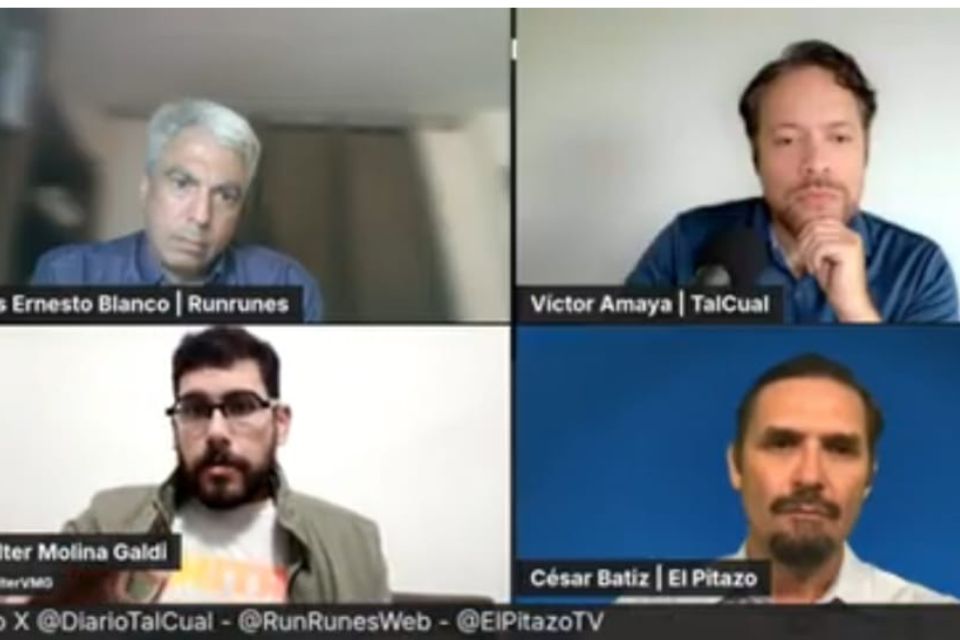
Where is the Venezuela-United States relationship directed? It was the topic of the conversation of the Rebelde Investiga (ARI) alliance formed by Runrunes, The whistle and SuchWhich This Tuesday, July 29.
https://www.youtube.com/watch?v=rwngyou7hyi
In the moderate program by Víctor Amaya, director of SuchWhich; Luis Blanco, director of Runrunes, and César Batiz, director of The whistle; The political scientist said that while there are still no certainties about Chevron’s return to Venezuela, Trump’s administration recalled the reward of 25 million dollars for the capture of Maduro and others of his acolytes.
“That is not something less and has many implications. With the reminder of the rewards they are sending signals to other officials of Chavismo. That also means that you have to think twice when doing business with Maduro, who incur this can be persecuted and even subjected to freezing assets.”
Amaya pointed out that the reward of the State Department by Maduro and other officials of Chavismo dates back to 2020 and his new staging can obey a damage control scheme by Trump.
“It does not seem casual that a few days after the release of Americans who were imprisoned in Venezuela increase the tone with the poster of the Suns. The issue is that on the one hand you are telling Americans who do not come to Venezuela because it is a danger and on the other there are possibilities that oil explodes again.”
Molina sentenced that Trump’s international policy is difficult to predict.
“There is no certainty of what happens with Chevron, it is quite opaque that surrounds it. A general license is not the same as a special, it is a victory in quotes for the Maduro regime, which is real is that there are 25% tariffs for whom it bought Venezuelan crude.”
The political scientist said that with the alleged resumption of Chevron’s operations it is not clear if the Chavista government will receive royalties.
“Those who believe that with Maduro can do business are wrong, that of Venezuela is a kakistocratic regime, everything they touch destroy it.”
Molina said that the fact that maturism resumes oil businesses with the United States does not mean improvements in the quality of life of the Venezuelan people.
“Chavismo does not know how to generate wealth, they are the main causes of the economic crisis and migration, if hundreds of thousands go to power will return to the country. Far from the romantic vision of recovering democracy, the United States is convenient for a turn in Venezuela because that would have a positive impact on the region.”
The political scientist said that while the Chavistas negotiate to withdraw the sanctions, the democratic opposition does so to generate a transition.
“Negotiations exist, negotiating does not mean that you are giving up, they exist because otherwise the recent exchange of prisoners would not have been given.”
Blanco said that in the conversation of July 22, the spokeswoman in Spanish of the State Department, Natalia Molano, denied that the Trump government has negotiated directly with Maduro.
The expected turn
Molina sentenced that the message of the opposition leader María Corina Machado regarding a year of the presidential elections of July 28 has to do with a new form of protest.
“Convening a clandestine organization is not about going to the jungle, we must reorganize society with active and silent manifestations, there must be internal and external pressure, make the cost of permanence of the regime higher than the exit, there are those who are willing to immolate themselves, but others that do not.”
The political scientist indicated that so far the only person willing to immolate himself by Venezuela is Machado herself.
“The false opposition has no impact on people. The people have shown that they are not willing to continue participating in electoral farce such as 25m and 27J. There is an element that is not taken into account and is emotional, the military has relatives who also want freedom, but that will not happen until there is an important pressure because there is a lot of fear.”
Molina said that it is peremptory to make world leaders understand Trump that a turn towards democracy in Venezuela is a benefit for the region.
“While Venezuela is still governed by a tyranny, the United States is not going to benefit, there will be more migration.”
*Journalism in Venezuela is exercised in a hostile environment for the press with dozens of legal instruments arranged for the punishment of the word, especially the laws “against hatred”, “against fascism” and “against blockade.” This content is being published taking into account the threats and limits that, consequently, have been imposed on the dissemination of information from within the country.
Post views: 342