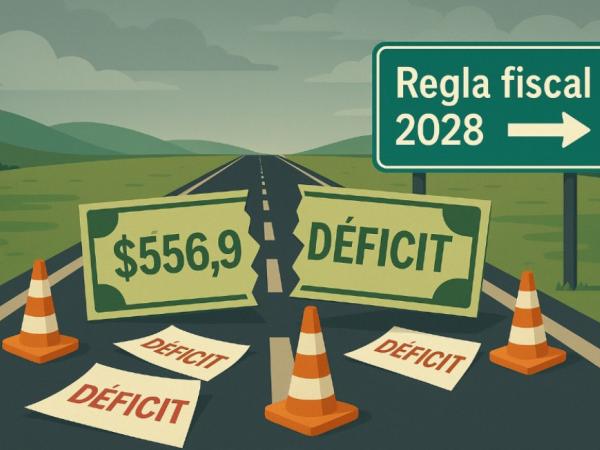
The bill of the General Budget of the Nation (PGN) for 2026, based by the Ministry of Finance before Congress, not only brings historical figures regarding its total size, but also alerts on on its sustainability; as various actors in the local economy have expressed, After the final proposal was known for which President Gustavo Petro will go.
With an amount that amounts to $ 556.9 billion, equivalent to 28.9% of the Gross Domestic Product (GDP), this expense plan is not only the most ambitious in the recent history of the country, but also one of the most questioned by analysts, technicians and former ministers due to its high unproductive spending component, its dependence of an uncertain tax reform, and the fiscal risks that could entail in the medium term.
See here: COlombia, among the countries affected by US tariffs
From the entry, the budget design includes $ 26.3 billion in contingent resources, that is, funds that can only be executed if Congress approves a new financing law and although this tax reform has not yet been filed, the Government already includes it as a pillar of the PGN 2026, which is equivalent to 1 in 20 pesos of the budget is without guaranteed support.
A budget that grows, but not in investment
Of the total budgeted, $ 365.7 billion will be used for operating expenseswhich represents an increase of 11.1% compared to what is approved in 2025. This growth is mainly explained by increases in personnel and operational expenses of the State; While, in contrast, the investment item will only grow 5.7%, going from $ 83.9 billion this year to $ 88.7 billion in 2026.
National budget accounts concern experts.
Chatgpt image
For José Manuel Restrepo, former Minister of Finance and current rector of the EIA University, this distribution is worrisome, since “the spending in operation, in constant prices compared to 2022, has grown almost 40%. Investment as a percentage of GDP, on the other hand, it has been falling. That means that the budget is to spend in bureaucracy, to pay debt interest, but not to make productive investment or social investment”.
To the above, this analyst adds the silent cut in key sectors such as science, technology, sport and culture They fall in real terms, that is, their assignments do not even compensate for inflation.
More information: Supersalud asks for clarification and partial nullity of court ruling in EPS Sanitas
On the other hand, the most forceful criticism comes from the Autonomous Committee of the Fiscal Rule (CARF), which issued an unfavorable prior concept to the new financial plan presented by the Government, which is consistent with the PGN 2026; Noting that, just a month after publishing the medium -term fiscal framework (MFMP), the Executive decided to raise the primary expenditure at $ 18.2 billion, carrying the estimated primary deficit of 1.4% to 2% of GDP by 2026.
This decision, according to the committee, completely blurs the consolidation path Prosecutor and remember that although the total fiscal deficit is maintained at 6.2% of GDP, the deterioration of the primary balance indicates that the country is using uncertain resources to finance recurrent expenses, such as health ($ 7.2 additional billion), energy subsidies ($ 5.7 billion) and investment ($ 5.9 billion).

National budget accounts concern experts.
Chatgpt image
The CARF also warns that the total missing to meet the fiscal goal is extended to $ 38 billion, which implies that the adjustment effort in 2027 will be much greater than that initially expected.
“The primary deficit must be reduced 1.7 PIB points in a single year, which is a very difficult goal to meet without strong cuts or extraordinary income. This mine institutional trust and hinders the return to the fiscal rule in 2028, ”they said.
It may interest you: Trump imposes additional 50% tariffs on imported products from Brazil
Tax Reform: An uncertain bet
It should be remembered that the Minister of Finance, Germán Ávila Plazas, defended the budget against Congress highlighting that $ 301.7 billion will come from tax revenues, $ 1.4 billion non -tax revenues and $ 29.6 billion of income from public establishments.
However, he acknowledged that the full execution of PGN depends on Congress Approves the aforementioned Financing Law, in line with the provisions of article 347 of the Constitution.

National budget accounts concern experts.
Chatgpt image
Given this, the president of Amcham Colombia, María Claudia Lacouture, was skeptical of this bet and said that “we are concerned that the project includes, from its formulation, a item of 26 billion pesos conditioned to a tax reform on which details and whose approval in Congress is uncertain” are not known. “
🧵1/ The Autonomous Committee of the Fiscal Rule (CARF) gave an unfavorable prior concept to the change of the financial plan of 2026, consisting of the General Budget of the Nation (PGN) 2026 presented by the Government. Because? Here we explain it to you with figures.
– Autonomous Committee of the Fiscal Rule (@Carfcolombia) July 30, 2025
From its perspective, the budget must be adjusted responsible to guarantee a balance between realistic income and productive spending, and avoid further tax difficulties In the short and medium term.
Other news: Declaration of Income 2025: Exogenous information of the DIAN is now available
Meanwhile, the Itaú Bank estimates that, without the approval of the tax reform, the investment could fall to $ 62.4 billion, which would be equivalent to an annual 14% contraction, reducing its participation in the GDP to 3.2% and account that this would mean that the adjustment would fall directly on social and productive investment, further weakening the country’s growth engines.
In fact, Itaú estimates that the debt service without $ 454.5 billion (23.6% of GDP), With the operation expenditure growing 11% and the investment only 4.6% and throws a clear conclusion, according to which, if the reform is not approved, the cut will not be in bureaucracy or in current expenditure, but in the sectors that have the most impact on the real economy.

National budget accounts concern experts.
Chatgpt image
The Fiscal Observatory of the Javeriana University joined the debate and warned that this level of definance contrasts with the adjustments that are needed after the activation of the exhaust clause, since “without structural measures in income and expenditure, the fiscal deficit and the debt could deteriorate to similar, or even superior levels, to those observed during the pandemic”.
In this way, the discussion of the PGN in Congress will not be technical, but political, and will focus on whether an ambitious tax reform must be approved in an environment of low trust and high uncertainty or if it is due Adjust the expense in a budget already committed to rigidities and structural inflexibility.
Also read: They withdraw from Colombia an alleged ‘lung cleaner’: this was the invima alert
For experts, both outputs have costs, since although they make it clear that the greatest threat is to maintain the current course, with expansion of spending without clear sources, growing deficit, decreasing investment and a weakened fiscal rule. Meanwhile, Congress must review the budget with magnifying glass and make difficult decisions, not only by 2026, but for the future of fiscal discipline in the country.
Daniel Hernández Naranjo
Portfolio journalist