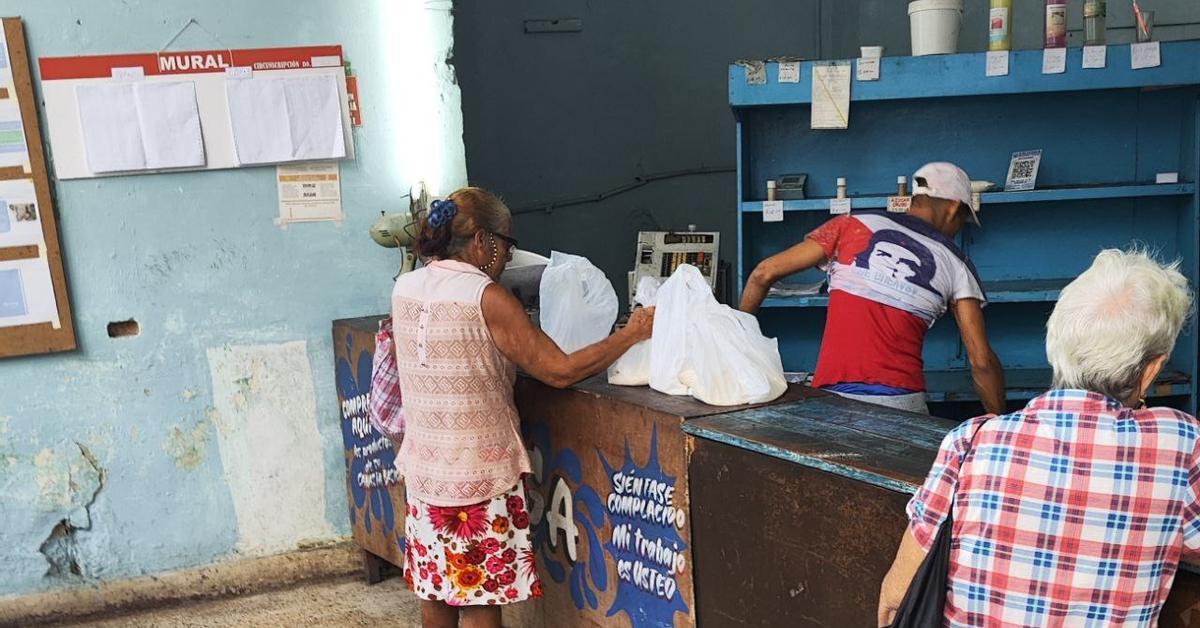
Havana/“The list does not fit the ticket” – a sharp, resigned popular phrase – summarizes better than any speech the food tragedy in Cuba. And although the power bureaucrats intend to ignore it, any family father knows that the basic food basket (CBA) and the supply notebook are today two concepts that barely touch each other. A recent study of Food Monitor Program It makes it clear: for a couple to eat dignity in Havana, more than six average salaries are needed.
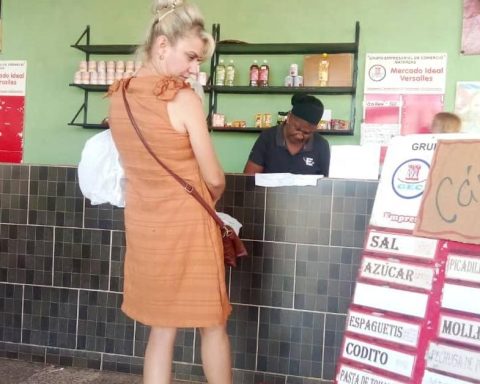
While the national average salary nominally rose from 4,648 pesos in 2023 to 6,506 in 2025 – according to official figures – food prices shot much faster. Eggs, milk, chicken meat, or any basic product in the private market can devour, in a single blow, an entire retirement. And in the meantime, the notebook – that exhaust symbol of another time – distributes less and less rice, bread and sugar, and with an unpredictable frequency. It is not surprising that 96.6% of Cubans consider that subsidized products do not meet their needs or taste, and that one third qualifies them as “lousy.”
National agricultural production has fallen 67% in recent years
Trying to calculate a CBA in Cuba is like playing dominoes with the chips changing value at all times. Official consumption patterns are based on what is achieved, not what is needed. Bureaucracy statistics ignore the prices of informal markets, MSMEs and street vendors, which are today the main source of supply. To this is added a more forceful fact: national agricultural production has fallen 67% in recent years. As a result, fruits and vegetables have disappeared from the majority menu.
The Food Monitor programmed a field study in Havana and Cienfuegos between the late 2024 and the first half of 2025, monitoring prices, quality and availability of 29 basic products distributed in eight groups. The analysis starts from a minimum monthly diet of 54,000 calories for women and 66,000 for men. And it also adjusts to concrete limitations, such as irregular access to water, electricity and fuel. These factors, more and more, condition what, how much and how it is cooked.
In Havana, a minimum CBA for two people is around 41,735 pesos, the equivalent of 6.41 average salaries
The results show that, in Havana, a minimum CBA for two people is around 41,735 pesos – equivalent to 6.41 average salaries. In Cienfuegos, the figure descends slightly to 39,595 pesos, or 6.09 salaries. In other words: for two to eat, they need the wallet of four other people. And that, without counting clothes, transport, hygiene, gas or medications. Only food. Just the minimum.
In parallel, accumulated inflation since 2021 already reaches almost 191%, and the real salary has collapsed 35%. The subsidy model, sustained for decades as a social shield, has become unsustainable. The government itself has recognized that 80% of the content of the notebook is imported, and maintaining its coverage is unfeasible. The solution? Transfer the load to the informal market, to the remittances, to the exiled families. What remains is a fragmented, unequal, chaotic system: an “administrative capitalism” where everything is paid, and where nothing reaches.
The accumulated inflation since 2021 already reaches almost 191%
In this context, the basic basket ceases to be a technical instrument to become the mirror of a failure. It does not reflect only how much it costs to live, but who can afford it. Eating decently in Cuba is, more and more, a privilege.
The Food Monitor Program proposes to think about CBA not as a list of minimum products, but as an ethical threshold. A map of what should be possible. Because in Cuba, where feeding depends more on ingenuity than income, the basic basket is not an economic calculation, but the radiography of a fracture. And what it reveals is as clear as bitter: in today’s Cuba, dignity is rationing – like everything else – in impossible slices.