The second semester of the year is already underway, and with it a trend marked in the complexity that companies and the social environment live, in addition to a panorama that has redefined the way of doing business.
In this context there are Five trends that should not be lost sight of:
- The AI revolutionwhich went from being a tool to a process enhancer in companies.
- The consolidation of ESG As a strategic element, reaching 33.9 billion dollars of projected investment by 2026, according to the PWC study.
- The definitive standardization of hybrid work with six out of 10 collaborators preferring this modality and four out of 10 jobs offering remote flexibility according to Gallup in their report of Hybrid Work.
- The acceleration of hyperautomatizationwith 95% of companies facing the challenge of transforming unstructured data into actionable information according to Forbes.
- Geopolitical risk growth and cybernetics that demand more resilient supply chains and robust security strategies.
These trends require a New type of leadership That combines strategic vision, technological agility, sustainable awareness and ability to connect distributed equipment globally, positioning leaders as architects of a more intelligent, sustainable and human business future.
The above implies that also for work teams, things are changing, so they begin to outline clearly The competencies that are required to face the future and prepare companies to achieve results in an increasingly complex environment.
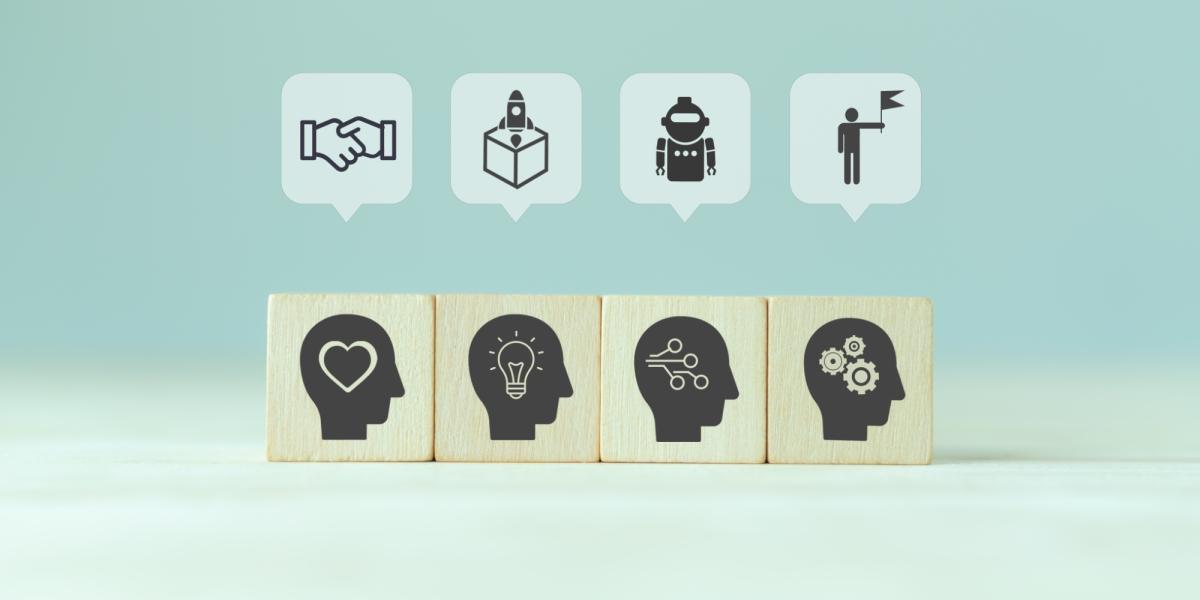
Given this context, there are four basic skills to face the future:
»1. Know how to ask the right questions (analytical thinking)
The emergence of the AI opens us incredible possibilities to bring analysis and strategy to another level. For this reason, organizations are integrating Hybrid work forcesthat combine human intelligence with the artificial.
That is, today we have the challenge and the opportunity to take advantage of the best of the two worlds, because the work can be enhanced using the knowledge base that the generative artificial intelligence It makes available to people, however, the challenge is to be able to correctly ask the questions.
For this reason, the experience of people, their ability to understand the strategic objective behind the mass of data and the vision of impact (for us to do things) play a key role as skills that must be accelerated In individuals and teams.
»2. Be able to adapt agile and fluidly (change and flexibility)
Changes throughout the planet are impacting market behaviors. Consumers with greater access to products and services globally impose New demands to organizationswhich must anticipate and adapt their value offer.
It is no longer just a change management task, now companies need to develop “taste” to change, that is, the change capacity You need to be part of the mentality with which people are integrated into the teams.
In this context, culture becomes a powerful lever that, driven in the right way, makes leaders develop environments in which innovation and adoption of new ways of working are natural and pleasant for the teams.
Move of place, market, solution or sector quickly And comfortable is already a fundamental capacity of organizations.
»3. Achieve maximum potential (curiosity and learning)
Constantly wonder about New ways to achieve resultsthinking about new solutions for the client, transforming the culture and way of working, is now a matter of business survival.
The constant question It is focused on what we can do to achieve the maximum of each solution, how to bring to the client a different experience, where is the competitive advantage and, above all, how we connect with the purpose of the people of the organization.
This approach implies a apprentice mentality Constant, where paradigms are just another opportunity to find new paths. This implies that teams must achieve so effective communication and collaboration that allows them to quickly adopt new ways of doing things.
»4. Generate a deep personal connection (empathic listening)
In order for the change to really be sustainable and the competencies mentioned in the previous points can be developed, a genuine connection between peoplewhere trust is the axis of the relationship, so that the error derived from experiencing new ways of working is a lever for equipment growth.
This competition is the most important, not only in the leaders, but in team members. Today more than ever they are required Psychological security environments where people can find true reasons to belong and thus challenge themselves to look for better results with different schemes.
The next years will be framed in the capacity of organizations of harmonize human and artificial workovercoming the fears of some and the limitations of others, so surely people will be the center of transformation and leadership the competitive advantage of companies that triumph.