In 1935, the International Labor Organization (ILO) adopted Agreement 47, which advocated a weekly 40 -hour workday without reduction at the level of living of workers, but five years earlier, economist John Maynard Keynes had predicted that, in the future, His grandchildren would work just 15 hours a week thanks to the accumulated wealth of economic progress.
That said, a recent analysis of the Externado University warns that today, almost a century later, Colombian reality is far from both visions; Since, for example, in Colombia, the weekly workday was set at 48 hours since 1934 and remained without modifications until the approval of Law 2101 of 2021.
See here: RThey add a project that seeks to regulate artificial intelligence in Colombia
“This standard, which represents one of the greatest advances in terms of labor well -being in decades, established a progressive reduction of the day of 48 to 42 hours per week without affecting the salary or the benefits acquired. The implementation was designed by phases in which by 2023 it was reduced to 47 hours, In 2024 to 46, in 2025 to 44, and it is expected to reach 42 hours in 2026, ”they explained.
Although everything seems positive at first glance, this report, by Stefano Farné and Andrés Escobar of the Observatory of the Labor Market and Social Security of the Externado University of Colombia, argues that the practice continues to be distant from the regulatory framework and that for now there are sectors, such as the informal, in which these benefits are a distant reality.
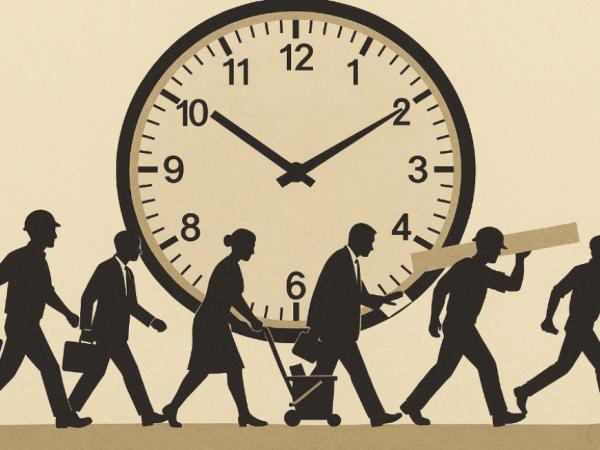
The day must reach 42 hours a week in 2026.
Chatgpt image
“In the period July 2024 – June 2025, the salaries of the formal private sector declared Work on average 47.7 hours per week, that is, almost two hours above what is allowed by law for that year (46). In other words, the legal reduction of day has not yet been fully translated into a real reduction in the time worked, ”they said.
The situation is aggravated when what happens in the informal sector is observed, since informal employers and self -employed not only escape regulation, but also face even more extensive conditions and according to the same report, these workers work, on average, more than 54 hours a week.
More information: With the income statement nearby, why is exogenous information not enabled?
“Also recorded days close to 50 hours domestic employees and workers without formal remuneration. In contrast, formal wage earners, both from the private and public sector, of the public, They are the least hours work with a little more than 47 weekly, ”says the report.
The reduction of the legal day brings indisputable benefits in terms of health, well -being and conciliation between working and personal life. But it also implies an increase in unit labor cost. In Colombia, this increase has been 2.1% in 2023, 2.2% in 2024 and 4.5% in 2025.

The day must reach 42 hours a week in 2026.
Chatgpt image
For both analysts, this pressure on costs can discourage Hiring, although the possibility of reducing the day generates more employment is also raised, if it is necessary to hire more people to cover the reduced hours (the so -called “worksharing”).
“The truth is that the effect of the reduction of day on employment, productivity and informality is still uncertain. Empirical research offers mixed results, and the magnitude of the effects, when they exist, is usually modest,” they said.
Other news: ANDXpansion, the Warehouse Bet: In 2025 he hopes to open 2 new stores
That is why the authors of the report insist on the need to accompany policy with complementary measures such as time flexibility, hybrid work, compressed work week, and even subsidies to companies that maintain or expand their work plant.
“In the last three years, Colombia has registered a general decrease in the number of hours actually worked, although with unequal intensities according to the type of worker. But the advances remain limited if compared to the goal of the 40 hours weekly recommended by the ILO. And not to mention the dream of Keynes: His grandchildren, if they live in Colombia, work more than three times than he had imagined, ”they said.

The day must reach 42 hours a week in 2026.
Chatgpt image
Thus, they closed saying that the gap between law and reality persists, and its closure will depend not only on stricter norms, but also on a broader redesign of the Colombian labor model that takes into account the dynamics of employment, especially in the informal sector, where these laws are a distant reality.
Daniel Hernández Naranjo
Portfolio journalist