During “the weekly with the press”, the president highlighted improvements in health, institutionality and sustainability, and positioned the country as leader in Latin America in compliance with the SDGs
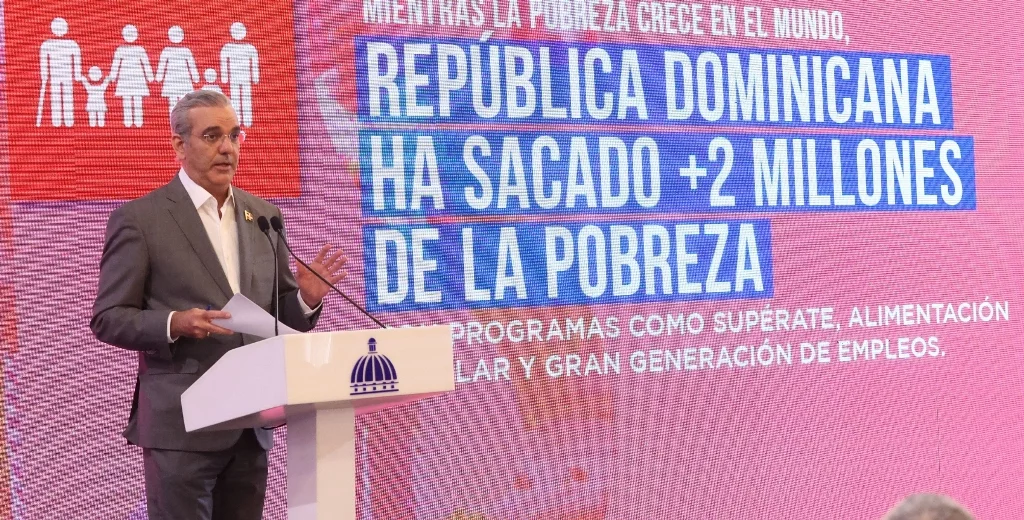
Santo Domingo.- President Luis Abinader said Monday that the Dominican Republic has made a significant leap in sustainable development indicators, consolidating as one of the Latin American countries with the greatest advances towards the 2030 Agenda, and stressed that more than 2 million Dominicans left monetary poverty between 2020 and 2024.
With the motto “Sustainable Development advances in the Dominican Republic”, the president presented data from the SDG Index (index of the Sustainable Development Goals), which place the country in the 52nd position worldwide, improving 40 positions since 2016. In Latin America and the Caribbean, the nation occupies the fourth place, only surpassed by Chile, Uruguay and Argentina.
“Statistics speak. Today we are the third country that has advanced the most in the region in sustainable development,” Abinader said during his participation in the weekly with the press.
One of the most prominent achievements, according to the president, is the reduction of poverty. While worldwide many countries recorded setbacks after the pandemic, more than 2 million Dominicans left monetary poverty between 2020 and 2024. General poverty fell from 39% in 2012 to 18.98% in 2024, and extreme poverty from 9.9% to about 3%.
Abinader attributed this improvement to social programs such as Supérate, school feeding, and the increase in real minimum wage.
In terms of health, the Head of State said that the coverage of medical insurance is practically universal, that life expectancy increased to 75 years, and that infant and neonatal mortality rates reached their lower levels in the registered history of the country.
He also stressed that the percentage of people with malnutrition fell to 3.6%, data confirmed by FAO, and that the participation of women in the labor market rose from 45.3%to 53.6%.
Despite the international economic context, the country maintains a projected growth of 3.5% by 2025, twice the regional average, according to the president. Foreign direct investment exceeded 4.5 billion dollars, and the minimum wage in large companies went from RD $ 10,000 in 2012 to RD $ 26,000 in 2025.
A historical improvement was also reported in the transparency index, with a rise of 33 positions, as well as in judicial independence, political stability and government efficiency, according to international measurements such as those of the World Bank and international transparency.
The installed capacity of renewable energy increased by 130%, especially in solar energy, advancing towards a cleaner and more sustainable energy matrix.
In terms of inequality, Gini’s index fell from 0.49 to 0.38, and rural poverty fell from 38.5% to 14.5%, taking more than 200,000 people from the field of poverty during their management.
“Not everything is resolved, but we are moving forward”
Abinader closed his speech recognizing that there are still important challenges in areas such as infrastructure, health, education and citizen security. “Not everything is fine, but we are advancing with public policies that have demonstrated results,” he said.
Finally, he recalled that these indicators not only improve the quality of life, but are also evaluated by investors, risk qualifiers, airlines and the tourism sector, which projects to close the year with the arrival of 12 million visitors.
“These data are not perceptions, they are made by international organizations. Our responsibility is to continue advancing, correcting and strengthening each area of national development,” he concluded.