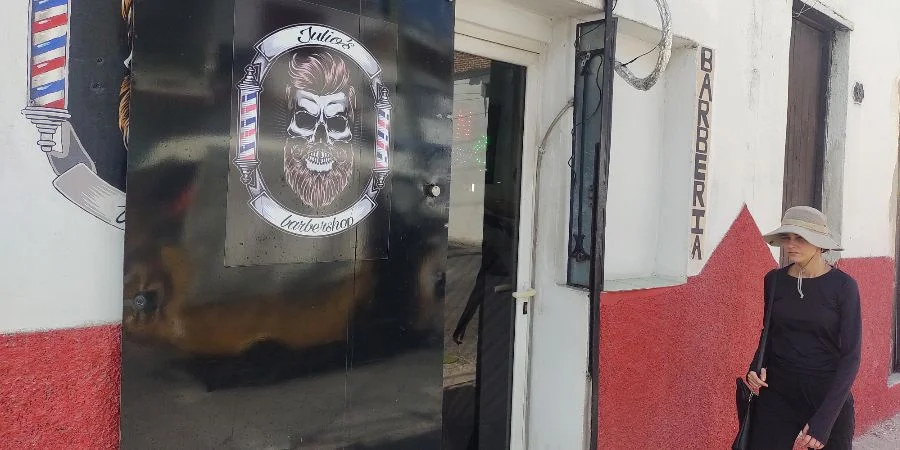
The high price of hair cuts in Cuba goes beyond a simple complaint.
Holguin, Cuba. – “The barbers now become millionaires. They are charging too expensive. The cheapest peeled costs 200 pesos and they do it in less than five minutes,” says the holguinero Rolando Delgado, who also states that a visit to the barber shop, before a routine procedure, is now a major expense.
The high price of hair cuts in Cuba goes beyond a simple complaint. Barbers, to be able to work, must face considerable expenses caused by unstoppable inflation and the need to buy their tools in dollars. The investment is transferred to the client, which particularly affects the most vulnerable, such as retirees, whose checkbook is no longer enough for such an essential expense.
The Holguin Víctor Herrera recognizes that barbers are workers who also face the crisis. “They are parents, it is true that they have to buy products … but never in life had been so expensive to peel in this country.”
The reaction of the Holguineros has been pragmatic. Gerardo Martínez confirms that the standard rate has risen. “A normal peeling in some sites in the city costs 500 pesos. If you ask for a degraded or a specific peeling is more expensive.”

Given this panorama, many opt for domestic solutions. “As are the prices of barbers, it is better to buy a peel and peel machine yourself,” says Ionelio García. His calculation is simple and forceful: “If you add the money you pay to a barber, you can buy three machines.”
The holguinera Lucrecia Torres confirms the trend: “People buy the little machines and they peel themselves. My grandson, the father bought a little machine to peel him himself.”
The official explanation points to a phenomenon that transcends barberies. The state media have framed this rise within an inflationary tendency that affects the entire nation, with An official closure of 24.88% in 2024.
This number, however, for some experts falls short. The Cuban economist and former minister José Luis Rodríguez offers a much more revealing figure: inflation in the non -state segment, where most of these businesses operate, it was 82% that same year. Your warning is clear: “The inflationary process has sustained the purchase capacity of wages, pensions and social assistance benefits.”
The task ordering, a failed governmental economic reform initiated in January 2021, did nothing more than aggravate price distortion and depreciation of the Cuban weight. “The ordering task has generated an increase in prices and rates, accompanied by a regrowth of inflation unknown to many Cubans for its intensity and inequality, along with a noticeable shortage of goods,” wrote in June 2021 on this site The prominent Cuban economist Elías Amor.
In December 2023, during the VII Plenary of the Central Committee of the Communist Party, the Cuban regime finally recognized the failure of the reform, but the damage was already irreversible.
The increase in barberia rates cannot be understood without looking at the currency market. With a dollar, which is quoted at 385 pesos, imported inputs, from pelar machinites to the talc, trigger the costs of the service. Barbers are forced to buy abroad or in the informal market inevitably moving that expense to the final customer.
This reality translates into direct costs for the proprietary ones. Reynaldo Torres, a barber of the distribution Alcides Pino, lists its expenses as follows: the lease of the premises, the payment of the patent, the maintenance of its tools and the electricity consumption. “People complain that barbers have very high prices, but do not value all the expenses we have to do to provide a quality service.”
It also adds a determining factor: “I am a family and the prices of food and other needs continue to rise, and that is why we also have to raise prices.”

The privatization of barberia service It consolidated between 2010 and 2011when state employees’ barbers were transformed into tenants who assumed their own expenses.
In the 70s and 80s, a hair cut cost a weight, but at the end of the 90s, with the economic crisis due to the fall of the socialist field of Eastern Europe, it began a rise in prices that today seems to have no brake.
The journalist Carlos Herrera Rodríguez denounced on his Facebook profile An extreme case: a barbershop in the beach municipality, in Havana, charges 1,600 pesos for a cut, a figure greater than the minimum pension of 1,528 pesos per month.
For retirees, the service has become prohibitive. The holguinero Emilio Sánchez expresses it without Rodeos: “My retirement cannot pay barbers prices, so my hair myself with a sharp scissors sharp in front of the mirror (…). A retiree cannot pay those prices.”
In the midst of this crisis, actions arise to support the most vulnerable. In the city of Holguín, a group of barbers has organized days of free cuts in San José Park. The initiative, without a fixed month or month, remains active and shows the other side of a profession trapped between the need to subsist and the reality of a community that can no longer pay its services.